
Official statement
Other statements from this video 1 ▾
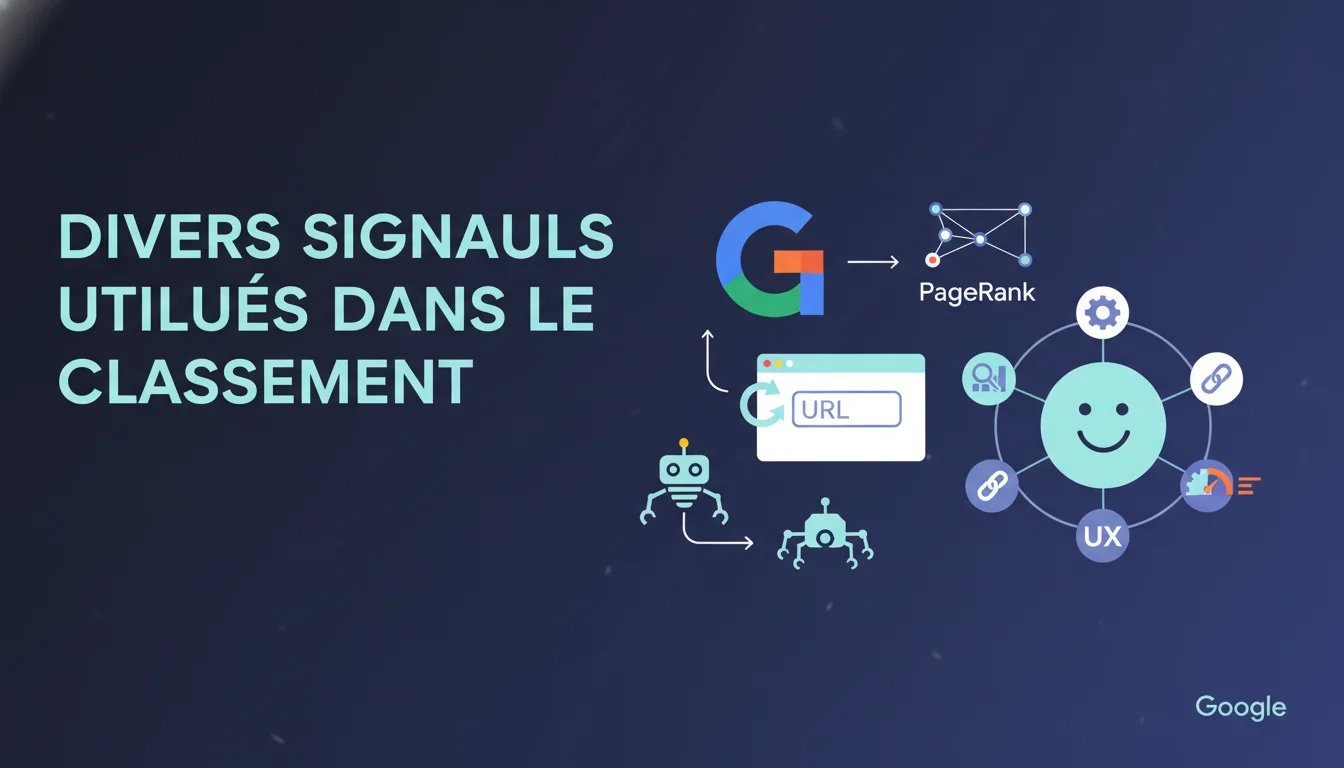
Google confirms that ranking does not rely on a single factor but on a weighted combination of signals: PageRank, anchor text, content, URL, titles, headers, and word proximity. The algorithm assigns a different weight to each signal depending on the context of the query. For an SEO practitioner, this means that optimizing a single aspect is never enough: overall performance stems from a balance among all these elements, and their importance varies based on the type of search.
What you need to understand
What does this "combination" of signals really mean?
Google does not rank your pages using a fixed formula. Each query triggers a different weighting of available signals. For informational searches, textual content and header structure carry a lot of weight. In a commercial query, backlinks and anchor text gain more significance.
The proximity between words mentioned by Google refers to local semantic relevance: if two terms from the query appear close to each other in your content, it increases the likelihood that your page accurately addresses the intent. This lexical proximity signal remains underestimated by many practitioners who focus solely on keyword density.
Why does Google emphasize the "weighting" of signals?
Because not all signals hold equal value across different contexts. PageRank remains a pillar for assessing authority, but for certain ultra-specific queries, a page with fewer backlinks but perfectly targeted content may outperform a page with high authority but vague content.
Google continuously adjusts these weightings through its algorithm updates. Effective optimization is not about maximizing a single signal but balancing the whole: an impeccable title will never compensate for empty content, and vice versa. The real challenge lies in the lack of transparency regarding these weighting coefficients.
What signals does Google not mention here?
This statement dates back to a time when Google was still openly communicating about PageRank. Today, the company avoids listing its signals precisely to prevent manipulation. It is known that hundreds of other factors are now at play: loading speed, mobile compatibility, content freshness, user behavior, and EEAT.
The absence of mention of these modern signals in this statement does not mean they did not already exist in an embryonic form. Google constantly tests new criteria before broadly rolling them out. Never consider an official list as exhaustive: it is always a partial window into a much more complex system.
- No single signal dominates: ranking results from a contextually weighted combination
- Lexical proximity between query terms in your content reinforces perceived relevance
- Weighting varies by query type: informational, transactional, local, etc.
- Google reveals only a fraction of its signals: hundreds of undocumented factors are at play
- Optimizing a single aspect yields limited results: performance arises from overall balance
SEO Expert opinion
Is this statement still valid in light of recent algorithm changes?
The principle of weighted combination remains absolutely valid. Google has never strayed from this multi-signal logic; it has only made it more complex. Core Web Vitals, generative AI integrated into Search, and EEAT detection systems have been added to the existing stack without replacing the fundamentals.
What has changed is the increasing opacity surrounding weighting coefficients. Google now refuses to quantify the relative importance of each signal. Practitioners must therefore work by hypotheses and tests, extending optimization cycles. [To verify]: the real impact of anchor text has likely diminished with the rise of semantic analysis and machine learning, but Google provides no numerical data to confirm this.
What contradictions are observed between this statement and the reality on the ground?
On some saturated commercial queries, it is observed that PageRank and backlinks overshadow all other signals. A mediocre page with 50 backlinks from authoritative domains regularly outperforms a perfectly optimized page without backlinks. This contradicts the idea of an “equilibrium” between signals: some clearly carry much more weight.
Conversely, for very specific technical niches, pages with zero backlinks but ultra-specialized content can rank on the first page. Weighting varies so drastically by context that a formula can never be generalized. Google is right, but this truth is unusable without knowing the actual coefficients for each type of query.
Should you still optimize internal anchor text?
Absolutely. Internal linking remains an underutilized lever by many sites. Google analyzes the anchor text of your internal links to understand the theme of the target pages. An internal link with anchor text like “comprehensive technical SEO guide” conveys more semantic signal than a simple “click here.”
The classic mistake is to over-invest in external linking and neglect the consistency of internal linking. Yet, Google has repeatedly confirmed that internal links help distribute PageRank and clarify thematic structure. On a large site, a chaotic internal linking structure dilutes authority and confuses signals sent to the algorithm.
Practical impact and recommendations
What concrete actions arise from this multi-signal logic?
First step: audit your site's current balance on basic signals. Check that your title tags contain the main keyword, that your H1s are unique and descriptive, and that your URLs remain short and readable. These fundamentals may seem trivial, but many sites still fail at these basics.
Next, analyze the lexical proximity of your target keywords. If you're targeting “SEO agency Paris,” ensure that these three terms appear together in the first paragraph, in an H2, and in at least one internal link. No need for mechanical repetition: a well-placed natural occurrence is enough if the overall semantic context is coherent.
How can you avoid errors from imbalanced optimization?
The most common error is to over-invest in a single signal at the expense of others. Typically: accumulating backlinks without ever restructuring the content of the target pages. Result: Google sends traffic to pages that do not convert or generate a high bounce rate, which ultimately degrades overall ranking.
Another pitfall: neglecting header structure. A long content piece without coherent H2/H3s loses readability for both the algorithm and the user. Google uses these tags to segment the content and understand the hierarchy of concepts. A 2000-word text in a single block without subheadings sends a low editorial quality signal.
How can you measure if your multi-signal balance is working?
Monitor average positions by query type. If you rank well for branded keywords but not for generic ones, it indicates your content or external linking is insufficient. If you rank for generic keywords but have a low CTR, your titles and meta descriptions may lack appeal.
Use Search Console to identify pages with high impressions but low CTR: this often signals a mismatch between your title and the actual intent of the query. Conversely, a high CTR but high bounce rate indicates your content does not meet the promise made by the title. These cross-metrics reveal imbalances in your multi-signal strategy.
- Systematically audit titles, H1s, and URLs to check for the consistent presence of target keywords
- Analyze lexical proximity: target keywords should appear together in the intro, H2, and internal links
- Balance external linking and internal linking: no backlinks without solid content on the target page
- Structure all long content with hierarchical H2/H3 tags to facilitate Google’s understanding of the concepts
- Cross-check average position, CTR, and bounce rate to detect imbalances between on-page and off-page signals
- Test the impact of variations in internal anchor text on the positions of deep pages
❓ Frequently Asked Questions
Le PageRank est-il toujours un signal de classement actif ?
La proximité des mots-clés dans le contenu influence-t-elle vraiment le classement ?
Peut-on compenser un faible PageRank par un contenu parfait ?
Le texte d'ancrage des liens internes a-t-il autant d'impact que celui des backlinks ?
Google révèle-t-il tous les signaux de classement qu'il utilise ?
🎥 From the same video 1
Other SEO insights extracted from this same Google Search Central video · duration 1 min · published on 02/06/2010
🎥 Watch the full video on YouTube →
💬 Comments (0)
Be the first to comment.