
Official statement
What you need to understand
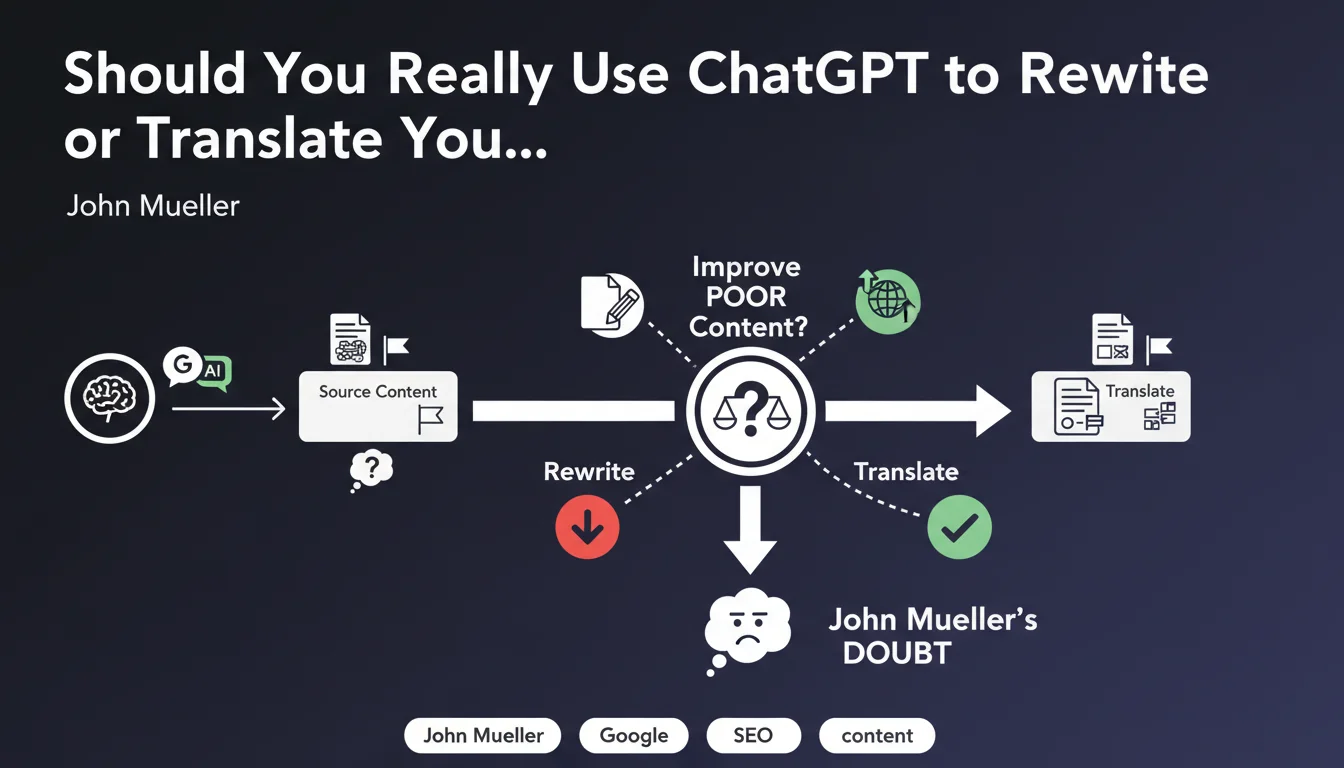
John Mueller has spoken about using ChatGPT for content rewriting, particularly in the context of modifying existing articles or translations. His position remains cautious and nuanced, without firm condemnation but with significant reservations.
The central point of his reflection concerns quality: can an AI really improve content that is already poor to begin with? The underlying question is essential for SEO practitioners.
Mueller raises a fundamental issue: human expertise remains decisive. Generating or rewriting content via AI without possessing sufficient knowledge in the field being addressed risks producing a result of mediocre quality.
- Google doesn't formally reject the use of AI for content rewriting
- The quality of the source content is decisive: rewriting bad content won't make it good
- Human expertise in the field being addressed remains indispensable
- Mueller deliberately remains evasive about the direct impact on rankings
- The question of the real added value of generated content is at the heart of the debate
SEO Expert opinion
This position from Mueller is typically Google: neither explicit authorization nor clear condemnation, but an invitation to focus on quality. In practice, we observe that AI-rewritten content does indeed perform well if it respects E-E-A-T criteria (Experience, Expertise, Authoritativeness, Trustworthiness).
The crucial point often overlooked: ChatGPT and similar AIs amplify what you give them. Mediocre content that's rewritten remains mediocre, sometimes even with a loss of nuances or precise factual information. Conversely, quality content can be improved, restructured, or adapted effectively with AI as an assistance tool.
For translations, caution is even more important. AIs can miss the cultural and semantic nuances essential to local SEO. A literal translation doesn't account for differences in search intent across markets.
Practical impact and recommendations
- Systematically validate all AI-rewritten content with an expert in the relevant field before publication
- Never rewrite content that's already weak hoping that an AI will save it: start from a solid foundation or recreate from scratch
- Use AI to structure and reformulate, but always bring your expertise and personal experience into the final content
- For translations: always have them reviewed by a native speaker who knows the SEO of the target market
- Enrich rewritten content with concrete examples, updated data, and unique insights that AI cannot provide
- Test and measure: track the performance of AI-rewritten content versus 100% human content on your own properties
- Document your editorial process: keep a record of human supervision and the expertise mobilized
- Always prioritize E-E-A-T signals: lived experience, demonstrated expertise, recognized authority, and verifiable trustworthiness
Implementing a content strategy that balances AI and human expertise requires a fine understanding of algorithms, advanced editorial skills, and constant monitoring of Google's evolutions. These strategic issues can quickly become complex to orchestrate in-house, particularly for multi-language sites or YMYL (Your Money Your Life) sectors. Support from a specialized SEO agency allows you to structure this approach in a personalized way, defining validation protocols adapted to your sector and ensuring that every published content meets the quality standards expected by search engines.
💬 Comments (0)
Be the first to comment.