
Official statement
What you need to understand
What is Google's official position regarding UGC?
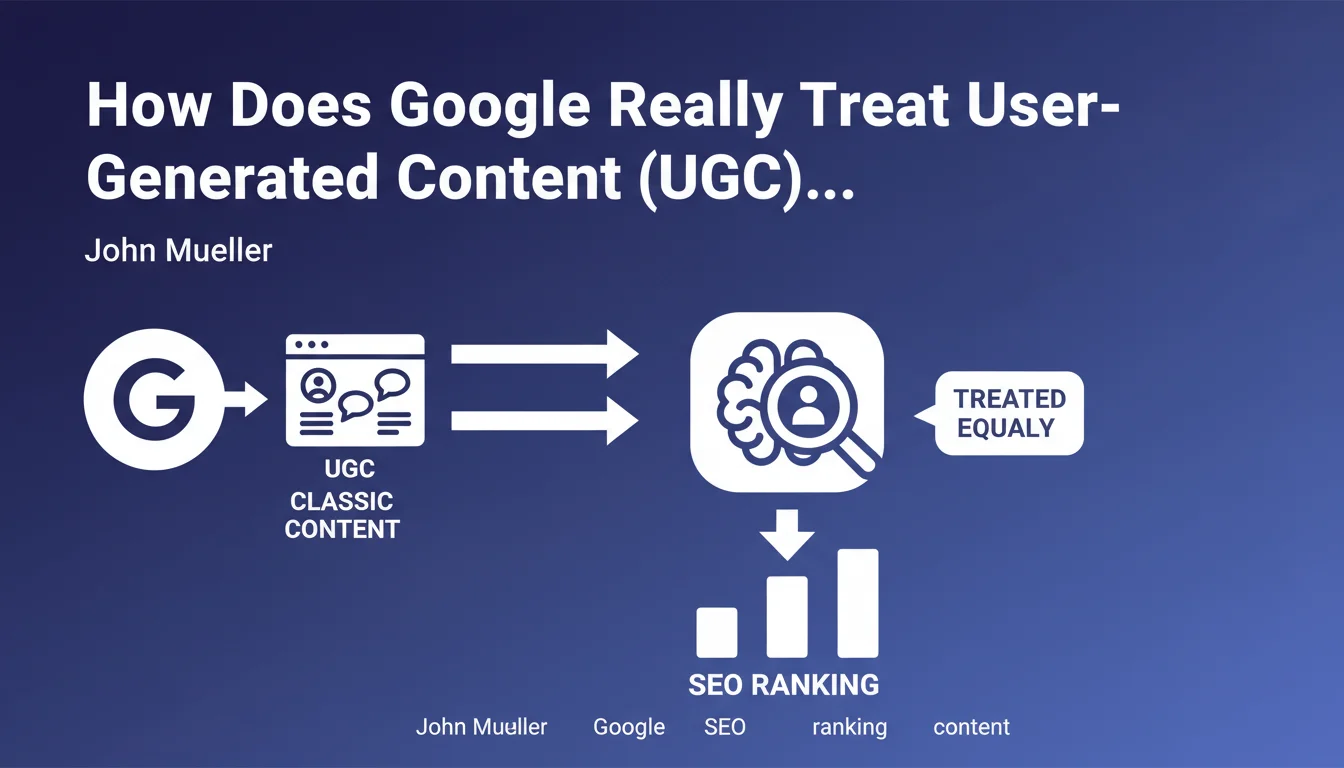
Google makes no distinction between the editorial content you write and the content generated by your users (comments, reviews, forums, etc.). As soon as you publish UGC on your site, Google considers that you assume editorial responsibility for it.
This official statement means that all content visible on your pages influences your ranking in search results. The search engine does not differentiate the source of content production but evaluates its overall quality.
Why does this clarification matter for SEO practitioners?
This stance fundamentally changes how we must approach UGC. Many professionals believed that Google gave less weight to content generated by visitors.
However, this statement confirms that UGC can either strengthen your ranking if it's high-quality, or deteriorate it if it's low-quality, spam, or off-topic. Editorial responsibility falls entirely on you.
What are the concrete takeaways from this announcement?
- Google treats UGC exactly like classic editorial content for ranking
- You are entirely responsible for the quality of content published on your site, regardless of its source
- Poor-quality UGC can penalize your overall SEO
- Moderation is not optional but becomes an SEO necessity
- The rel="ugc" attribute alone is not sufficient to neutralize problematic content
SEO Expert opinion
Is this statement consistent with field observations?
My 15 years of experience fully confirm this position. I have observed numerous cases where sites with spam comments or low-quality content saw their performance drop, particularly after Helpful Content updates.
Sites that have implemented strict moderation of their UGC generally maintain better rankings. Conversely, platforms that are lax about quality control progressively accumulate SEO debt that eventually impacts the entire domain.
What important nuances should be added to this rule?
While Google treats UGC like standard content, it nevertheless has contextual signals to interpret it. The rel="ugc" attribute and HTML5 semantic tags (like <article> vs <aside>) help differentiate sections.
However, these markers do not constitute an excuse to publish mediocre content. They simply inform Google about the nature of the content, without neutralizing its impact on the overall perceived quality of the page.
In what cases does this rule present particular implications?
Sites with high volumes of UGC (forums, marketplaces, review sites) are most exposed. A forum with 80% short and uninformative messages dilutes the site's overall quality.
Media platforms accepting comments must also exercise heightened vigilance. An excellent article can see its SEO impact diminished if followed by dozens of spam or off-topic comments that increase the weak content/strong content ratio.
Practical impact and recommendations
What should you do concretely to optimize your UGC?
The first action is to implement a robust moderation system, whether automatic, manual, or hybrid. Use spam filters, banned keyword validations, and human review for sensitive content.
Next, establish minimum quality standards: minimum comment length, rejection of generic content ("great!", "top product"), review validation after purchase verification. These criteria must be clearly communicated to users.
For existing sites with lots of UGC, conduct a cleanup audit. Identify and delete or deindex sections with very low-quality content that provide no value.
What critical mistakes must you absolutely avoid?
Don't rely solely on the rel="ugc" attribute as magical protection. It signals the nature of the content to Google but doesn't prevent mediocre content from harming your quality reputation.
Also avoid letting UGC represent the majority of content on your strategic pages. A product page with 50 words of description and 2000 words of generic reviews sends a problematic quality signal.
Never activate UGC features without first preparing your moderation infrastructure. The setup time often allows spam to accumulate, making it difficult to clean up later.
How can you effectively audit and secure your site's UGC?
- Conduct a comprehensive audit of all existing UGC on the site (comments, reviews, forums, Q&A)
- Implement automatic moderation tools (Akismet filters, Google reCAPTCHA, sentiment analysis)
- Define a clear publication charter with minimum quality criteria
- Set up a dedicated moderation team or outsource this function
- Properly use rel="ugc" attributes and semantic HTML5 tags
- Regularly monitor quality metrics (spam rate, average length, engagement)
- Create a pre-publication validation process for sensitive content
- Configure automatic alerts to detect spam spikes or problematic content
- Deindex or delete obsolete UGC sections with low added value
- Train teams in best practices for managing UGC in an SEO context
💬 Comments (0)
Be the first to comment.