
Official statement
What you need to understand
What Does Google Actually Say About Multi-Keyword Optimization?
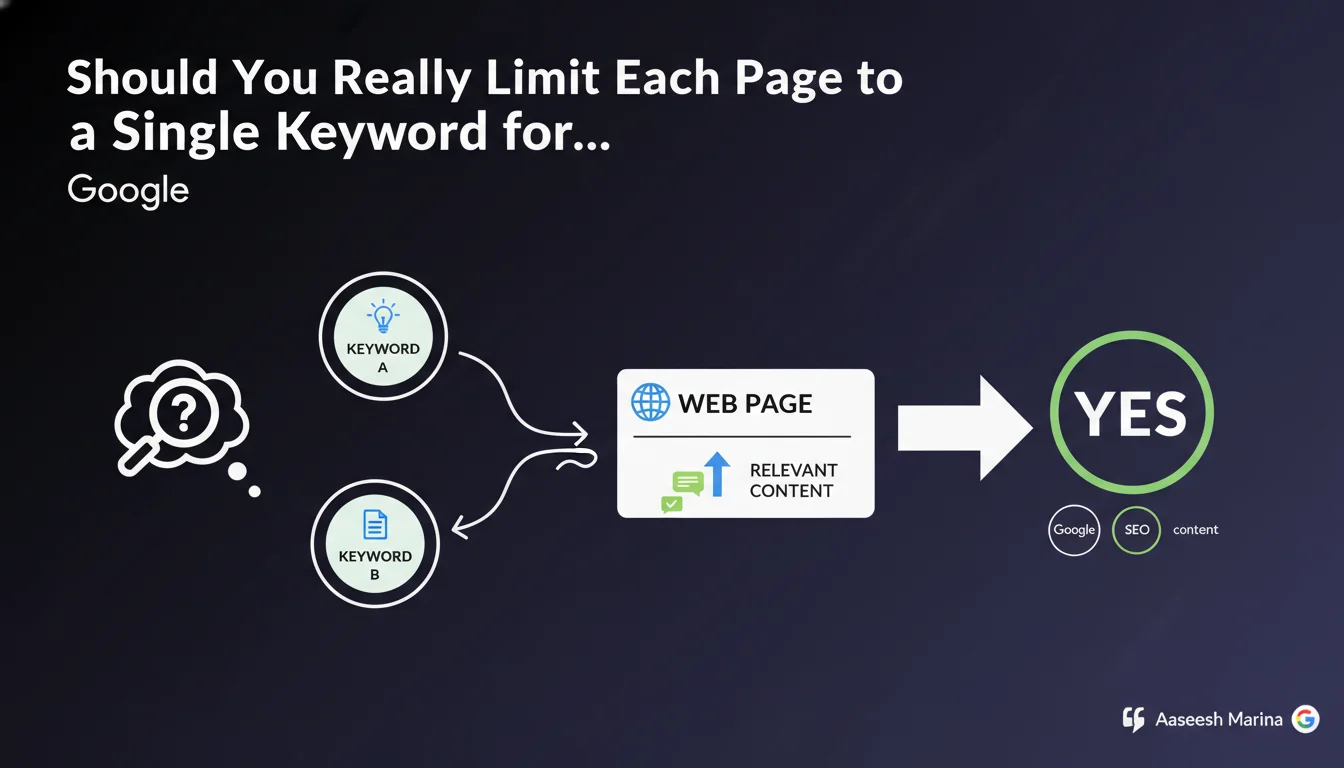
Google's official statement confirms that it is entirely possible to optimize a page for multiple keywords simultaneously, provided the content is relevant for these different queries. This position nuances a widely spread rule in the SEO community.
Googler Aaseesh Marina sees no technical or algorithmic obstacle to a page ranking for multiple search expressions. The determining factor remains the content's relevance to the targeted search intents.
Why Is the "1 Page = 1 Keyword" Rule So Widespread?
This rule was born from a pragmatic and pedagogical approach aimed at avoiding content dilution. It allows beginner SEOs to structure their strategy effectively without dispersing their efforts.
In practice, this method helps create a clear site architecture where each page has a defined objective. It also prevents the risk of cannibalization between pages that would target too similar queries.
What's the Difference Between Optimizing for Two Keywords and Naturally Ranking for Multiple Queries?
The example given shows that a page can rank for 130 different queries in Google's Top 100 without specific optimization for each one. This is the natural result of rich and relevant content.
Actively optimizing for two keywords means consciously structuring content to answer two distinct intents. Naturally ranking for numerous variations is a positive consequence of quality content that covers a topic in depth.
- Google explicitly allows optimization for multiple keywords if the content is relevant
- The "1 page = 1 keyword" rule remains a good structuring practice but is not a technical limitation
- A well-optimized page can naturally rank for dozens or even hundreds of queries
- Content relevance takes precedence over the number of targeted keywords
SEO Expert opinion
Is This Approach Consistent with Practices Observed in the Field?
Absolutely. As an SEO expert, I observe daily that the most performant pages systematically rank for multiple query variations. Sites that dominate their sectors never limit themselves to a single keyword per page.
Modern SEO strategy relies on semantic clusters and thematic silos. A well-designed pillar page can legitimately target several related expressions that share the same search intent, while serving as a hub for more specific satellite pages.
What Important Nuances Should Be Added to This Statement?
Permission to target multiple keywords doesn't mean you should do it systematically. The essential condition remains semantic coherence: the targeted keywords must share sufficient intent proximity.
For example, optimizing for "running shoes" and "running sneakers" on the same page is relevant because the user intent is identical. Conversely, mixing "running shoes" and "hiking boots" would create confusion that would harm ranking for both queries.
When Is This Multi-Keyword Approach Particularly Recommended?
E-commerce category pages benefit greatly from this approach. A "Samsung smartphones" page can legitimately target "Samsung phones," "Samsung mobiles," "Samsung Galaxy" because these expressions represent the same product search.
Local service pages constitute another relevant use case. A plumber can optimize for "plumber Paris 15th" and "plumbing repair Paris 15th" on the same page, as these queries express a single need with different formulations.
Finally, in-depth informational content (comprehensive guides, exhaustive tutorials) can naturally cover multiple aspects of a topic and thus rank for various complementary queries without forcing optimization.
Practical impact and recommendations
How Do You Decide Whether a Page Should Target One or Multiple Keywords?
Start by analyzing the search intent behind each keyword considered. If the intents are identical or very close, you can group them on the same page. Use Google to verify: if the displayed results are similar for your different queries, it's a good sign.
Then evaluate the search volume and competition. Keywords with high potential sometimes deserve a dedicated page to maximize your chances. Conversely, low-volume variants can be grouped to create a more robust page.
Analyze your current architecture: do you have enough unique content to produce to create several distinct pages? If creating separate pages leads you to repeat the same information, grouping is preferable.
What Concrete Mistakes Should You Absolutely Avoid?
Don't fall into the trap of semantic keyword stuffing by attempting to artificially place all your target keywords. Write for the user first; search engines will naturally follow if your content is relevant.
Avoid cannibalization between pages: if you create multiple pages targeting too similar keywords, they will compete with each other and none will perform properly. Use tools like Search Console to detect these conflicts.
Don't forget to adapt your Hn structure and title/meta tags accordingly. If you're targeting two main keywords, ensure your markup reflects this dual intent without appearing artificial.
- Conduct a search intent analysis for each keyword before deciding on grouping
- Manually check Google SERPs for your target keywords: similar results indicate a grouping opportunity
- Create a keyword/page mapping to visualize your strategy and avoid duplicates
- Prioritize depth of treatment rather than accumulation of keywords without added value
- Use variations naturally in your content without forcing their inclusion
- Monitor your positions on multiple keywords via a tracking tool to measure effectiveness
- Regularly audit your site to identify and correct cannibalization
- Test and adjust: SEO is iterative, measure results and adapt your approach
💬 Comments (0)
Be the first to comment.