
Official statement
What you need to understand
What's the difference between indexing and ranking in this context?
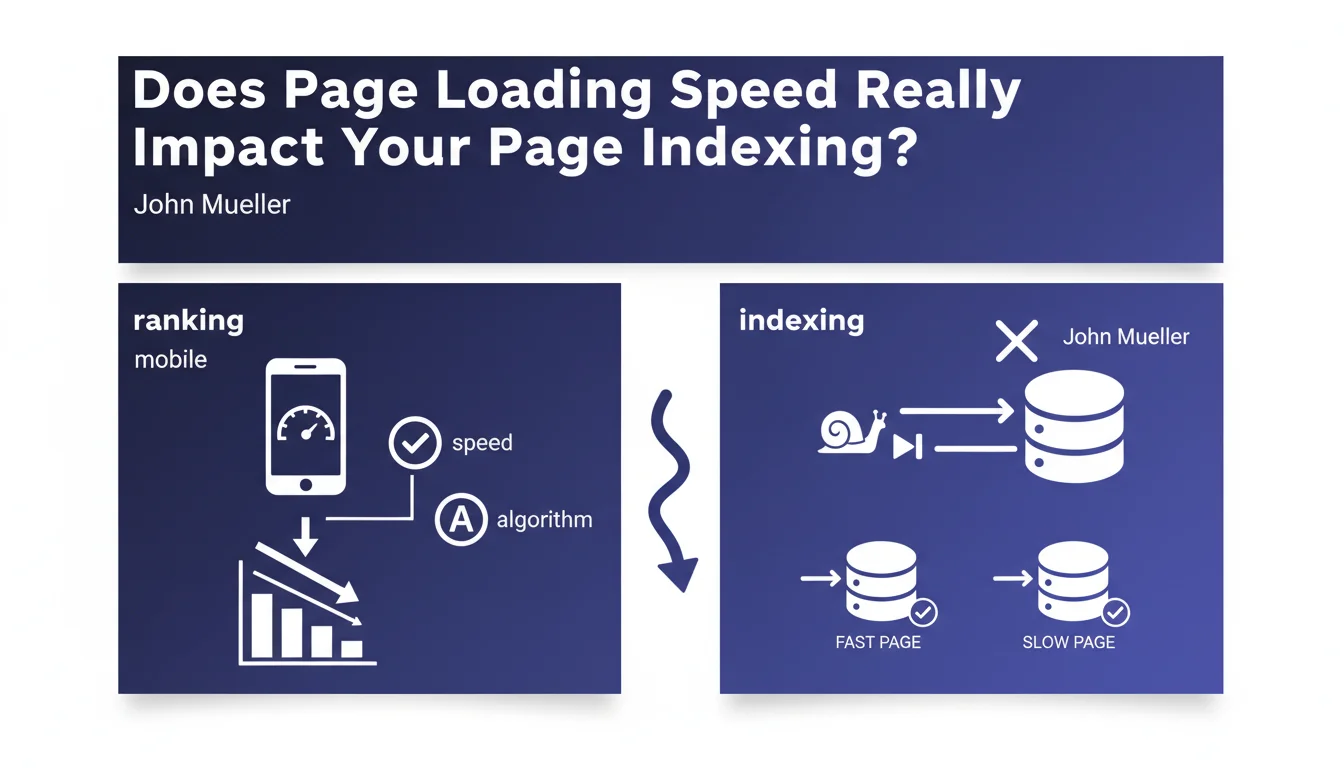
The Speed Update introduced by Google establishes a fundamental distinction: display speed influences the ranking of pages on mobile, but does not affect their ability to be indexed. A slow page can therefore perfectly well be included in Google's index.
This separation is logical: indexing concerns the discovery and recording of content, while ranking evaluates the quality of the user experience. Google does not want to exclude relevant content simply because it loads slowly.
Why does Google make this distinction between page and site?
Google makes a subtle but crucial nuance. While an isolated slow page does not prevent its indexing, the overall slowness of a site has consequences on the crawl budget allocated by Googlebot.
A structurally slow site slows down robot exploration. Google then adjusts the crawl frequency and depth, which can delay the indexing of new pages or important updates.
What are the essential takeaways from this update?
- Loading speed has been a mobile ranking factor since the Speed Update
- A slow page can be indexed normally, but will potentially rank lower
- Systemic site slowness reduces the crawl budget and hinders overall indexing
- The ranking impact primarily concerns extremely slow pages
- Speed optimization remains a worthwhile investment for mobile SEO
SEO Expert opinion
Is this statement consistent with field observations?
After 15 years of experience, I can confirm that this distinction between indexing and ranking corresponds exactly to what we observe. I've seen very slow sites perfectly indexed, but with degraded positions on mobile.
The nuance regarding crawl budget is particularly relevant. On sites with several thousand pages, high server response time creates a bottleneck visible in Search Console: new pages discovered but not crawled for weeks.
What nuances should be added to this rule?
Speed is just one factor among hundreds in the ranking algorithm. Its relative weight remains moderate: exceptional content on a moderately fast page will outrank mediocre content that's ultra-fast.
Furthermore, Google has specified that only pages offering the slowest experience are truly penalized. A page with 3 seconds loading time is not in the same category as a 10-second page. The exact threshold is not communicated, but Core Web Vitals provide reliable benchmarks.
In which cases doesn't this rule apply completely?
On sites with server timeout issues (frequent 5xx errors), even indexing becomes problematic. Googlebot abandons crawls that systematically fail, regardless of theoretical loading time.
Similarly, on sites with heavy JavaScript, slowness can prevent proper content rendering. If Googlebot cannot execute the JS within a reasonable timeframe, it will index an empty or incomplete page, which amounts to an indirect indexing problem.
Practical impact and recommendations
What should you prioritize concretely in your strategy?
Focus first on the overall technical health of your site: server response time, availability, absence of systemic errors. This is what protects your indexing and crawl budget.
Next, optimize Core Web Vitals to improve your mobile rankings: image compression, lazy loading, JavaScript optimization, effective caching. Prioritize strategic pages with high traffic or commercial potential.
Don't forget that speed also impacts conversion rate and user experience. Every second saved reduces abandonment and improves behavioral signals that, indirectly, influence SEO.
What common mistakes should you absolutely avoid?
Never sacrifice content quality for pure speed. Rich text with a few optimized images is better than an ultra-fast page with no added value.
Avoid optimizations that create accessibility problems for Googlebot: poorly configured lazy loading that prevents image crawling, JavaScript that blocks main content rendering, or multiple redirects that lengthen the crawl path.
How can you effectively audit and monitor these metrics?
- Analyze the crawl stats report in Search Console to monitor your crawl budget
- Use the Core Web Vitals report to identify problematic pages on mobile
- Set up monitoring alerts on server response time (threshold: 200ms maximum)
- Test your strategic pages with PageSpeed Insights to get real field data
- Check mobile rendering with the URL inspection tool to ensure content is accessible
- Track the evolution of your mobile vs desktop rankings to detect a Speed Update impact
- Regularly audit render-blocking resources and total page weight (target: less than 2 MB)
💬 Comments (0)
Be the first to comment.