
Official statement
Other statements from this video 10 ▾
- 0:39 Do Google Ads campaigns really affect your organic search ranking?
- 1:42 Are Content and UX Really Enough to Rank on the First Page?
- 2:17 Do social signals really influence Google rankings?
- 4:59 Can a website's design really remain unchanged without hurting its SEO?
- 6:41 Should you really create a landing page for each city or risk a quality penalty?
- 12:45 Why does Google refuse to show the Sitelink search box on your site?
- 19:40 How does Google really handle duplicate content on your site?
- 27:48 Are canonical tags really enough to manage duplicate content?
- 32:08 Do Google's daily algorithm updates really change the game for your SEO?
- 44:40 Do major brands really dominate Google search results?
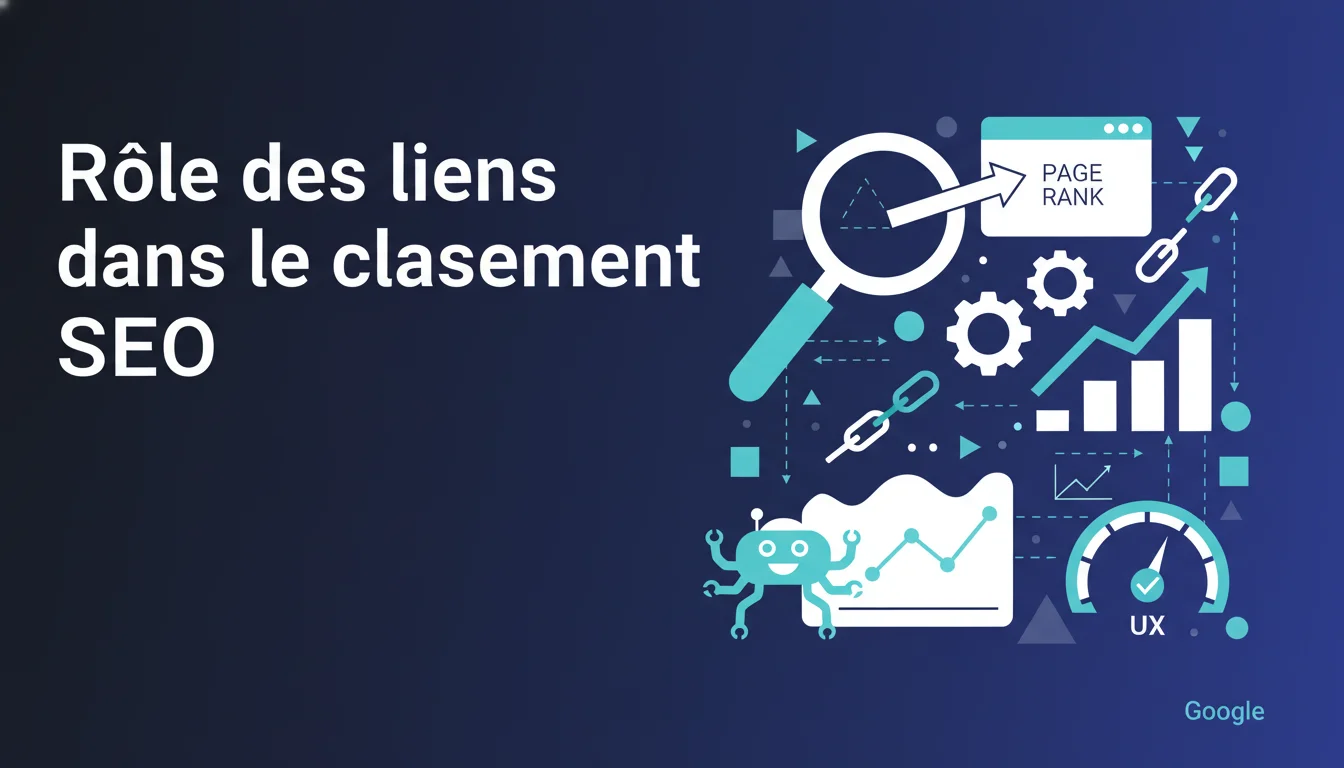
Google confirms that links are major signals for ranking and continue to feed the PageRank calculation. For SEO practitioners, this means that the quality and relevance of backlinks remain crucial, despite the increase in other ranking signals. The challenge is distinguishing links that genuinely transfer authority from those that merely create a cosmetic effect on the link profile.
What you need to understand
Why does Google maintain the importance of links in its algorithm?
Google's statement reaffirms what SEOs have known since the inception of the engine: links are a vote of confidence between web pages. PageRank, while evolving and combined with hundreds of other factors, has never been abandoned. It still serves as the foundation for the knowledge graph Google builds to assess the authority and relevance of content.
What many don’t know: the PageRank calculated today is no longer the raw score visible in the old toolbar. Google now applies contextual variations of PageRank based on theme, freshness, and other dimensions. A link from an authoritative site in your niche is worth infinitely more than a generic link from a poorly maintained directory.
How does Google differentiate a helpful link from a manipulative one?
Over the decades, Google has refined its filters to detect artificial link schemes. The signals analyzed include: the velocity at which links are acquired, their editorial diversity, thematic consistency between source and target pages, and the overall quality of referring sites. A natural link profile exhibits a consistent statistical distribution: a mix of diverse referring domains, varied anchors, and progressive growth.
Which links trigger alerts? Those from private blog networks (PBNs) with identical footprints, systematic link exchanges detectable by excessive reciprocity, or overly optimized anchors repeated identically across hundreds of domains. Google doesn't always penalize: often, it simply ignores these links in the PageRank calculation.
Does PageRank still operate like it did in the 2000s?
No, and it’s crucial to understand. The original PageRank was a universal score passed from page to page via links. Today, Google uses sector-specific and temporal versions of PageRank. A page might have a high PageRank for tech queries and a mediocre score for health queries if its backlinks come solely from tech sites.
Additionally, modern PageRank incorporates devaluation mechanisms: a link from a poorly linked page or buried deep within a structure conveys less juice than a link from a well-linked page close to the home. The link's position in the content, its visibility, and even the semantic context around the anchor influence its value.
- Links remain a top-ranking signal, officially confirmed by Google
- PageRank is not dead: it has evolved into contextual and thematic versions
- Quality > quantity: a relevant editorial link is better than 100 directory links
- Google ignores artificial links rather than systematically penalizing sites
- Internal architecture influences PageRank distribution: optimizing the internal linking is still beneficial
SEO Expert opinion
Does this statement reflect recent field observations?
Yes, and data from recent years confirm it. Sites that sustainably progress in competitive SERPs consistently feature a strong backlink profile. Correlation studies still show that the number of unique referring domains strongly correlates with top 3 positions, especially for high-volume commercial and informational queries.
But here’s the critical nuance: correlation is no longer linear. Between 0 and 20 quality referring domains, the impact is massive. Between 200 and 220, the marginal effect becomes weak. Google prioritizes diversity and thematic relevance of sources over raw accumulation. A site with 50 highly relevant backlinks can outrank a competitor with 500 mediocre links.
Which practices still work despite algorithm updates?
Editorial link building is still king. Digital press relations, expert contributions to niche media, and partnerships with authoritative sites in your sector generate links that Google fully values. These links fit into a rich semantic context, come from credible sources, and arrive naturally in the editorial flow of the referring site.
Linkable assets still work: proprietary data studies, free tools, comprehensive guides cited as references. A good asset generates backlinks over several years without active intervention. On the other hand, tactics like massive guest blogging, triangular exchanges, or purchasing links on public platforms come with a declining ROI and increasing risk. [To be verified]: Google claims to detect these patterns, but some sites continue to exploit them without visible sanctions. However, the risk exists.
Should you still invest heavily in link building?
It depends on your market and current positioning. In low-competition niches, optimized content with a solid internal link structure may suffice without aggressive link building. In saturated sectors (finance, health, real estate, insurance), it’s impossible to break into the top 10 without quality backlinks. The link building budget should be proportionate to the competitive intensity.
A common mistake: neglecting internal PageRank. Many sites have a structure that dilutes link juice to unnecessary pages (terms of service, legal notices, empty author pages). Optimizing the internal linking to concentrate PageRank towards strategic pages can deliver gains equivalent to 10-20 external backlinks without any risk. Start by auditing your internal link structure before purchasing backlinks.
Practical impact and recommendations
How to effectively audit your current backlink profile?
Start by extracting the complete list of your referring domains using Google Search Console, Ahrefs, or Majestic. Rank them by domain authority and thematic relevance. Identify links coming from spammy sites, suspicious blog networks, or pages unrelated to your sector. These links contribute nothing and can be disavowed if their volume pollutes your profile.
Next, analyze the anchor distribution. A natural profile shows a majority of brand or naked URL anchors, with only 15-25% of anchors optimized for keywords. If 60% of your anchors contain your exact primary keyword, you are in the red zone. Diversify by acquiring links with contextual or generic anchors.
What concrete actions should you prioritize to strengthen your link authority?
Focus your efforts on acquiring links from authoritative sites in your niche. An effective strategy: identify reference content (top 3 for your target queries), analyze their backlinks with an SEO tool, and reach out to the same referring sites with superior or complementary content. The success rate of a well-targeted outreach campaign is around 5-10%.
Additionally, optimize your internal linking. Create pillar pages that concentrate PageRank and redirect this juice to your commercial pages via relevant contextual links. Use descriptive anchors, avoid footer links that dilute PageRank, and remove orphan pages that capture juice without redistributing it.
Which critical mistakes should you absolutely avoid?
Don’t fall into the trap of low-cost link networks sold on public platforms. Google indexes these sites, knows their owners, and detects common footprints (same CMS, same themes, same IP patterns). Links from these networks are at best ignored, at worst they trigger manual action. The risk isn’t worth the reward.
Another mistake: neglecting acquisition velocity. A site that gains 200 backlinks in one month after 6 months of stagnation triggers alerts. Plan for gradual growth, ideally correlated with your content publication or communication campaigns. A rate of 5-15 new referring domains per month is sustainable and natural for an average site.
- Audit your backlink profile quarterly with Search Console and a third-party tool
- Disavow only confirmed toxic links (spam, detected PBN, over-optimized anchors)
- Prioritize 5-10 quality backlinks per quarter rather than 100 mediocre links
- Diversify your anchors: 50% brand/URL, 30% contextual, 20% keywords
- Optimize your internal linking to redistribute PageRank to strategic pages
- Monitor acquisition velocity: no sudden spikes without editorial justification
❓ Frequently Asked Questions
Le PageRank est-il toujours utilisé par Google en interne ?
Un site peut-il ranker sans aucun backlink externe ?
Les liens nofollow transmettent-ils du PageRank ?
Combien de backlinks faut-il pour ranker en première page ?
Faut-il désavouer systématiquement les mauvais backlinks ?
🎥 From the same video 10
Other SEO insights extracted from this same Google Search Central video · duration 48 min · published on 22/09/2015
🎥 Watch the full video on YouTube →
💬 Comments (0)
Be the first to comment.