
Official statement
What you need to understand
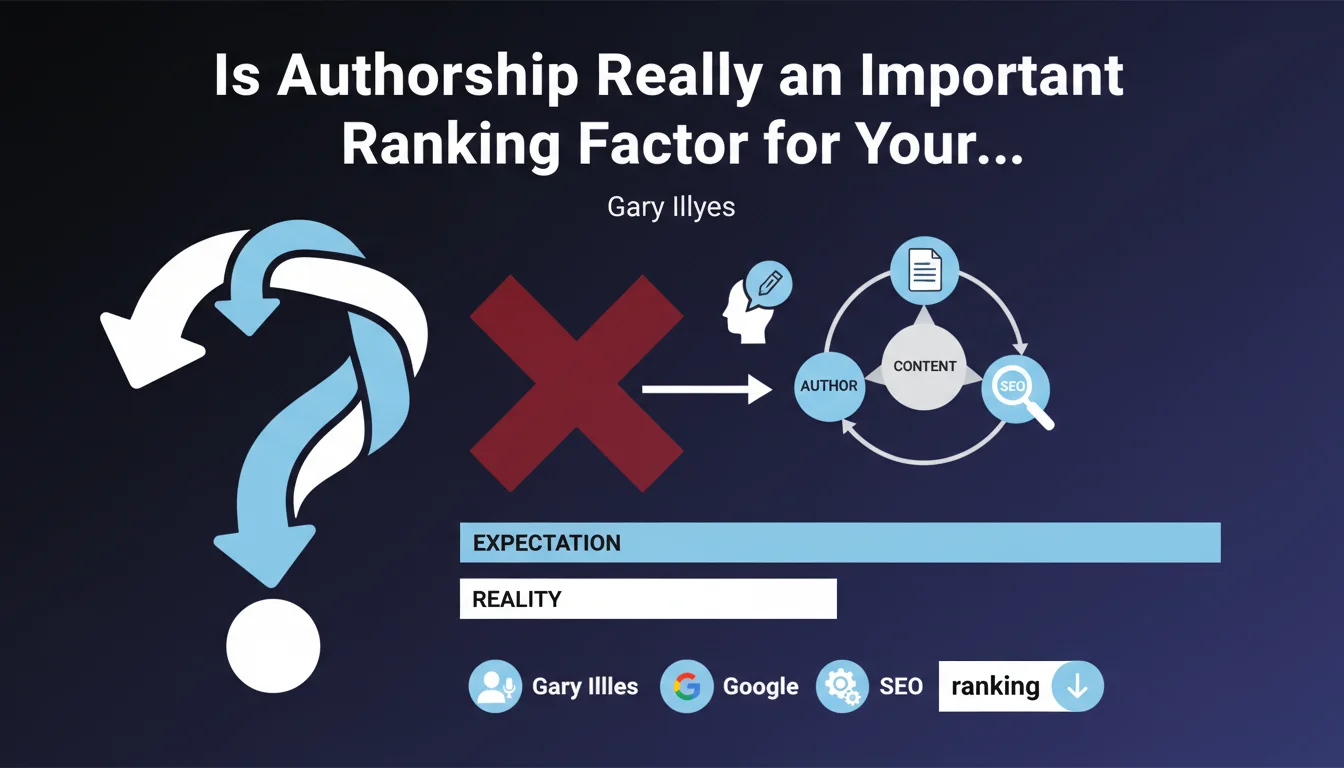
During a 2023 conference, Google clarified that authorship would be less important than many SEO professionals imagine. Concretely, this means that simply attributing content to a specific author does not in itself constitute a major ranking factor in the algorithm.
This statement may seem to contradict the concept of E-E-A-T (Experience, Expertise, Authoritativeness, Trustworthiness) that Google has been promoting for several years. However, it's important to understand that Google distinguishes between the quality of content and the formal identity of its author.
The search engine primarily analyzes the relevance, depth, and reliability of the content itself, rather than blindly relying on an author's signature. Authorship can play an indirect role, but it's not a direct and powerful ranking signal.
- Authorship is not a major ranking factor according to Google
- Content quality takes precedence over author identity
- E-E-A-T remains important but is evaluated differently
- Credibility signals are multiple and complex
SEO Expert opinion
This position from Google is partially true but deserves to be strongly nuanced depending on the industry sector. In YMYL (Your Money Your Life) domains such as health, finance, or legal matters, the demonstrated expertise of an author remains a determining element for credibility.
In practice, we observe that content signed by recognized experts performs better, not directly because of authorship markup, but through the set of associated signals: citations, quality backlinks, mentions on other authoritative sites, established social profiles. Authorship acts as an indirect trust catalyst.
The key lies in distinguishing between technical authorship (schema.org markup) and the real authority of the author built across the web. It's the latter that truly makes the difference.
Practical impact and recommendations
- Prioritize content quality and depth before any authorship considerations
- Still implement schema.org Author markup for clarity and consistency
- Build the real authority of your authors: detailed profiles, complete bios, links to professional networks
- In YMYL sectors, invest particularly in verifiable credentials and qualifications
- Develop your experts' external presence: guest articles, citations, interviews, profiles on authoritative sites
- Avoid creating fictional authors or attributing content to unqualified individuals
- Focus on holistic E-E-A-T signals: proof of experience, cited sources, transparency
- Measure performance through interaction quality and engagement rate rather than authorship alone
Implementing a coherent E-E-A-T strategy requires a comprehensive approach that combines technical expertise, quality content creation, and long-term authority development. These multidimensional optimizations demand strategic vision and varied skills that can prove complex to orchestrate internally. Engaging a specialized SEO agency allows you to benefit from personalized support to effectively structure your authorship and authority approach, aligning all the necessary levers for your success.
💬 Comments (0)
Be the first to comment.