
Official statement
What you need to understand
Google's link disavow tool allows website owners to report toxic or unwanted backlinks. Some SEOs accumulate massive lists of links to disavow, sometimes in the thousands, fearing they might harm their rankings.
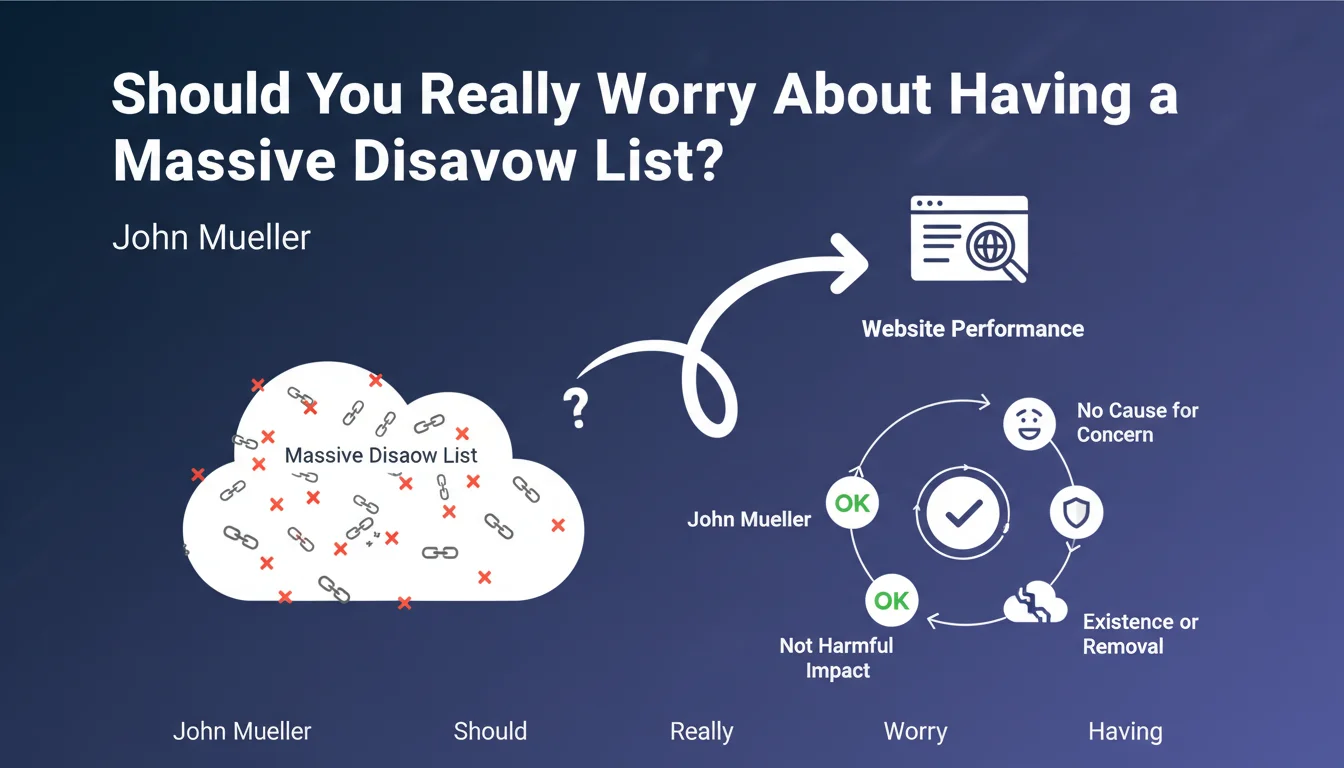
Google clarifies here that the presence or absence of such a list does not negatively impact your site. Whether you've disavowed 10 or 10,000 links, or completely delete your disavow file, it will not create a problem.
This position is explained by the fact that Google autonomously decides the value of links. The disavow file is merely a suggestion, not a mandatory directive for the search engine.
- The disavow tool is a recommendation, not an absolute directive
- Google analyzes the reliability and relevance of links independently
- The algorithms already naturally ignore low-quality links
- A massive disavow list is neither beneficial nor detrimental in itself
- Removing a disavow file will not cause any problems
SEO Expert opinion
This statement is consistent with the evolution of Google's algorithms since Penguin 4.0 (2016). The search engine has become sophisticated enough to automatically devalue artificial or spammy links without manual intervention.
In practice, I indeed observe that disavow files have lost their critical importance. Sites that remove their disavow lists generally don't experience drops in rankings. Google effectively filters bad links upstream.
However, an important nuance: in case of a manual penalty for artificial links, the disavow remains an expected element in the reconsideration procedure. Similarly, after a massive and recent negative SEO campaign, reporting these links can accelerate their neutralization.
Practical impact and recommendations
- Stop spending hours systematically analyzing and disavowing every questionable link
- Favor a selective approach: disavow only in cases of proven negative SEO or manual penalties
- Audit your link profile 2 to 4 times per year maximum, not weekly
- Reallocate the time saved toward creating quality content and natural link building
- Monitor abnormal spikes in new backlinks via Search Console to detect potential attacks
- Document your disavows if you make them, in case you need to justify them later
- Don't hastily delete your existing disavow file, but stop feeding it systematically
- Focus on the fundamentals: technical, content, user experience, and editorial links
A modern link building strategy requires sharp expertise to distinguish high-ROI actions from low-impact tasks. Finding the balance between vigilance and time optimization is delicate. For businesses wanting to maximize their organic visibility without dispersing their resources, support from a specialized SEO agency provides an objective analysis of your link profile and a tailored strategy aligned with current algorithmic realities.
💬 Comments (0)
Be the first to comment.