
Official statement
What you need to understand
What is the original purpose of the tag in HTML?
The tag was designed to identify abbreviations and acronyms in HTML code. It allows displaying a tooltip on hover, explaining the full meaning of the abbreviated term.
Its primary objective is to improve accessibility and user experience, particularly by helping screen readers correctly interpret acronyms for visually impaired users.
Why did some SEO professionals think this tag could help with search rankings?
The hypothesis was that this tag could help Google better understand the semantic context of a page. By explicitly identifying acronyms, the search engine could theoretically enrich its understanding of the content.
For example, distinguishing "SEO" (Search Engine Optimization) from "CEO" (Chief Executive Officer) using tags might have seemed relevant for semantic analysis.
What does Google officially say about using the tag?
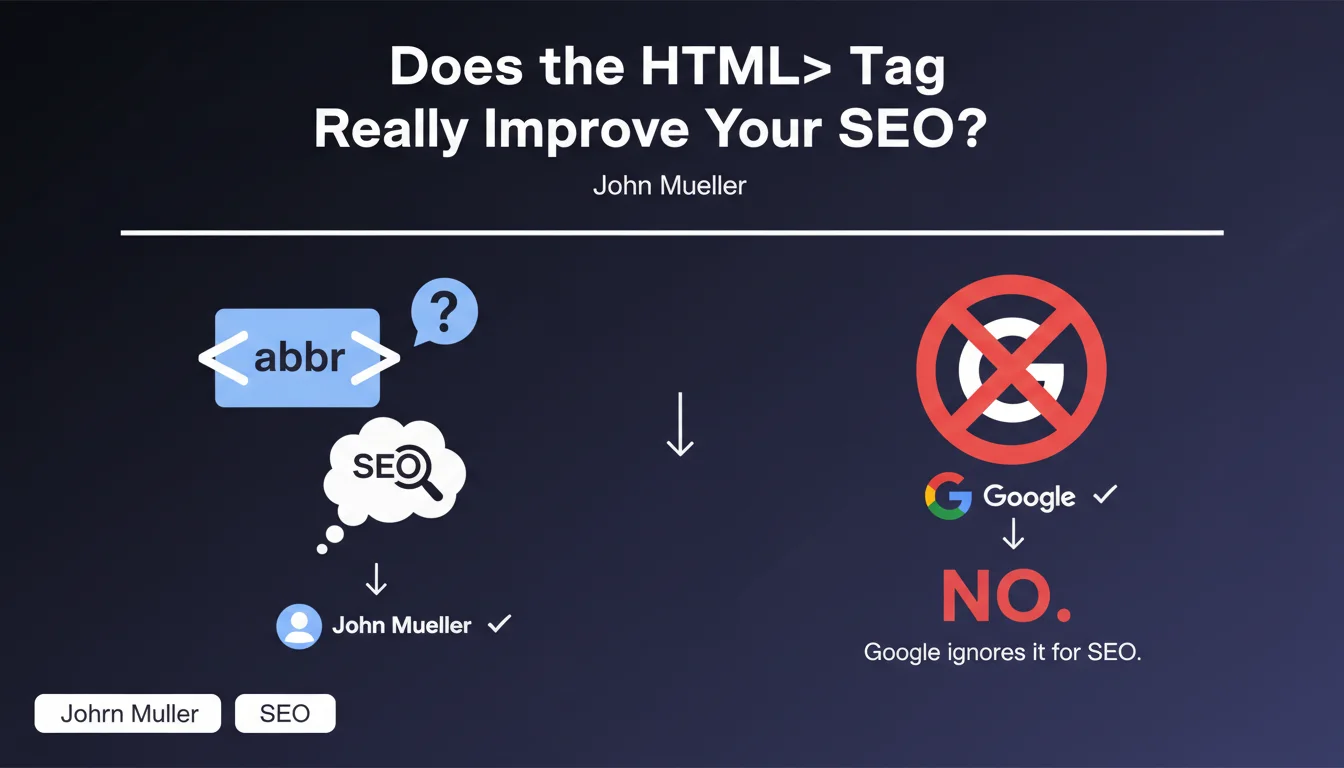
John Mueller's answer is categorical and unambiguous: Google does not take the tag into account when processing pages. This tag has no impact on search engine optimization.
This means it influences neither the ranking in search results nor the semantic analysis of content by Google's algorithms.
- The tag is not taken into account by Google
- It does not improve semantic analysis of content
- It has no impact on page ranking
- Its usefulness remains limited to accessibility and user experience
SEO Expert opinion
Is this statement consistent with practices observed in the field?
This confirmation fits into a broader trend: Google ignores many semantic HTML tags considered secondary. The algorithm focuses on more robust and less manipulable signals.
In my audits of thousands of sites, I've never observed a significant correlation between the use of and SEO performance. This statement therefore validates empirical field observations.
Why doesn't Google place more value on semantic markup?
Google prioritizes its natural language processing (NLP) to understand context. With the advances of BERT, MUM, and now generative AI, the search engine no longer needs explicit tags to identify acronyms.
The risk of manipulation and spam also plays a role. If Google explicitly valued these tags, they would immediately be over-optimized by unscrupulous SEOs, diluting their actual usefulness.
In what cases does using remain relevant despite everything?
Even without direct SEO benefits, the tag retains utility for web accessibility. It improves the experience for screen reader users and complies with WCAG standards.
There's also a potential indirect impact: better user experience can reduce bounce rate and increase time on page, behavioral signals that Google observes.
Practical impact and recommendations
Should you remove existing tags from your site?
No, absolutely not. If your site already uses this tag for accessibility reasons, keep it. It doesn't harm SEO, it's simply neutral.
Removing these tags would represent unnecessary development time without any SEO gain. Your energy will be better invested in optimizations with real impact.
What should you actually do to optimize Google's processing of acronyms?
Rather than relying on HTML tags, expand acronyms in your textual content at their first occurrence. For example: "SEO (Search Engine Optimization) is essential..."
Create FAQ or glossary sections explaining your industry acronyms. This enriches your content with vocabulary understandable by both Google and your users.
Work on your semantic cocoon by creating related content that establishes the context of your technical terms, rather than betting on HTML micro-optimizations.
How can you effectively prioritize your SEO optimization efforts?
- Focus on essential structural tags: Title, H1-H6, meta description
- Expand acronyms directly in the text at their first mention
- Invest in content quality and depth rather than HTML micro-optimizations
- Prioritize Schema.org structured data that Google actually uses
- Don't remove existing tags if they serve accessibility purposes
- Create resources (glossaries, FAQs) to contextualize your technical vocabulary
The tag provides no SEO advantage according to Google, which relies on its natural language processing to understand acronyms. No need to invest time implementing this tag for search engine optimization purposes.
Instead, prioritize textual explanation of acronyms and creating content rich in semantic context. Keep only for web accessibility if it's already implemented.
Modern SEO optimization requires distinguishing myths from truly effective levers. Faced with the growing complexity of algorithms and the proliferation of false good ideas, structuring a relevant optimization strategy can prove complex. For businesses wanting to maximize their visibility without wasting time on ineffective actions, support from a specialized SEO agency enables prioritizing high-ROI optimizations and avoiding common pitfalls that dilute efforts.
💬 Comments (0)
Be the first to comment.