
Official statement
What you need to understand
Why Does Google Penalize Complex Tables for Featured Snippets?
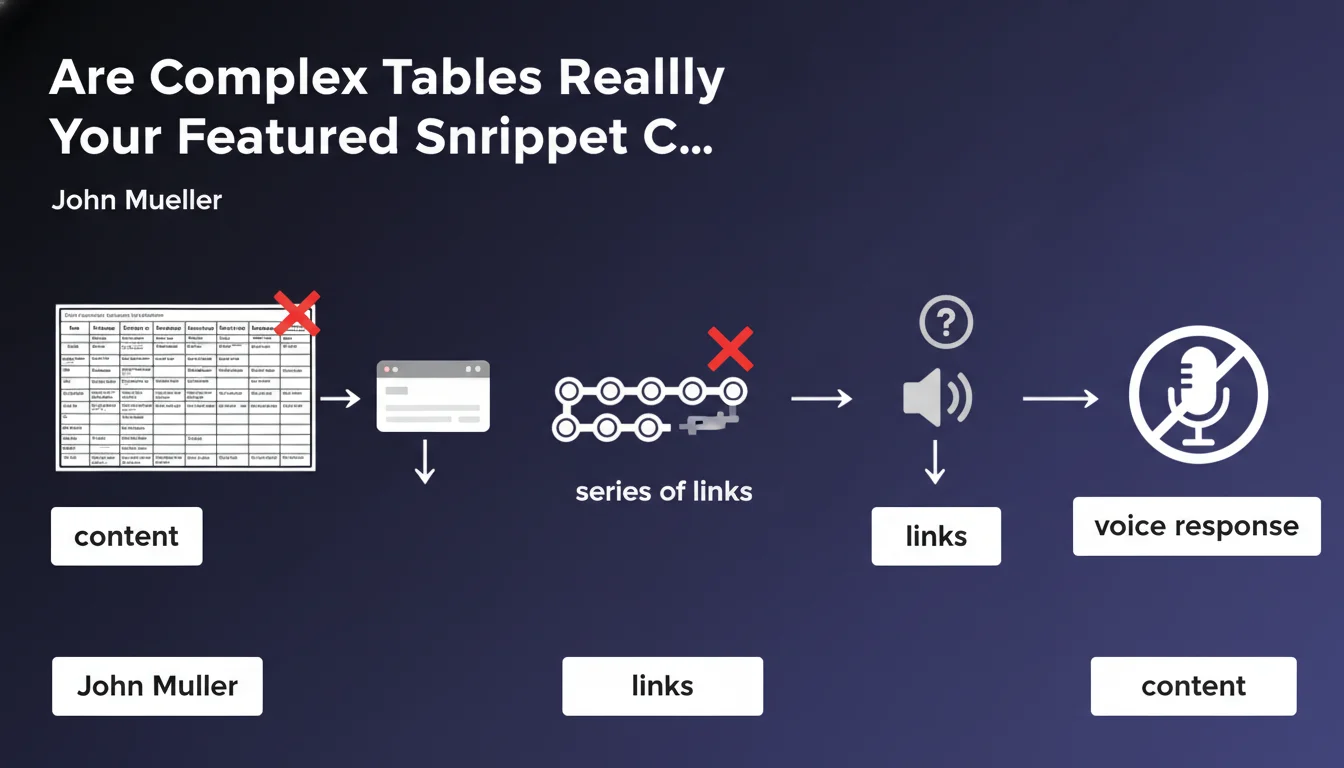
Featured snippets are designed to provide quick and easily understandable answers to users, particularly in the context of voice search. A large table with numerous columns and rows cannot be read effectively by a voice assistant.
Google therefore favors content that can be extracted and summarized simply. A large table of raw data does not meet this criterion of accessibility and immediate clarity.
What's the Difference Between HTML Tables and Complex Visual Tables?
This is not about avoiding <table>, <tr> and <td> HTML tags. The distinction concerns the complexity and density of the information presented.
A small HTML table with 3 rows and 2 columns can perfectly qualify for table-type featured snippets. On the other hand, a huge table with 50 rows and 10 columns, even well-structured in HTML, will be too complex to be extracted.
Which Content Formats Are Actually Optimized for Position Zero?
Paragraph-type featured snippets represent the majority of current position zero results. They generally consist of 40 to 60 words directly answering a question.
Google also displays snippets in bulleted lists (steps, rankings) and simple tables (comparisons, pricing). The objective always remains the same: to provide a clear, concise and easily vocalizable answer.
- Short paragraphs (40-60 words) dominate featured snippets
- Numbered lists work well for tutorials and procedures
- Simple tables (3-5 rows maximum) can be extracted
- Long series of links or complex data are ignored
- Voice compatibility is a determining selection criterion
SEO Expert opinion
Is This Recommendation Consistent with Real-World Observations?
Absolutely. Analyses of featured snippets in production confirm that Google massively favors simple and structured formats. Sites that regularly obtain position zero use clear definition paragraphs.
Tables present in snippets are systematically streamlined and synthetic. You rarely find more than 4-5 rows with 2-3 columns maximum. This observation fully validates Mueller's statement.
What Important Nuances Should Be Applied to This Rule?
Be careful not to delete all your data tables. A complex table can have immense value for users looking for detailed information, even if it is not eligible for featured snippets.
The optimal strategy consists of offering both formats: a summary in the form of a paragraph or small table for the snippet, followed by the detailed table for those who want to go deeper. This way you maximize both your visibility AND your added value.
In Which Contexts Does This Rule Not Fully Apply?
For certain highly specialized queries in B2B or technical fields, users are specifically looking for complex data. In these cases, the priority is not the featured snippet but classic positioning on long-tail queries.
Financial data sites, statistics sites or technical comparison sites must keep their detailed tables. Their value lies in comprehensiveness, not in voice synthesis.
Practical impact and recommendations
How Can You Restructure Your Content to Maximize Your Featured Snippet Chances?
Start by auditing your pages positioned on Google's first page for interrogative queries. Identify those that present large tables or long lists of links in the introduction.
Reorganize the content by first placing a synthetic answer (40-60 words) in the form of a clear paragraph. Then add your detailed data for users who wish to delve deeper.
- Identify pages with tables of more than 5 rows at the top of the page
- Add a summary paragraph before each complex table
- Use subheadings in question form (H2/H3) for structure
- Create simplified versions of your complex tables when relevant
- Avoid long enumerations of links without explanatory context
- Test your content with voice assistants to check readability
What Specific Mistakes Should You Absolutely Avoid?
Never place a 20-row table immediately after your H1 title. Google will not be able to extract a clear answer and will ignore your page for featured snippets, even if you are well positioned.
Also avoid endless lists of links without descriptive text. A landing page composed solely of a series of internal links provides no extractable value for a snippet.
How Can You Verify Your Pages' Optimization for Featured Snippets?
Use Google Search Console to identify queries where you appear in position 1-5 without a featured snippet. These are your priority opportunities for content restructuring.
Analyze your competitors' current snippets for these queries. Observe their format (paragraph, list, simple table) and create even clearer and more direct content.
💬 Comments (0)
Be the first to comment.