
Official statement
Other statements from this video 14 ▾
- 60:30 Your site isn’t indexed but no technical issues are found: should we really blame content quality?
- 145:32 Do crawl reports really help you diagnose your indexing issues?
- 147:47 Do crawl errors really block your content from being indexed?
- 260:15 Does Google really deindex outdated pages to protect your site?
- 315:31 What does the 'empty content' alert in Search Console really hide about potential redirection issues?
- 355:23 Why does your sitemap marked as 'not submitted' not necessarily indicate a problem?
- 376:17 Should you really wait for Google to switch your site to mobile-first indexing?
- 432:28 Does duplicate content really lead to a Google penalty?
- 451:19 Does the DMCA really protect your content from scraping?
- 532:36 Why might Google rank a third-party site above an official brand site?
- 630:10 Do we really need to mark up article reviewers for SEO?
- 714:26 Does Search Console really erase all your historical data before verification?
- 771:59 Is it really okay to duplicate your website content on your Google Business Profile without risking an SEO penalty?
- 835:21 Are cookie and legal interstitials really harming your SEO?
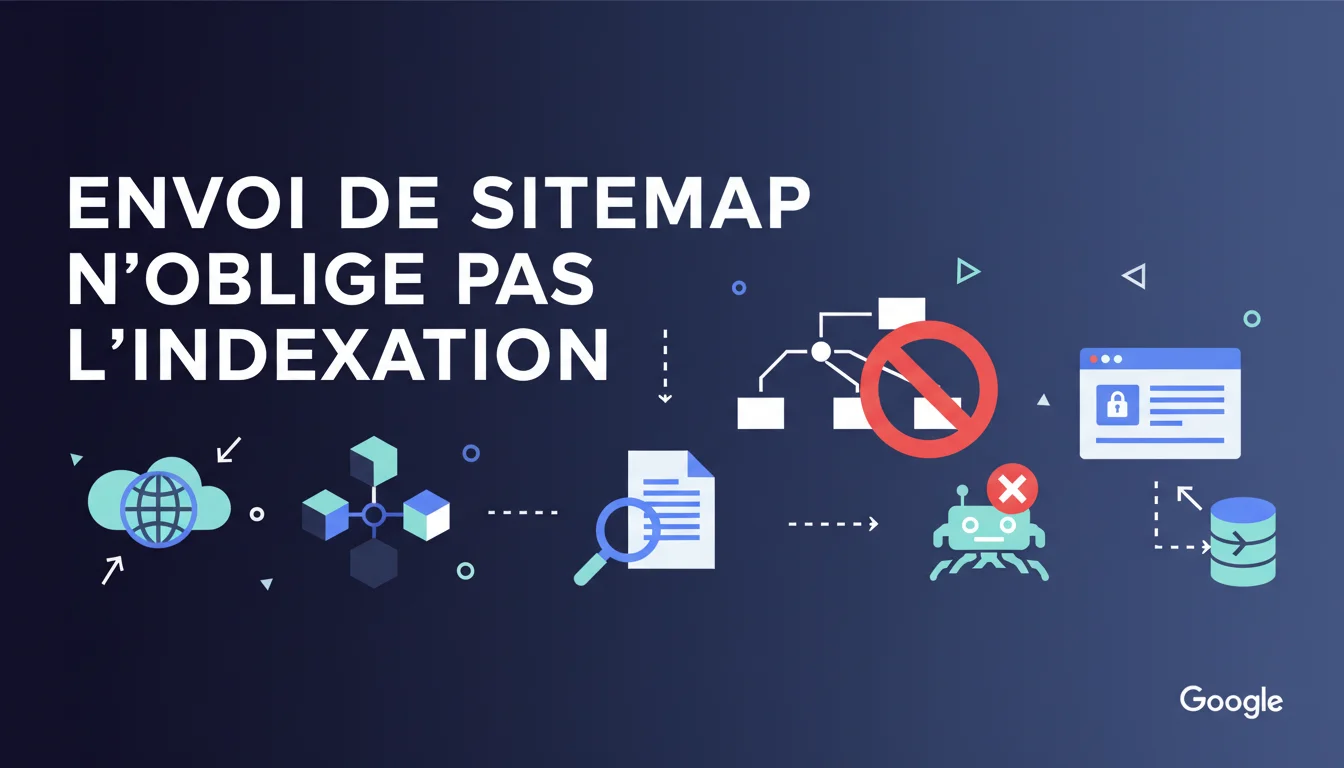
Google states it clearly: submitting a sitemap or requesting indexing via Search Console are suggestions, not commands. The engine decides on its own what to index based on its quality and relevance criteria. In practice, you can have a flawless sitemap and perfectly crawlable pages that remain outside the index — and that’s normal.
What you need to understand
Why won't Google guarantee indexing?
The search engine handles billion of pages each day. Indexing everything available on the web would be technically impossible and ultimately unnecessary — a massive portion of online content is either duplicated, of mediocre quality, or of no value for users.
Therefore, Google operates with a filtering system: crawling does not guarantee indexing, and submitting a sitemap does not even guarantee systematic crawling. The engine allocates its crawl budget and indexing resources based on criteria it considers priority — content freshness, domain authority, perceived quality, user demand.
What’s the difference between crawling, indexing, and ranking?
Crawling is when Googlebot visits a URL. Indexing is adding that page to the engine’s searchable database. Ranking is how that page is positioned in the results for a given query.
Submitting a sitemap facilitates crawling by providing a structured list of URLs. But even a crawled page may never be indexed if Google deems it irrelevant, duplicate, or of low quality. And an indexed page may remain invisible if it ranks for no query.
What really determines whether a page gets indexed?
Google applies quality criteria: content uniqueness, depth of treatment, domain authority, engagement signals, thematic consistency. A technical page with no added value, even if perfectly accessible, can be discarded.
The engine also favors pages that respond to an identified user demand. If no one is searching for a given subject, or if 500 pages already cover that subject better than yours, indexing becomes optional for Google — it optimizes its resources.
- Submitting a sitemap aids in discovering URLs, but doesn’t force anything
- Requesting indexing via Search Console signals a priority, without a guarantee of processing
- Content quality remains the decisive lever: Google indexes what it finds useful for its users
- Crawl budget limits the number of pages visited — even with a complete sitemap, some URLs may wait weeks
- Orphan pages or poorly linked pages have little chance of being indexed, sitemap or not
SEO Expert opinion
Is this statement consistent with real-world observations?
Absolutely. Every SEO practitioner has encountered pages submitted via sitemap but never indexed, or indexing requests in Search Console left unprocessed for months. Google doesn’t hide this reality — but many teams continue to believe that an XML sitemap resolves all indexing issues.
The truth is that Google sorts. It indexes what it thinks deserves a place in its index based on opaque but consistent criteria: perceived quality, freshness, authority, user demand. A low-authority site with 10,000 pages may see 80% of its content ignored, even if perfectly crawlable.
What nuances should be added to this statement?
Google doesn’t say sitemaps are useless — it states they guarantee nothing. Essential nuance. A well-structured sitemap accelerates discovery of new URLs, signals priorities (via lastmod and priority), and helps Googlebot understand the site’s architecture.
However, the sitemap doesn’t compensate for weak or redundant content. If your pages don’t add anything new, they will remain outside the index, even with a perfect sitemap. [To be verified]: Google claims that the <priority> tag in sitemaps is largely ignored — several field tests suggest that only the lastmod signal has a measurable impact.
Are there cases where this rule doesn’t apply?
Let’s be honest: there are no cases where Google guarantees indexing. Even sites with maximum authority can have certain pages excluded. The statement is universal.
However, certain situations drastically increase the chances of rapid indexing: fresh content on an authoritative domain, pages responding to emerging user demand (trending topics), URLs pointed to by high-quality external links. In these cases, the sitemap remains a suggestion — but Google reacts quickly.
Practical impact and recommendations
What should be done concretely to maximize indexing chances?
Start by auditing the current index: site:yourdomain.com in Google, comparing with the number of pages submitted in the sitemap. The gap indicates your rejection rate. If 50% of your pages are out of the index, the problem is not the sitemap — it’s the quality or relevance of the content.
Next, optimize the internal linking. Google favors well-linked pages, accessible within 3 clicks from the home page. An orphan page, even in the sitemap, has little chance of being indexed. Use internal PageRank as leverage: point your strategic pages from already indexed and authoritative pages.
What mistakes should be absolutely avoided?
Do not overwhelm Google with a sitemap of 50,000 URLs if 40,000 are thin or duplicate content. The engine will crawl a portion, index a fraction, and reduce your crawl budget for future updates. Better to have a 5,000 pages quality sitemap than a giant directory.
Avoid also requesting indexing in a loop via Search Console. Google interprets this as spam — and it changes nothing. If a page is rejected after several requests, the problem is with the page, not the submission method. Fix the content before trying again.
How can you check if your indexing strategy is working?
Analyze server logs to identify which pages Googlebot actually visits, how frequently, and which it ignores. Cross-reference this data with the coverage report in Search Console. If a page is crawled but not indexed, Google has judged it — and rejected it.
Also test the voluntary removal of weak URLs: noindex or delete low-value pages, then see if the crawl budget reallocates to strategic content. This is often more effective than trying to forcibly index 10,000 mediocre pages.
- Audit the gap between submitted pages (sitemap) and indexed pages (site:)
- Prioritize internal linking to strategic pages
- Clean weak or duplicate URLs from the sitemap
- Check server logs to distinguish between lack of crawling and refusal of indexing
- Use Search Console to identify pages marked “Crawled, currently not indexed”
- Test removal of low-quality pages to reallocate the crawl budget
❓ Frequently Asked Questions
Pourquoi mes pages sont-elles crawlées mais non indexées ?
Un sitemap XML améliore-t-il le référencement d'un site ?
Faut-il supprimer les pages non indexées du sitemap ?
Combien de temps faut-il attendre avant qu'une page soit indexée ?
La balise priority dans le sitemap influence-t-elle vraiment Google ?
🎥 From the same video 14
Other SEO insights extracted from this same Google Search Central video · duration 1076h29 · published on 25/02/2021
🎥 Watch the full video on YouTube →
💬 Comments (0)
Be the first to comment.