
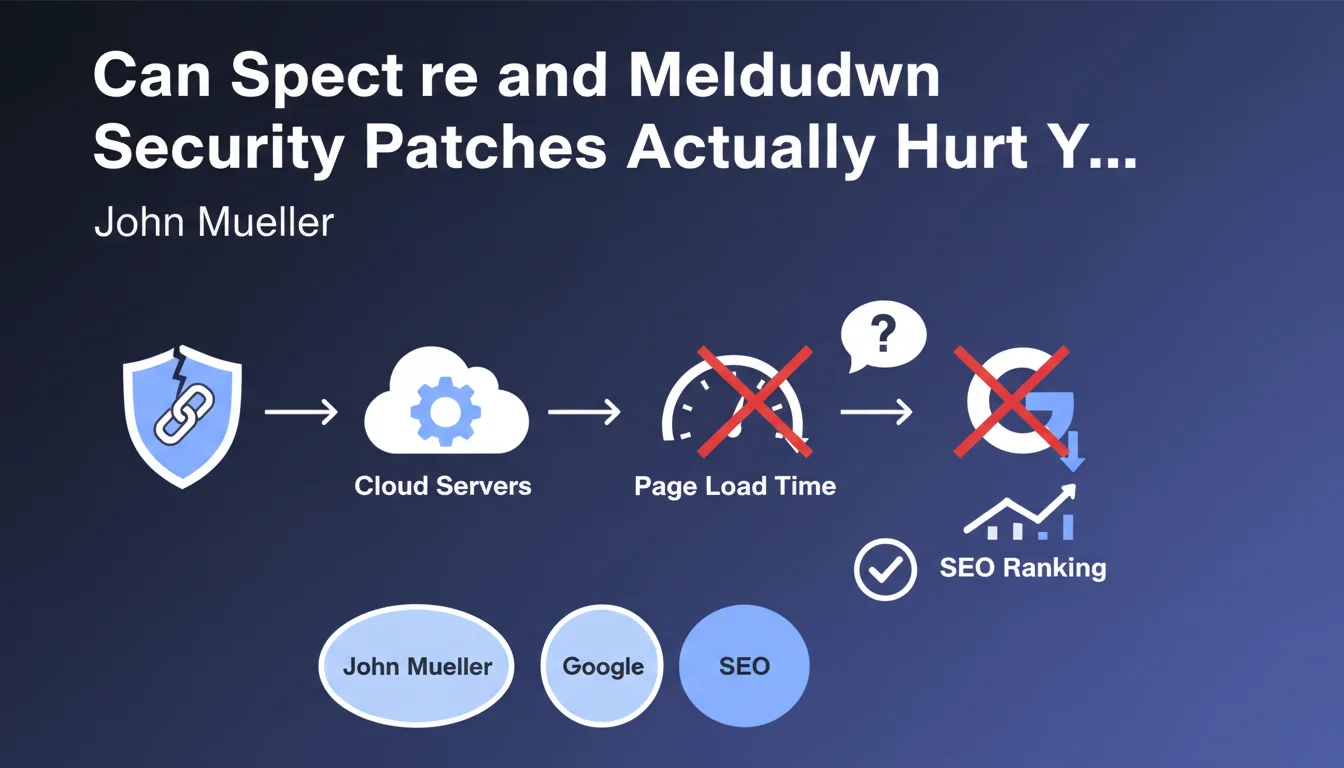
Official statement
What you need to understand
What's the context behind this official Google statement?
In 2018, two major security vulnerabilities called Spectre and Meltdown were discovered in modern processors. To fix these vulnerabilities, security patches were deployed on servers worldwide.
These patches caused a performance slowdown on certain servers, particularly those hosted on cloud infrastructures. The SEO community then wondered about the potential impact of these slowdowns on search result rankings.
What is Google's official position on this matter?
John Mueller, Google spokesperson, clarified that the slowdowns caused by these patches should not have a significant impact on search rankings. Google only penalizes sites showing excessive slowness, well beyond the few milliseconds lost due to these security patches.
This statement emphasizes that Google's algorithm has a tolerance threshold regarding loading speed. Penalties only apply to genuinely very slow sites, not to minor performance variations.
What are the key takeaways for SEO practitioners?
- The Spectre and Meltdown patches cause minor slowdowns that remain below Google's penalty threshold
- Google only sanctions sites with major speed issues, not slight performance variations
- Server security must remain an absolute priority, even if it involves minor speed compromises
- This tolerance also applies to mobile-first criteria, where speed is nevertheless an important factor
- The focus should remain on overall optimization of performance rather than micro-variations
SEO Expert opinion
Does this statement align with what we actually observe in the field?
Absolutely. This position from Google confirms what we've been observing for years: penalties for slowness only apply to extreme cases. In practice, moderately fast sites don't suffer direct sanctions, even if they don't benefit from the advantages granted to ultra-fast sites.
Field data shows that a site generally needs to exceed 5 to 7 seconds of loading time consistently to begin observing a measurable negative impact. The few milliseconds caused by security patches are completely negligible in this equation.
What important nuances should we add to this statement?
While direct penalties are rare, we shouldn't confuse absence of penalty with absence of impact. A faster site benefits from considerable indirect advantages: better conversion rate, reduced bounce rate, improved user experience.
Moreover, this statement dates from 2018. With the introduction of Core Web Vitals in 2021, speed has taken on an even more important dimension. Although penalty thresholds remain high, the performance criteria are now more granular and measurable.
In what cases might this rule not fully apply?
If your site was already borderline in terms of performance before applying the patches, even a minor slowdown could tip the metrics into the red zone. This is particularly true for sites with already high server response times or undersized infrastructures.
E-commerce sites and high-traffic platforms must also be more vigilant. In these contexts, every millisecond counts for user experience and conversions, even if Google doesn't penalize directly.
Practical impact and recommendations
What should you actually monitor on your infrastructure?
Start by measuring the actual impact of patches on your infrastructure. Use monitoring tools to compare performance before and after applying the patches. In most cases, the impact will be less than 100 milliseconds.
Focus on the metrics that really matter: Time to First Byte (TTFB), First Contentful Paint (FCP), and Largest Contentful Paint (LCP). These are the indicators that reflect the actual user experience and that interest Google within the Core Web Vitals framework.
What are the real optimization priorities to maintain?
Don't let Google's tolerance distract you from fundamental optimizations. Image compression, code minification, browser caching, and implementing a CDN remain far more impactful levers than the few milliseconds from security patches.
Adopt a holistic approach to performance. Security patches are necessary and their impact is negligible compared to the potential gains from well-executed optimization of your front-end and database.
- Perform a performance audit with Google PageSpeed Insights and Search Console
- Regularly measure your Core Web Vitals using field data (not just lab data)
- Verify that your TTFB stays below 600ms, ideally under 200ms
- Keep all your security patches up to date without SEO concerns
- Prioritize front-end resource optimization: images, CSS, JavaScript
- Implement a continuous performance monitoring system
- Regularly test your site under real-world conditions (mobile connections, different locations)
How should you integrate this information into your overall SEO strategy?
This statement should reassure you on one point: security should never be sacrificed for SEO performance reasons. Apply all recommended security patches without hesitation, while maintaining active monitoring of your site's overall performance.
Keep in mind that speed remains a crucial user experience factor, even if direct penalties are rare. A fast site generates more conversions, reduces bounce rate, and improves overall satisfaction, which indirectly influences your SEO through positive behavioral signals.
💬 Comments (0)
Be the first to comment.