
Official statement
What you need to understand
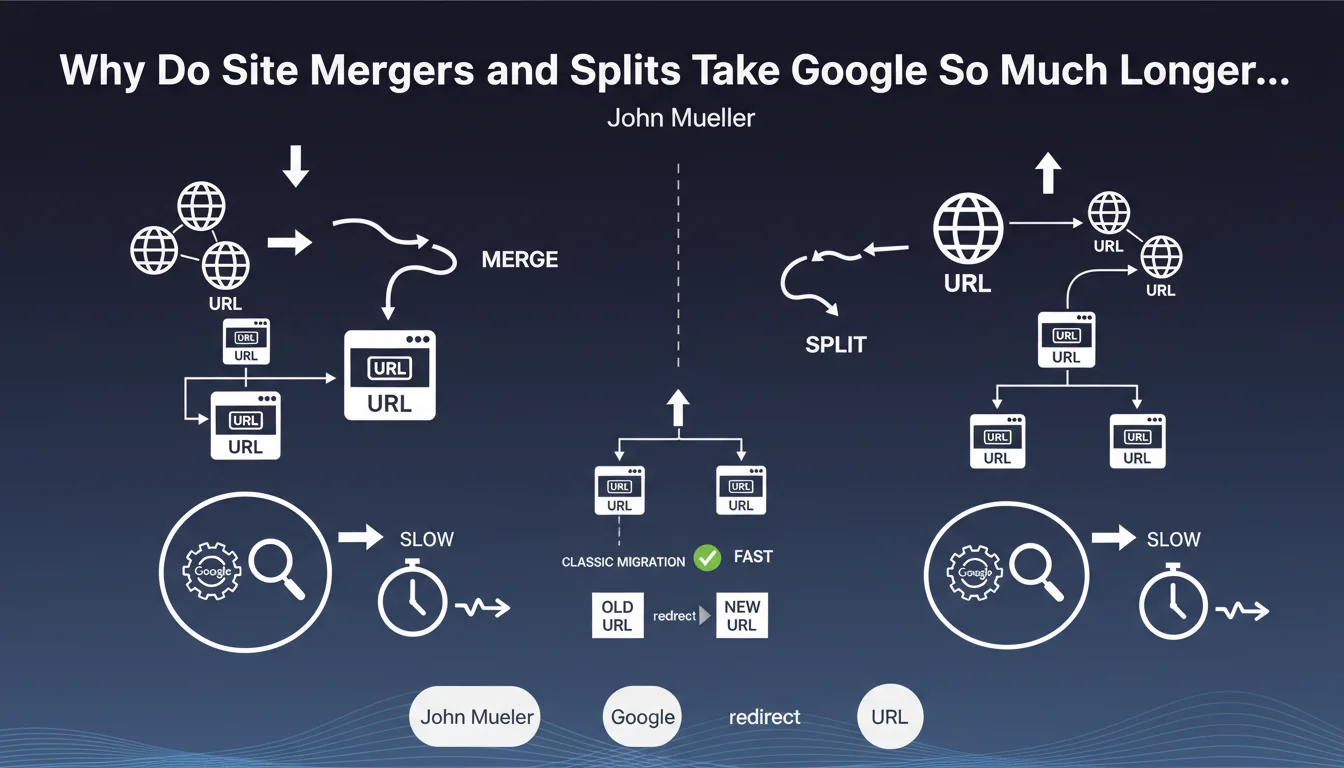
What's the difference between a classic migration and a site split/merger?
A classic migration involves moving a site from domain A to domain B while maintaining the same structure. Each URL from the old site points to an equivalent URL on the new site via one-to-one 301 redirects.
Conversely, a site split involves dividing one domain into several new thematic domains, while a merger combines multiple sites into one. These operations profoundly modify the information architecture that Google has analyzed.
Why does Google take longer to process these operations?
During a split or merger, Google must recalculate the authority of each new domain or the new consolidated structure. The search engine doesn't just follow simple redirects: it must reassess thematic relevance, semantic coherence, and PageRank distribution.
The analysis work is multiplied because Google must understand how quality signals (backlinks, user behavior, expertise) are now distributed. On large-scale sites, this requires massive recrawling and an extended observation period.
How much time should you plan for these operations?
For medium-sized sites, the process can take several months. For platforms with several million pages, John Mueller implicitly mentions timeframes that can reach several quarters, or even a year.
- Classic migration (one-to-one): generally 2 to 8 weeks
- Site split: 3 to 12 months depending on size and complexity
- Site merger: 4 to 18 months for complete stabilization
- Patience is crucial: temporary traffic fluctuations are normal
SEO Expert opinion
Does this statement align with real-world observations?
Absolutely. Empirical data consistently confirms that complex structural operations take significantly more time. I have personally supported mergers where the return to normal took 14 months on high-authority sites.
The main reason lies in the fact that Google doesn't rely solely on technical redirects. The search engine observes user behavior, new internal linking patterns, and especially the thematic coherence of the newly created entities.
What nuances should be added to this rule?
Not all splits or mergers are equal. A split of a site into two clearly thematically distinct domains (example: an e-commerce site separating fashion and electronics) will be better understood than an arbitrary division without editorial logic.
Similarly, merging sites that already have similar backlink profiles and a common audience accelerates the process. Conversely, merging sites without thematic coherence can generate algorithmic penalties related to relevance dilution.
In which cases are these operations still recommended?
Despite the timeframes, a split can be strategically relevant to create specialized brands with better conversion, or to meet business imperatives (sale of a business division, distinct internationalization).
Mergers are justified when several underperforming small sites can create a critical mass of authority sufficient to compete with established players. The cost/benefit equation must integrate the transition period.
Practical impact and recommendations
How do you effectively prepare for a site split or merger?
Preparation begins 6 to 12 months before the operation. You need to precisely map which sections migrate to which domains, maintaining maximum thematic coherence for each new site.
Create a comprehensive redirection plan that preserves link equity. For a split, ensure that each new domain receives a critical mass of pages (minimum 500-1000 quality pages) to be considered a viable entity by Google.
- Audit the current structure and identify natural thematic clusters
- Prepare new domains 3-6 months in advance with initial content
- Establish a progressive redirection schedule rather than an abrupt switchover
- Configure Search Console for all new domains before migration
- Document each redirect with the associated business logic
What critical mistakes must you absolutely avoid?
The most common mistake is redirecting too quickly without a transition period. Keep old URLs active with content for at least 2-3 months, even after implementing redirects, to facilitate Google's discovery.
Never neglect semantic coherence. A split that sends related content to different domains destroys the thematic silos that Google has identified and valued. This is equivalent to starting from scratch in terms of thematic authority.
How do you monitor and accelerate the process once launched?
Track metrics daily in Search Console: crawl rate, indexing errors, and performance of key queries. Use coverage reports to identify problematic URLs that aren't properly redirected.
Accelerate the process by submitting detailed XML sitemaps for each new domain, regularly updating content, and obtaining backlinks to new URLs to signal their relevance to Google.
- Create custom dashboards tracking traffic by domain and category
- Check weekly that all redirects are working (301 codes, no chains)
- Analyze server logs to confirm Googlebot is actively crawling new domains
- Communicate the new structure through coherent internal linking
- Plan a targeted link building campaign to strengthen new domains' authority
💬 Comments (0)
Be the first to comment.