
Official statement
Other statements from this video 2 ▾
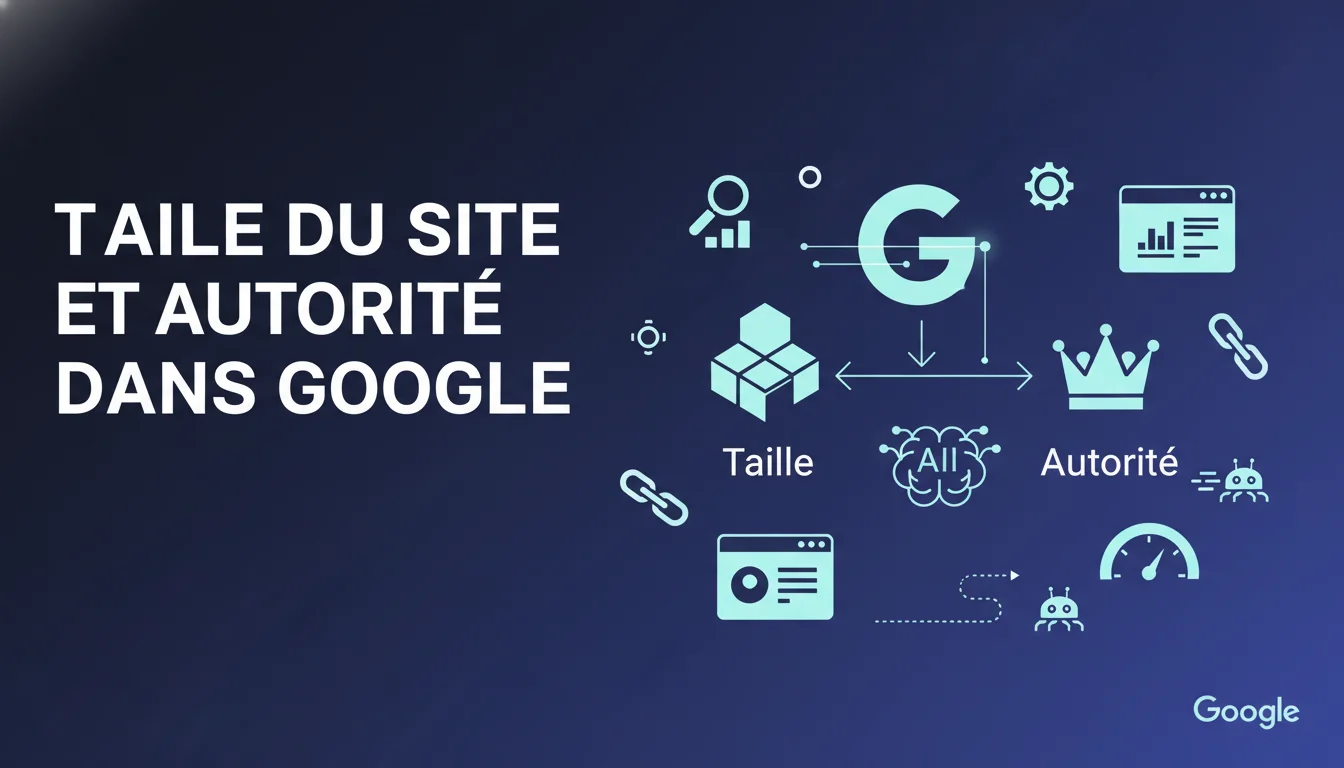
Google states that the number of indexed pages on a site has little impact on its authority in search results. It is the profile of inbound links that primarily determines this authority, not the volume of content. In practical terms, producing mass content without a link-building strategy will not boost your rankings: it is better to have 50 well-optimized pages than 5,000 invisible pages.
What you need to understand
What does Google really mean by this statement?
Google makes a distinction between two concepts that are often confused: index coverage (how many pages are in the index) and domain authority (the weight of the site in the ranking algorithm). The sheer size of a site does not give it any intrinsic competitive advantage.
This position contradicts a widespread belief that large sites mechanically dominate the SERPs due to their volume. In reality, a 100-page site with a strong link profile can outperform a competitor with 10,000 pages but few endorsed by external sources.
Why does Google prioritize inbound links?
The search engine has historically relied on the link-based voting model: each backlink represents an external recommendation validating the relevance of a page. The more these links come from reliable and thematically coherent sources, the more authority they convey.
This principle remains the foundation of the original PageRank, even though the modern algorithm now incorporates hundreds of other signals. Google clarifies that it is the links observed to the pages that matter, not to the domain as a whole — an important nuance for link-building strategy.
What is the difference between site size and editorial quality?
A large site does not imply mediocre content, but Google indicates here that quantity alone is not enough. Many sites artificially inflate their number of pages with poor content (minor variations, poorly controlled facet pages, automated content) in hopes of capturing more traffic.
This strategy fails if these pages do not attract any natural links and do not meet any clear search intent. Google favors sites that build a coherent body of useful pages rather than a sprawling library of redundant content.
- The volume of indexed pages is not a direct authority signal for Google
- Quality backlinks remain the main lever for establishing a site's authority
- Massive content production without an external promotion strategy dilutes resources without real gain
- Each page must justify its existence through its added value and ability to attract natural links
- Authority is built page by page, not only at the root domain level
SEO Expert opinion
Does this statement align with practical observations?
Yes and no. Empirical data confirms that inbound links carry significant weight in ranking, and no serious practitioner disputes this. However, the wording "little effect" regarding site size deserves qualification: large sites often enjoy indirect advantages linked to their volume.
A site with several thousand well-structured pages naturally captures more long-tail traffic, generates more cumulative user signals, and statistically attracts more spontaneous natural links across all its content. Google may be simplifying reality to discourage the industrial production of low-quality pages.
What gray areas remain in this assertion?
Google does not specify how its algorithm handles the thematic coherence of a large corpus. Does an expert site that thoroughly covers a topic with 500 interconnected pages not receive any topical relevance bonus compared to a competitor with only 20 pages? [To verify]
Additionally, the wording “little” remains vague: 2% impact? 5%? 10%? This imprecision hinders truly informed decision-making. In practice, it is observed that established authority sites (news, Wikipedia, marketplaces) index millions of pages and dominate many queries — indeed due to their links, but their massive size also facilitates their omnipresence.
In what cases does this rule not apply completely?
E-commerce sites and marketplaces represent a special case. A catalog of 10,000 unique product listings naturally generates more long-tail traffic than a competitor offering only 100, even with a comparable link profile. Google cannot ignore the relevance of a product page that exactly matches a specific transactional query.
Furthermore, certain sectors require encyclopedic coverage to establish credibility: a medical site offering 5,000 sourced articles benefits from an E-E-A-T advantage over a competitor publishing only 50, regardless of backlinks. Volume thus becomes an indirect marker of depth of expertise.
Practical impact and recommendations
What content production strategy should be adopted?
Prioritize editorial quality and thematic depth over raw volume. Before creating a new page, ask yourself three questions: does it answer a real search intent? Does it provide distinct value from what exists? Does it have reasonable potential to attract natural links or shares?
If you manage an e-commerce site with 50,000 references, do not try to index every minor variant in color or size. Instead, focus on rich pillar pages that aggregate variations and offer differentiated editorial content. Then concentrate your promotional efforts on these strategic pages.
How can you optimize your inbound link profile?
Since Google positions backlinks as the main lever of authority, audit your existing profile: which pages receive links? Which sources mention you? Identify naturally linkable content (case studies, exclusive data, comprehensive guides) and produce more of it.
Avoid dispersion: getting 10 quality links to a key page is better than 100 mediocre links scattered across the entire site. Invest in targeted media relations, relevant editorial partnerships, and content worthy of being cited as references in your field.
Should you reduce the size of your existing site?
Not necessarily, but a content audit is necessary. Identify orphan pages with no traffic, no backlinks, and no clear user value. Three options: consolidation (merging several weak pages into one strong resource), enhancement (enriching content to make it worthy of indexing), or outright removal.
A compact and coherent site also facilitates crawl budget: Google spends more time on important pages if you do not clutter the index with noise. This streamlining indirectly improves the visibility of your strategic content, even if Google claims that raw size does not matter.
- Audit the existing link profile and identify pages that naturally receive links
- Prioritize creating content with high potential for citation and sharing
- Remove or consolidate pages without traffic or backlinks after 12 months
- Structure internal linking to pass authority from linked pages to strategic content
- Measure editorial ROI: time invested vs traffic generated vs links obtained
- Invest in a media relations strategy and thematic partnerships
❓ Frequently Asked Questions
Un site de 10 000 pages peut-il quand même surclasser un concurrent de 100 pages ?
Faut-il privilégier les liens vers la homepage ou vers les pages internes ?
Comment mesurer concrètement l'autorité de mon site ?
Les pages sans backlinks ont-elles une chance de ranker ?
Cette déclaration remet-elle en cause les stratégies de cocon sémantique ?
🎥 From the same video 2
Other SEO insights extracted from this same Google Search Central video · duration 1 min · published on 21/10/2009
🎥 Watch the full video on YouTube →
💬 Comments (0)
Be the first to comment.