
Official statement
What you need to understand
What is the site: operator and what is it used for?
The site: operator allows you to query Google about indexed pages of a specific domain. By typing "site:yourdomain.com" in the search bar, you get the list of URLs that Google has indexed for that site.
This tool is valuable for SEO audits: it allows you to quickly check indexation, detect unwanted pages in the index, or identify structural issues. Professionals use it daily as a first health diagnosis of a site.
What does Google officially say about ranking site: results?
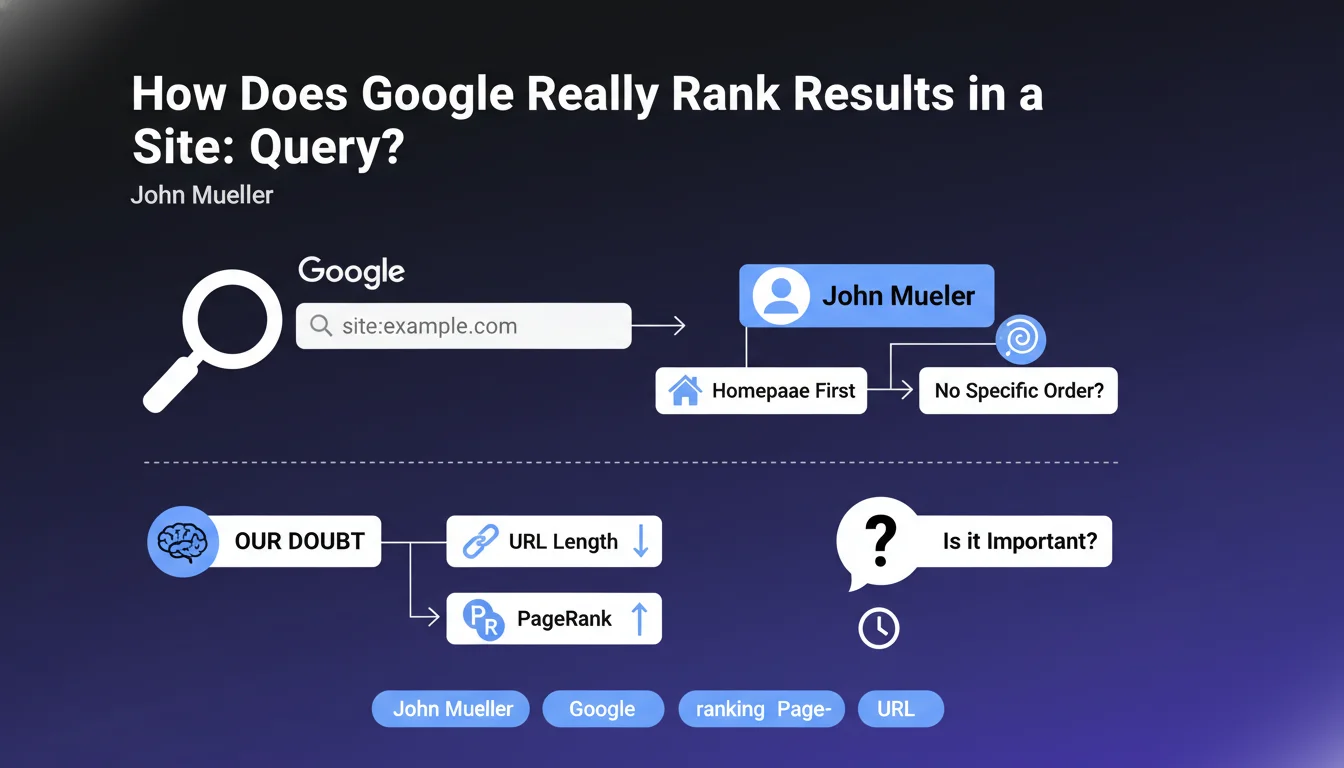
According to John Mueller, the homepage systematically appears first in the results of a site: query. For the rest of the pages, Google claims that there is no specific ranking or order.
This statement suggests that the display order would be relatively random beyond the homepage. Google thus downplays the importance of this order in interpreting a site's SEO health.
Why does this statement raise doubts among experts?
Field observations contradict this claim. SEO practitioners notice recurring patterns in the display order of site: results.
Two factors seem particularly influential: URL length (shorter URLs often appear higher) and the internal PageRank of pages. These repeated observations suggest that an underlying algorithm does indeed organize these results.
- The site: operator displays indexed pages of a domain
- Google claims a non-significant order after the homepage
- Observations show patterns related to URL structure and PageRank
- The question of the actual importance of this order remains debated
SEO Expert opinion
Is this statement consistent with practices observed in the field?
No, empirical observations reveal a clear logic in the order of site: results. Pages with short URLs and low click depth systematically appear higher.
Similarly, pages benefiting from strong internal linking (receiving numerous internal links) rise in the results. These patterns are too consistent to be the result of chance. Google probably uses a simplified version of its ranking algorithm for these queries.
Why does Google minimize the importance of this order?
Google likely seeks to prevent SEOs from over-interpreting site: results. Indeed, the display order in a site: query does not directly reflect the ranking potential of pages on competitive queries.
It's a way of saying: "Don't use site: as an absolute performance barometer". Nevertheless, this order remains a relevant indicator of the structure perceived by Google and the distribution of internal PageRank.
In which cases does this information become truly useful?
Analysis of site: results is particularly relevant during a structure audit. If strategic pages only appear deep down, this reveals an internal linking or architecture problem.
It's also an excellent diagnostic for detecting orphan content or poorly connected pages. If your important pages are buried among hundreds of technical or low-value URLs, your site probably suffers from a crawl budget prioritization problem.
Practical impact and recommendations
What should you concretely do with this information?
Start by analyzing the appearance order of your strategic pages in a site: query. If your main landing pages or high-value-added content appear late, it's a warning signal.
Then work on your internal linking to strengthen these pages. Create links from your main navigation, your footer, and your high-authority content. Also reduce click depth: an important page should never be more than 3 clicks from the homepage.
Optimize your URL structure by favoring short and descriptive paths. Avoid overly deep hierarchies that dilute PageRank and complicate crawling. A clear and short URL also facilitates Google's work.
What mistakes should you absolutely avoid?
Don't focus solely on absolute position in site: results. It's only one indicator among others, not a success metric in itself.
Also avoid creating artificial linking solely to rise in site: results. Your internal link strategy should serve user experience and semantic logic above all.
Don't neglect the qualitative aspect: having 10,000 indexed pages that appear "poorly ranked" in site: is often less problematic than 100 well-placed but low-quality pages. Relevance always takes precedence over quantity.
How can you check and improve your current situation?
Conduct a comprehensive audit by cross-referencing site: query data with your crawl tool (Screaming Frog, Sitebulb, etc.). Identify strategic pages that don't appear in the first results.
Then analyze the internal link profile of these pages: how many links do they receive? From which pages? What is their click depth? This analysis will reveal priority optimization opportunities.
- Perform a site: query and note the position of your key pages
- Verify that all your strategic pages are properly indexed
- Analyze the click depth of your important content
- Strengthen internal linking to high-value pages
- Simplify overly complex URL architecture
- Cross-reference this data with a complete crawl audit
- Regularly monitor the evolution of these indicators
💬 Comments (0)
Be the first to comment.