
Official statement
What you need to understand
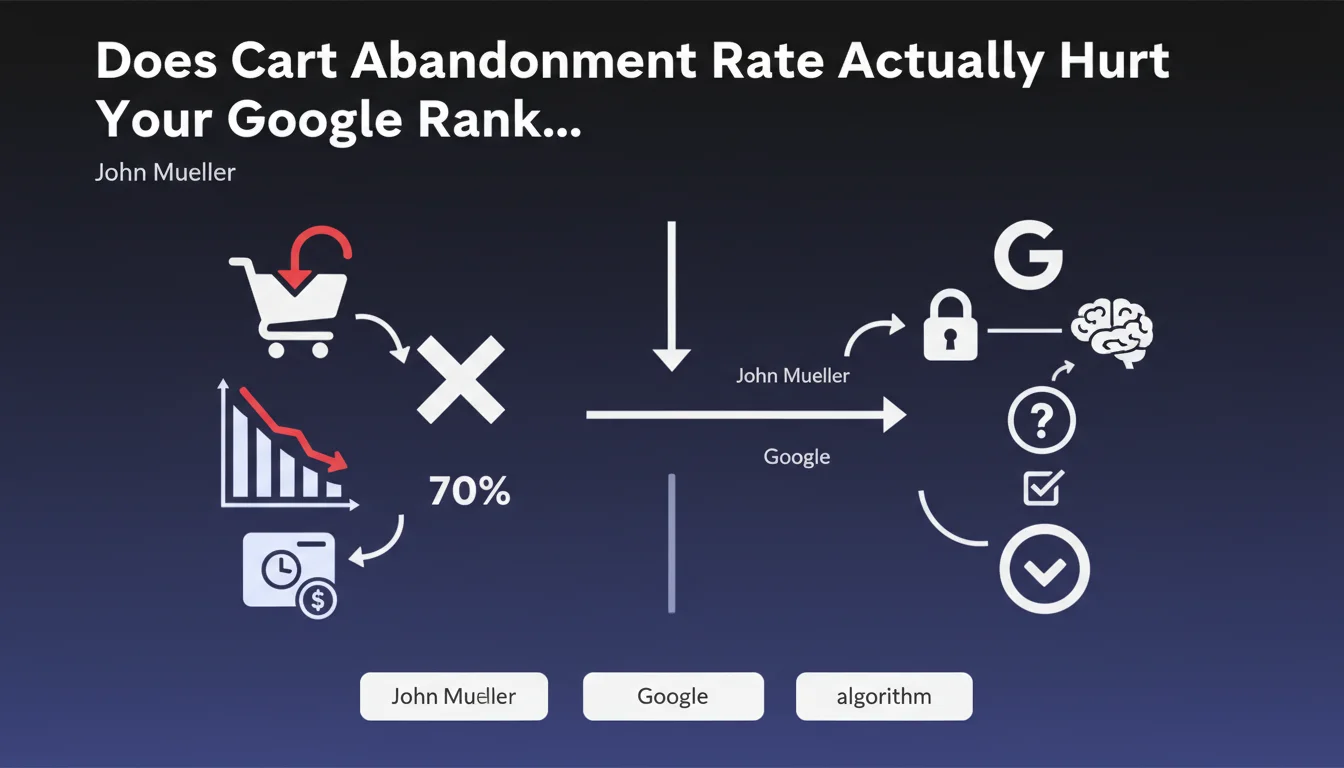
Google has officially confirmed that cart abandonment rate on an e-commerce site is not used as a ranking criterion in its algorithm. This clarification aims to reassure online store owners who might fear that a high abandonment rate could harm their visibility.
This statement nevertheless raises legitimate questions about Google's technical capability to measure this type of data. Without access to Google Analytics installed on all sites, and given the diversity of e-commerce solutions, this metric would be difficult to collect reliably and in a standardized manner.
From an SEO perspective, this means that your optimization efforts should not be oriented toward reducing abandonment rate with the specific goal of improving your rankings. This metric remains nonetheless crucial for your conversion rate and profitability.
- Cart abandonment rate does not directly affect your positions in Google
- Google probably does not have the technical means to measure this indicator across all sites
- Optimizing your conversion funnel remains essential for your business, but not for your SEO
- Focus your SEO efforts on the known actual ranking criteria
SEO Expert opinion
This statement is consistent with Google's technical logic. Without direct access to the backend data of e-commerce sites, the search engine effectively cannot reliably measure cart abandonments, especially on sites not using its analytics tools.
However, there is a possible indirect correlation: a site with a high abandonment rate may suffer from usability issues, loading time problems, or user experience deficiencies that are measurable signals for Google (Core Web Vitals, bounce rate via Chrome, session duration). So it's not the abandonment itself that would penalize, but its underlying causes.
In observed practice, well-positioned e-commerce sites are not distinguished by their abandonment rate, but by the quality of their product content, their technical architecture, and their internal linking strategy.
Practical impact and recommendations
- Don't sacrifice your UX for SEO: optimize your checkout funnel for your users, not for Google
- Focus your SEO efforts on confirmed criteria: quality content, technical structure, Core Web Vitals, relevant backlinks
- Invest in optimizing your product pages (unique descriptions, quality images, customer reviews) rather than forcibly reducing abandonment rate
- Monitor user engagement metrics (time on site, pages per session) that can indirectly signal quality to Google
- Ensure your site is technically performant: a slow site causes both abandonments AND an SEO penalty
- Use your analytics to improve your conversion, not your rankings
In summary: Cart abandonment rate is not a direct SEO criterion, but its underlying causes (slowness, poor UX, technical issues) are. Address these two dimensions separately in your strategy.
The simultaneous optimization of organic search rankings and shopping experience requires cross-functional expertise combining technical, editorial, and analytical skills. Given the complexity of these challenges and their direct impact on your revenue, support from an SEO agency specialized in e-commerce can prove decisive in identifying the right levers and effectively prioritizing your investments.
💬 Comments (0)
Be the first to comment.