
Official statement
What you need to understand
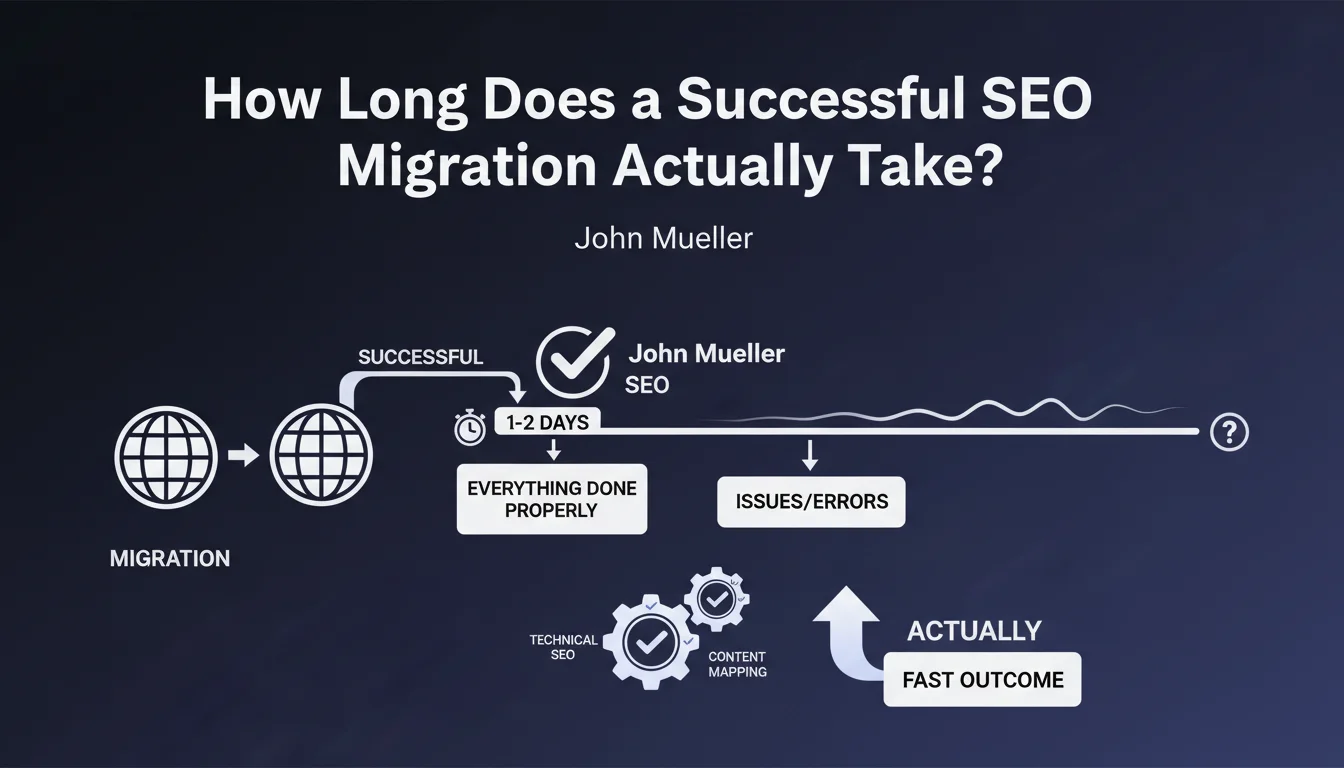
John Mueller claims that an SEO migration can be very fast, in the order of just a few days, provided that everything is perfectly executed. This statement raises the question of what "doing things right" actually means in concrete terms.
In reality, the duration of an SEO migration heavily depends on several factors: the type of migration (domain change, protocol change, CMS change), the number of pages involved, and the quality of the redirection plan. Google must recrawl the entire site to account for the changes.
For a site with a few dozen pages with simple redirects, the migration can indeed be ultra-fast. But for sites with hundreds of thousands of URLs, even with perfect execution, the process will necessarily be much longer.
- Type of migration: simple domain change vs complete architecture overhaul
- Site size: a few pages vs several hundred thousand URLs
- Crawl budget: Google must recrawl all pages to validate redirects
- Technical quality: 301 redirect plan, 404 error management, XML sitemap
- Site history: a trusted site will be recrawled more quickly
SEO Expert opinion
This statement from John Mueller is technically accurate but requires significant nuances. In my 15 years of experience, I've observed that "express" migrations in just a few days almost exclusively concern small sites with already established authority.
For the majority of e-commerce or media sites with several thousand pages, a well-executed SEO migration generally takes between 3 and 6 months for complete stabilization. The initial recrawl can certainly be quick, but the complete redistribution of PageRank, the reindexing of all URL variants, and the recovery of lost positions take time.
The factors that actually lengthen a migration include: limited crawl budget, errors in URL mapping, simultaneous content structure changes, or a site with little authority. Patience remains a cardinal virtue in SEO migration.
Practical impact and recommendations
- Before migration: Exhaustively audit your current site (complete crawl, inventory of strategic URLs, internal linking mapping)
- Redirect plan: Create URL-by-URL mapping for all important pages, never settle for generic redirects
- Test in preproduction: Validate all 301 redirects, verify there are no redirect chains or loops
- XML sitemap: Prepare sitemaps containing only the new URLs (not the old ones) to accelerate discovery
- Search Console: Set up the new property before migration and use the change of address tool if relevant
- Intensive monitoring: Monitor server logs, 404 error rates, and rankings for your strategic keywords daily
- Crawl budget: Optimize your robots.txt and remove unnecessary pages to focus crawling on essentials
- Anticipate a temporary drop: Inform your sales and marketing teams that a traffic loss of 2 to 8 weeks is normal
- Don't change anything else: Absolutely avoid modifying content, page structure, or other elements during migration
- Human resources: Ensure you have a technical team available 24/7 during the first few weeks post-migration
SEO migration remains one of the riskiest operations for a site's visibility. An error in redirect mapping or poor anticipation of crawl budget can waste years of SEO work.
Given the technical complexity and considerable business stakes, it's often wise to surround yourself with specialized experts who have already managed dozens of similar migrations. An experienced SEO agency can not only anticipate pitfalls specific to your configuration, but also ensure rigorous monitoring throughout the critical transition period.
💬 Comments (0)
Be the first to comment.