
Official statement
What you need to understand
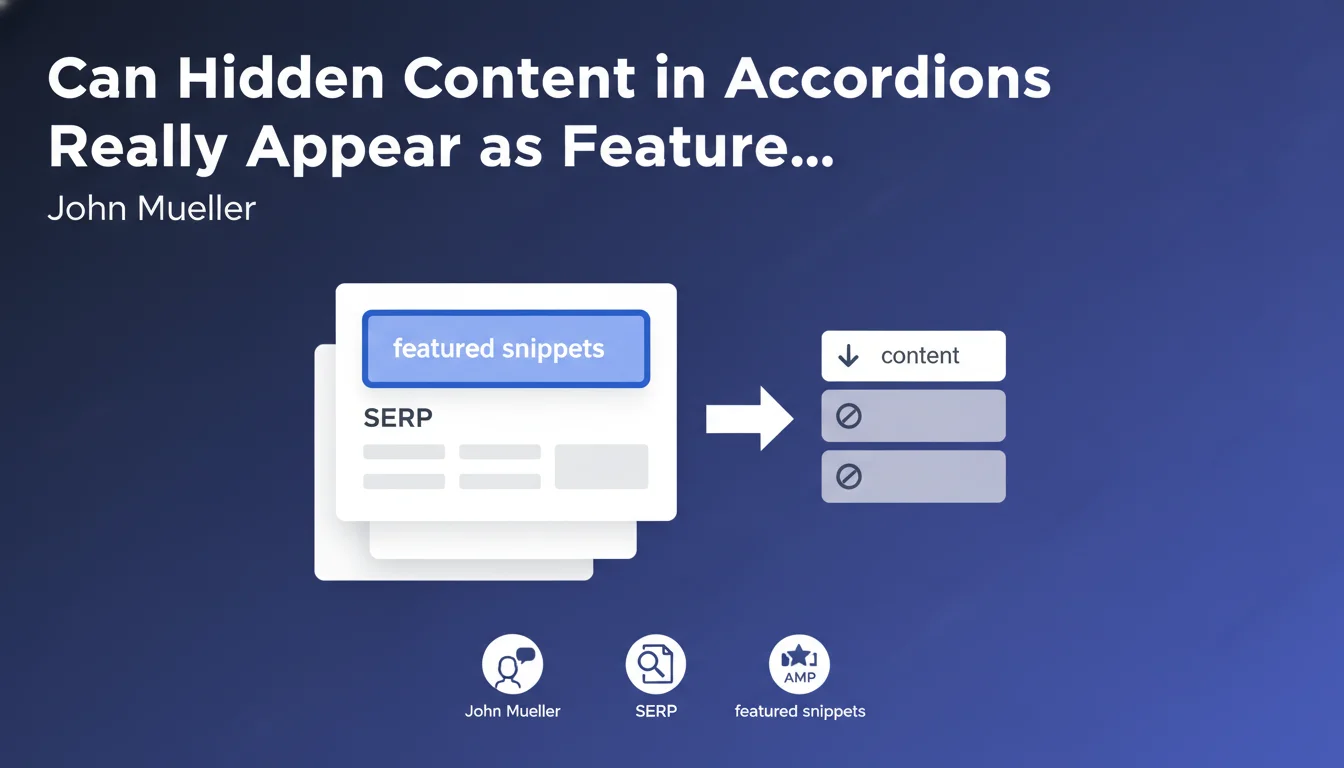
Google has confirmed a practice that surprises many SEO practitioners: content hidden by default in accordions or tabs can indeed be selected to appear as a Featured Snippet. This revelation contrasts with the usual treatment of semi-hidden content in search results.
Concretely, this means that Google assigns different value to hidden content depending on the display context. For Featured Snippets, the algorithm appears to analyze all page content, whether immediately visible or not. On the other hand, for the classic meta description displayed in SERPs, hidden content is generally ignored.
This distinction is fundamental to understanding how Google prioritizes information:
- Content in accordions or tabs remains indexable and can be used for Featured Snippets
- This same content will probably not appear in the standard page description
- Google considers the content accessible to users (one click is enough) and therefore legitimate for snippets
- This practice does not constitute cloaking or an attempt at manipulation
Several webmasters have confirmed through observation that content structured in accordions actually appeared in position zero, thus validating this official statement.
SEO Expert opinion
This clarification is perfectly consistent with the evolution of Google's approach to semi-hidden content. For several years, the search engine has progressively abandoned systematic penalization of accordions and tabs, recognizing their usefulness for user experience, particularly on mobile.
However, an important nuance must be added: just because Google can use this content doesn't mean it will do so systematically. The algorithm always favors clarity and immediate accessibility. Directly visible content will statistically have more chances of being selected than content requiring interaction. The probability of being captured as a Featured Snippet therefore remains higher for text displayed by default.
In my practice, I have observed that Featured Snippets from accordion content mainly concern FAQs and content structured with schema.org. Google seems particularly receptive when semantic markup clearly indicates the question-answer structure, even if it is collapsed by default.
Practical impact and recommendations
Concrete recommendations following this clarification:
- Continue to prioritize content visible by default for your most important strategic information
- Use accordions and tabs primarily to improve mobile UX, not as a primary SEO strategy
- Implement schema.org FAQPage markup if you use accordions for Q&A content
- Structure your answers in accordions concisely (40-60 words) to maximize capture chances
- Don't duplicate content: avoid having the same information both visible AND in an accordion
- Test the impact of opening certain strategic accordions by default on your conversion rates
- Audit your pages with competing Featured Snippets to identify whether their content is visible or hidden
- Ensure accordion content is accessible to crawlers (no blocking JavaScript)
- Monitor your own Featured Snippets to understand where Google extracts information from
In summary: This confirmation allows using accordions without fear for UX, while knowing they remain eligible for Featured Snippets. However, the optimal strategy remains to make any content with high SEO value visible by default.
Implementing a strategy that balances user experience, technical structure, and Featured Snippet optimization requires careful analysis of each context. These trade-offs between immediate visibility and mobile ergonomics can prove complex depending on your industry and objectives. Support from a specialized SEO agency can help you define the most effective content structure for your specific situation, by testing different approaches and precisely measuring their impact on your KPIs.
💬 Comments (0)
Be the first to comment.