
Official statement
What you need to understand
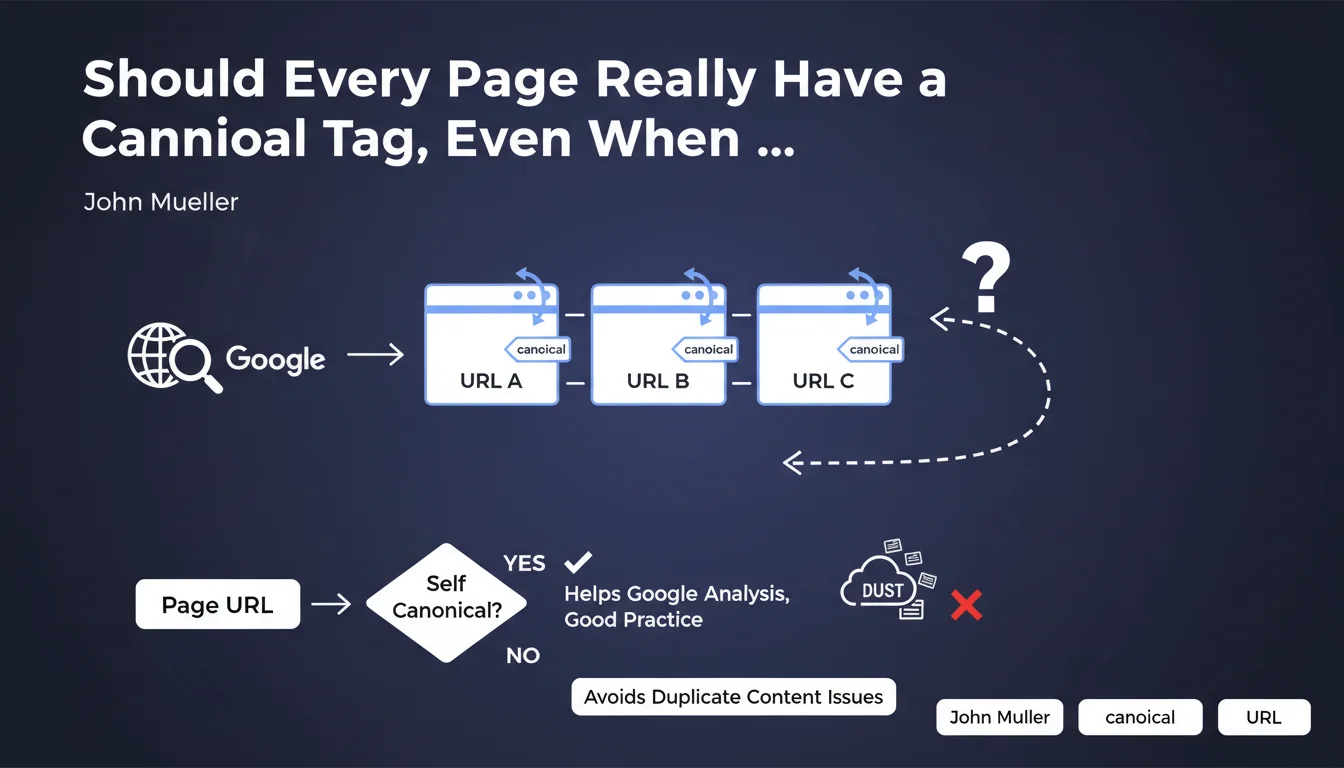
The self canonical technique consists of adding a canonical tag on each page of a site, which points to the page's own URL. This practice may seem redundant at first glance, but it addresses a specific technical need.
Google uses this tag to clearly identify which version of a URL should be considered the reference. Without this explicit indication, the search engine may hesitate between different URL variants (with or without www, with tracking parameters, with trailing slash, etc.).
According to John Mueller, while this practice is not strictly mandatory, it greatly facilitates Google's analysis work. It helps avoid DUST syndrome (Duplicate URL, Same Text) and consolidates SEO signals on the correct URL.
- Self canonical helps Google identify the canonical URL unambiguously for a page
- This practice prevents unintentional duplicate content issues
- It allows consolidation of ranking signals (backlinks, authority) on a single URL version
- Google recommends this approach as a general best practice
- The tag must be present on all indexable pages of the site
SEO Expert opinion
This recommendation from John Mueller is perfectly consistent with field observations. In practice, sites that systematically implement self canonical encounter significantly fewer cannibalization and authority dilution problems.
An important nuance: this practice becomes absolutely critical for e-commerce sites, sites with navigation filters, or any architecture generating URL variations. For a small 10-page showcase website with clean URLs, the impact will be marginal, but implementation remains recommended as a matter of consistency.
Be careful, however, of implementation pitfalls: a poorly configured self canonical (relative vs absolute URL, HTTP vs HTTPS protocol, trailing slash management) can create more problems than it solves. Consistency is absolutely crucial.
Practical impact and recommendations
Self canonical should become a systematic standard in any technical SEO strategy. Its correct implementation avoids numerous duplication problems and facilitates Google's work.
- Audit all your indexable pages to verify the presence of a canonical tag
- Implement a canonical tag on each page, pointing to its own URL in absolute format
- Verify that the protocol (HTTPS), domain (with or without www) and trailing slash are consistent
- Automate the addition of this tag in your templates or CMS for any new page created
- Test URLs with parameters: the canonical should point to the clean version without parameters
- Monitor regularly via Search Console for canonical errors in conflict or not found
- Document your canonicalization rules in a technical guide to maintain consistency
- Avoid absolutely canonical chains (page A → page B → page C) that dilute signals
Properly implementing a canonicalization strategy across an entire site can prove complex, particularly for advanced technical architectures or large-scale sites. The implementation subtleties between different CMS platforms, managing multiple environments, and coordinating with technical teams require in-depth SEO expertise. To ensure flawless implementation and avoid costly mistakes, support from a specialized SEO agency can save you valuable time and secure your technical investment.
💬 Comments (0)
Be the first to comment.