
Official statement
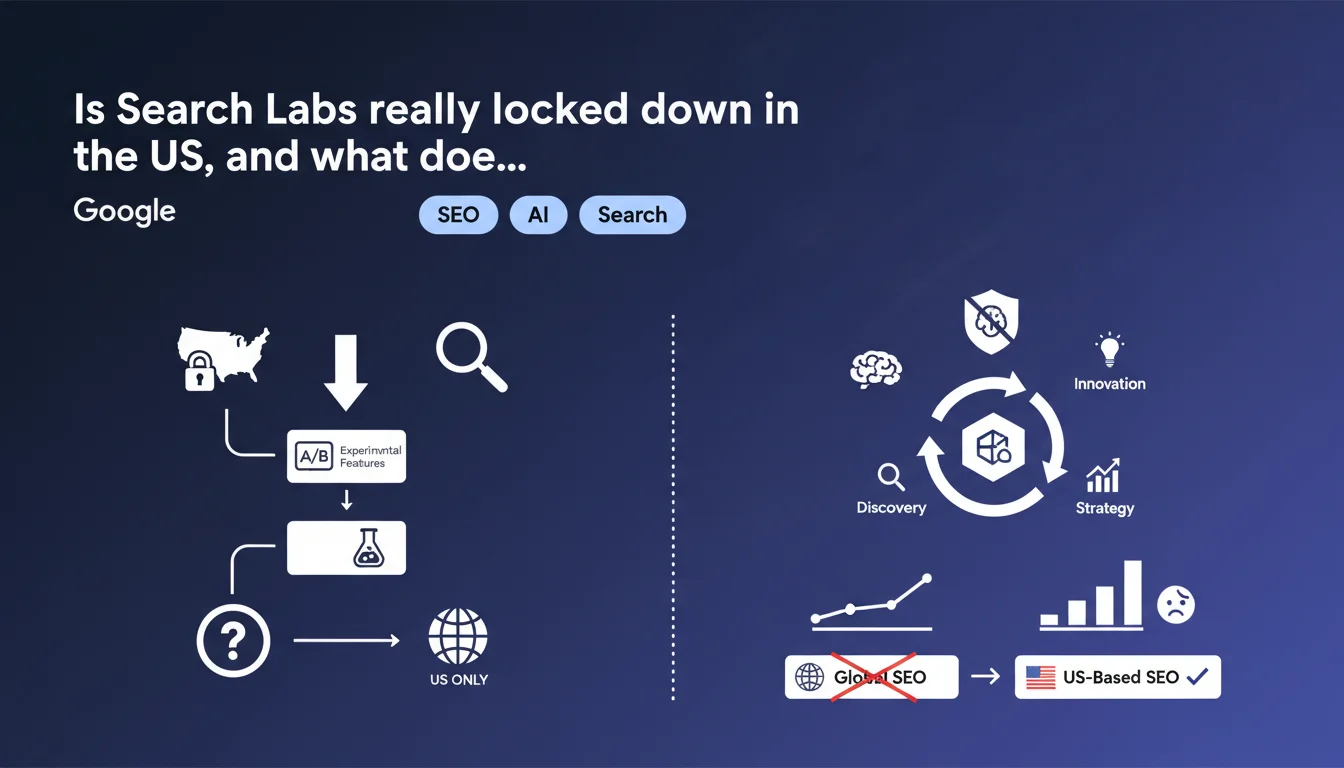
Google is limiting access to Search Labs to US-based users only at launch. This geographic restriction applies to all experimental features in the program, notably generative AI testing in search results. For SEO practitioners outside the United States, there's no direct way to access the new experiences that will potentially shape the future of the SERP.
What you need to understand
What exactly is Search Labs?
Search Labs is Google's experimental program that allows users to test early-access features still in development. We're talking primarily about integrating generative AI into search results (SGE - Search Generative Experience), new search interfaces, and unprecedented user experiences.
This program works through registration and manual activation from Google settings. The stated objective? Collect real-world feedback before a general rollout. Except this experimentation phase remains strictly limited to US territory for now.
Why does this geographic limitation create problems?
The US-only restriction means that SEO professionals based elsewhere can neither directly observe the developments nor anticipate their impact on content strategies. They depend on screenshots, indirect feedback, or analyses published by American colleagues.
This information asymmetry creates a time lag between markets. When a feature exits the Lab to be rolled out broadly, US practitioners have already had months to analyze it, while the rest of the world discovers it in real time.
Which features are covered by this restriction?
All active experiments in Search Labs: the generative AI that produces enriched summaries at the top of the SERP, new conversational interfaces, alternative search modes (enriched visual, personalized advanced filters).
Concretely, if Google is testing a major redesign of search results display or a new way to present AI-powered featured snippets, only US-based users have access. The rest of the world waits — sometimes for several months.
- Search Labs = experimental program reserved for the United States at launch
- Primarily concerns generative AI features (SGE)
- Creates an information gap between US and international practitioners
- Impossible to directly access tests from Europe, Asia, or elsewhere
- Future SERP analyses must rely on indirect feedback during the experimental phase
SEO Expert opinion
Is this geographic limitation really surprising?
No. Google has always deployed new features in a progressive and geographically controlled manner. The United States consistently serves as a privileged testing ground — a matter of jurisdiction, market size, and ease in collecting homogeneous data.
What changes with Search Labs is the strategic stakes. We're not talking about cosmetic window dressing but potentially the biggest SERP evolution in years with the integration of generative AI. And while some observe it firsthand, others are flying blind.
Can you bypass this restriction with a VPN?
Technically? Yes, sometimes. [To be verified] because Google checks signals beyond just IP address: account language, location history, system settings. A simple VPN isn't always enough — you typically need a Google account created from the United States with consistent history.
Even if you manage it, the data collected remains partial and biased. You're observing a user experience disconnected from your actual market, with results tailored to the American audience. The usefulness for optimizing a French or German website? Debatable.
What's the real risk for non-US SEO professionals?
The risk is the surprise factor. When a feature tested for 6 months in the United States suddenly lands in Europe or elsewhere, sites that haven't anticipated it find themselves reacting in crisis mode. Meanwhile, those who've closely followed US developments have already adjusted their strategy.
Another rarely mentioned point: Google never guarantees that a tested feature will be deployed elsewhere. Some experiments remain confined to the US market. So it's difficult to know whether what you observe represents global evolution or local specificity.
Practical impact and recommendations
How do you stay informed despite this access limitation?
First option: follow feedback from American practitioners on Twitter/X, LinkedIn, specialized forums. Look for screenshots, SGE behavior analyses, documented case studies. It's indirect but remains your best source while Search Labs is blocked.
Second avenue: monitor official Google announcements regarding feature rollouts outside the United States. Often, Google communicates a few weeks before a broader deployment. That leaves you a window to prepare your content.
Should you already adapt your content strategy for generative AI?
Honestly? Yes, even without direct access. Generative AI favors structured, factual content with clear sources and established authority. These criteria never hurt traditional SEO — at worst, you improve your current rankings.
Concretely, that means strengthening your structured data schemas, clarifying answers to frequently asked questions, improving your E-E-A-T. Even if SGE never arrives on your market (unlikely), these optimizations remain valuable.
What mistakes should you avoid while waiting for international rollout?
First mistake: completely ignoring the subject on the grounds that it doesn't concern you yet. SEO history shows that latecomers pay dearly when a new feature becomes mainstream.
Second mistake: over-reacting by redesigning your entire strategy based on rumors or partial US observations. Keep a watchful eye, test gradually, but don't blow up what's working for a hypothesis.
- Regularly follow feedback from SEO practitioners based in the United States
- Document Search Labs developments observed through third-party analyses
- Strengthen content structure right now (semantic tags, FAQ, structured data)
- Work on thematic authority and E-E-A-T signals on your strategic pages
- Prepare factual and sourced content, favored by generative AI
- Avoid overturning your entire strategy based on unconfirmed US experiments elsewhere
- Anticipate a potential rollout by monitoring official Google announcements
❓ Frequently Asked Questions
Peut-on accéder à Search Labs depuis la France avec un VPN ?
Quand Search Labs sera-t-il disponible en Europe ?
Les fonctionnalités testées dans Search Labs seront-elles toutes déployées mondialement ?
Faut-il déjà optimiser son contenu pour l'IA générative de Google ?
Cette limitation US affecte-t-elle les sites internationaux ciblant les États-Unis ?
🎥 From the same video 2
Other SEO insights extracted from this same Google Search Central video · published on 13/07/2023
🎥 Watch the full video on YouTube →
💬 Comments (0)
Be the first to comment.