
Official statement
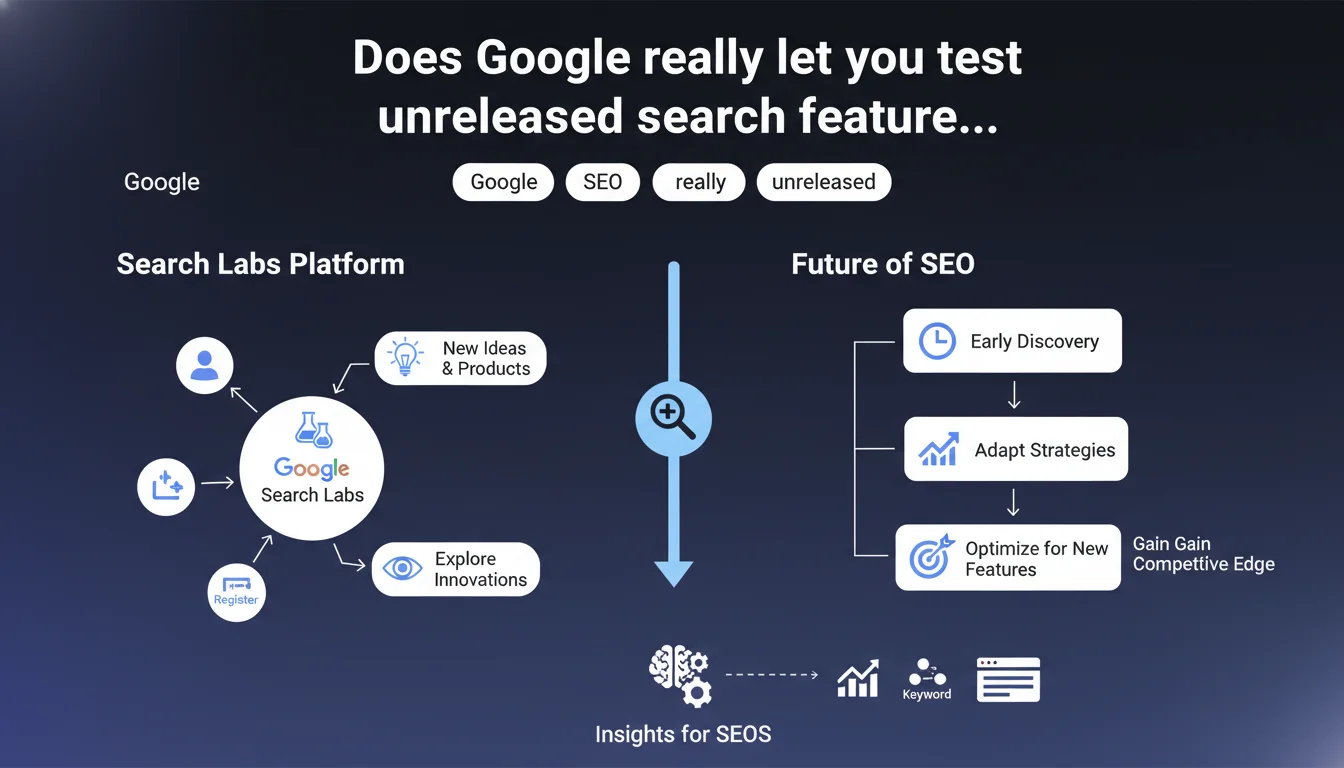
Google has launched Search Labs, a platform allowing users to register and test new search features before their official rollout. This initiative provides early access to ongoing innovations, giving SEO professionals the opportunity to anticipate future search engine evolution and adapt their strategies accordingly.
What you need to understand
What exactly is Search Labs, and why is Google launching this platform?
Search Labs is an experimental platform where Google invites users to test search features still under development. The objective? Gather real-world feedback before a broader rollout.
This approach isn't new in Google's ecosystem — think of the old Google Labs — but it takes on particular strategic importance here. Google wants to validate its innovations with real users before disrupting the search experience for billions of daily queries.
Who can access Search Labs, and what features are being tested?
Access to Search Labs happens through voluntary registration. Google then selects participants, typically in progressive waves. The tested features vary: new interfaces, result formats, generative AI mechanisms, advanced filters.
The specific content of Search Labs constantly evolves. Some experiments are abandoned, others refined before wider rollout. It's a living laboratory, not a fixed catalog.
Why should this announcement matter to an SEO professional?
Let's be honest: anticipating changes is worth its weight in gold for SEO. Search Labs offers a window into Google's search future, allowing you to identify emerging trends before they massively impact SERPs.
Observing these tests helps you understand where Google is investing its efforts — and therefore where you should concentrate your own resources. If an experimental feature favors certain content types or formats, you might as well know about it before your competitors do.
- Search Labs gives early access to Google search innovations
- Registration is voluntary but access isn't immediately guaranteed for everyone
- Tested features change regularly based on Google's priorities
- Observing these experiments allows you to anticipate future SERP evolution
- It's an opportunity to understand Google's strategic direction in search
SEO Expert opinion
Does this initiative reflect an acceleration in Google's innovation pace?
The launch of Search Labs comes amid increased competitive pressure — think ChatGPT advances and other conversational AI. Google is clearly accelerating its innovation cycle, and this platform lets it test rapidly without risking large-scale user experience disruption.
But there's a catch: what you see in Search Labs won't necessarily be rolled out globally. Google tests a lot, deploys less. Don't take every experiment at face value — some are trial balloons designed to measure reactions, not finalized features.
Should you adapt your SEO strategy based on features tested in Search Labs?
The short answer? Observe, analyze, but don't optimize prematurely. It would be reckless to massively restructure a site for a feature that might never make it to production.
That said — and this is where it gets interesting — identifying underlying trends remains relevant. If Search Labs systematically tests rich formats, direct answers, or conversational experiences, that's a clear signal about Google's direction. Adapt to trends, not individual features.
[To verify]: Google doesn't officially communicate its criteria for selecting Search Labs participants or the metrics used to evaluate experiments. Transparency remains limited.
What are the risks for sites that ignore Search Labs?
The main risk? Getting outpaced by competitors who anticipated a major SERP shift. Imagine a new feature massively favors content structured a certain way — those who identified it early gain an advantage.
But let's be realistic: Search Labs is just one signal among many. Real structural Google changes also come through official announcements, algorithm updates, and documented guideline evolution. Don't put all your eggs in this one basket.
Practical impact and recommendations
How do you access Search Labs and what should you do once signed up?
Registration happens directly from Google's search interface — look for the "Search Labs" icon or link, typically visible in settings or at the top of the page. Follow the registration process and wait for activation.
Once active, systematically explore each tested feature. Document your observations: what content types get prominence? Which formats are prioritized? How does the user experience differ from standard SERPs? Keep a dated record — experiments change quickly.
What concrete data should you monitor in Search Labs to anticipate SEO evolution?
Focus on recurring patterns, not cosmetic details. If Google tests multiple direct answer display variants, that format carries weight in their future vision. If rich results consistently take more space, adjust your structured data strategy.
Also compare Search Labs display with standard SERPs for identical queries. The gaps reveal Google's working hypotheses — and thus potential opportunities or threats to your organic visibility.
What mindset should you adopt toward Search Labs experiments?
Stay curious but pragmatic. Don't overhaul your SEO roadmap for every novelty spotted in Labs. However, integrate these observations into your strategic monitoring and gradually adjust priorities if clear trends emerge.
Test your own content in this experimental context: how does it perform against new features? Are there optimization opportunities you hadn't identified in traditional SERPs?
- Sign up for Search Labs as soon as possible to access testing features
- Systematically document experiments: screenshots, dated notes, comparisons with standard SERPs
- Identify recurring trends rather than fixating on isolated features
- Test your own content in the Search Labs environment to spot opportunities and weaknesses
- Integrate these observations into your strategic monitoring without prematurely changing your roadmap
- Pay special attention to generative AI experiments and direct answer format evolution
- Cross-reference this data with other signals: official announcements, algorithm updates, guideline changes
❓ Frequently Asked Questions
Search Labs est-il accessible à tous les utilisateurs de Google ?
Les fonctionnalités testées dans Search Labs seront-elles toutes déployées publiquement ?
Faut-il optimiser immédiatement son site pour les fonctionnalités vues dans Search Labs ?
Peut-on perdre l'accès à Search Labs une fois inscrit ?
Search Labs influence-t-il le référencement actuel de mon site ?
🎥 From the same video 2
Other SEO insights extracted from this same Google Search Central video · published on 13/07/2023
🎥 Watch the full video on YouTube →
💬 Comments (0)
Be the first to comment.