
Official statement
What you need to understand
What is Google's official position on the link between Schema.org and Featured Snippets?
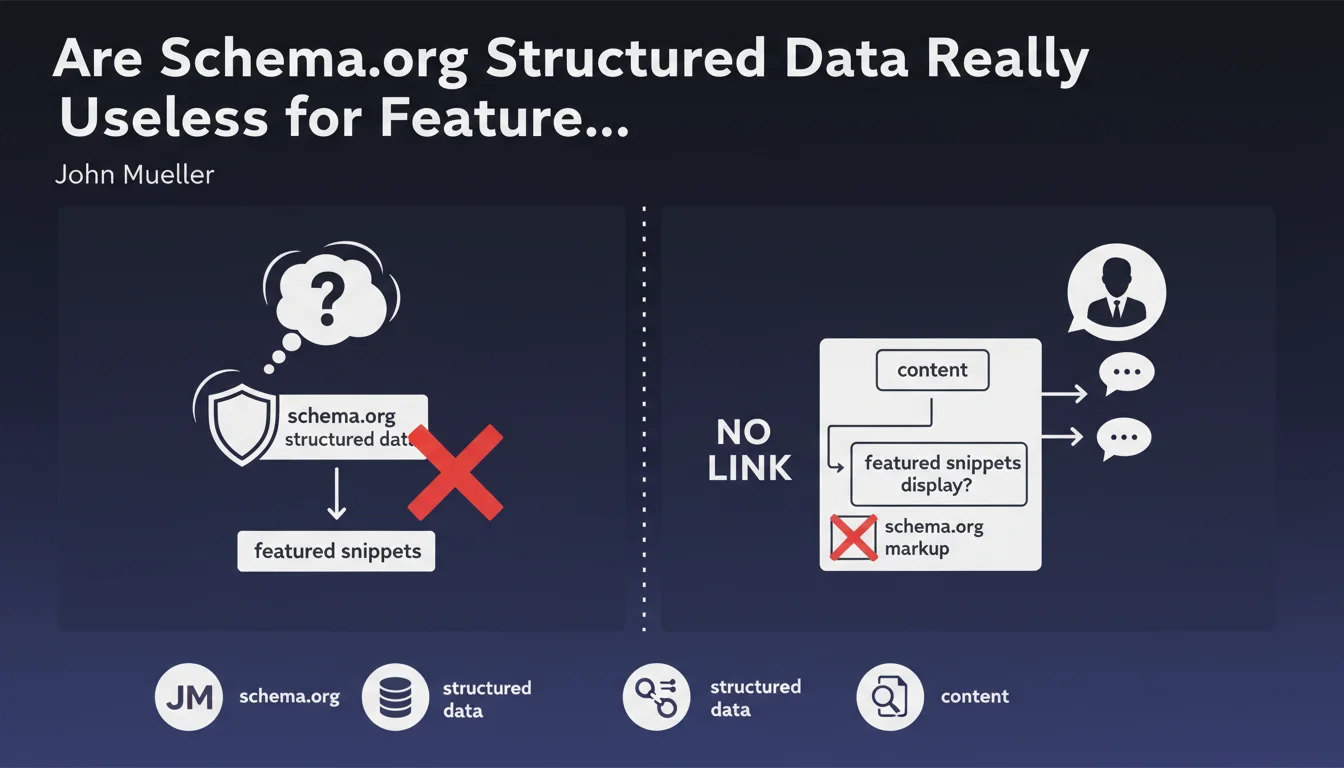
Google has clearly stated that Schema.org markup does not constitute a direct criterion for triggering the display of content in a featured snippet. This coveted position zero therefore does not formally require the presence of structured data.
John Mueller emphasizes that a page without any structured data markup can perfectly appear in a featured snippet. Schema.org markup is not a prerequisite for eligibility.
Why might this clarification be confusing?
This statement seems to contradict the intuition of many SEOs who observe a correlation between well-structured pages and presence in featured snippets. The confusion comes from the difference between correlation and causation.
In reality, structured data helps Google better understand the context and semantics of the content, which can indirectly promote eligibility for rich snippets.
What really determines appearance in Featured Snippets?
Google primarily relies on content relevance, clarity, and editorial structure. Algorithms look for concise, well-formatted answers with lists, tables, or explicit paragraphs.
Editorial quality, appropriate use of semantic HTML tags (h2, h3, ul, ol, table), and the ability to directly answer a question are the true determining factors.
- Schema.org is not a direct criterion for featured snippet display
- A page without structured data can appear in position zero
- Editorial structure and relevance remain the main factors
- Schema.org tags help indirectly by clarifying content
- Correlation does not mean causation in this context
SEO Expert opinion
Is this statement consistent with field observations?
After 15 years of experience, I confirm that this position from Google is technically accurate but strategically reductive. Indeed, I regularly observe pages without Schema.org in featured snippets.
However, in competitive sectors, pages intelligently using structured data seem to have a competitive advantage. Not because Schema.org triggers the snippet, but because it improves the overall understanding of content by algorithms.
What strategic nuances should be applied to this statement?
The fundamental nuance is that Schema.org acts as a clarity amplifier. If your content is already excellent and well-structured, structured data will strengthen its understanding by Google.
On the other hand, adding Schema.org to mediocre content will never compensate for fundamental editorial shortcomings. It's a facilitator, not a substitute for quality.
In which cases does structured data become particularly important?
For certain types of complex or specialized content (recipes, events, products, FAQs, how-tos), appropriate structured data becomes almost essential. Not for classic featured snippets, but for specific rich snippets.
In e-commerce, local, or event sectors, ignoring Schema.org amounts to voluntarily abandoning visibility. The distinction between featured snippet and rich snippet is crucial here.
Practical impact and recommendations
What should you actually do to optimize your chances?
First focus on the quality and editorial structure of your content. Identify the questions your audience asks and answer them in a concise, direct, and well-formatted manner.
Then add relevant structured data (Article, FAQPage, HowTo, etc.) to strengthen Google's understanding of your content. This combined approach maximizes your chances.
- Analyze current featured snippets in your topic area to identify preferred formats
- Write concise answers (40-60 words) to frequently asked questions in your sector
- Use appropriate semantic HTML tags (lists, tables, short paragraphs)
- Structure your pages with H2/H3 headings formulated as questions
- Implement Schema.org Article, FAQPage, or HowTo depending on content type
- Test your structured data with the Google Rich Results Test validator
- Don't create structured data that doesn't reflect visible content
What critical mistakes should you absolutely avoid?
The most common mistake is believing that massively implementing Schema.org will compensate for low-quality or poorly structured content. It's the opposite: structured data amplifies what already exists.
Another pitfall: using inappropriate Schema.org tags or creating deceptive structured data not reflected in visible content. Google penalizes these practices through manual actions.
How can you verify that your strategy is effective?
Use Google Search Console to track your impressions in positions 1-3 and identify featured snippet opportunities. Analyze queries for which you're close to position zero.
Systematically test your structured data and monitor implementation errors that could limit your eligibility for rich results.
In summary: Although Schema.org is not mandatory for featured snippets, neglecting structured data is a strategic mistake. The optimal approach combines editorial excellence, semantic HTML structure, and relevant structured data.
This multi-layered optimization requires in-depth technical and editorial expertise. Implementing a coherent strategy that requires careful analysis of your sector, your content, and its markup, many sites benefit from specialized support to effectively orchestrate these different dimensions and obtain measurable results quickly.
💬 Comments (0)
Be the first to comment.