
Official statement
What you need to understand
The fear of thematic saturation is a recurring concern among SEO practitioners. Many believe that Google might refuse to index or rank a page if its index already contains thousands of pieces of content on the same subject.
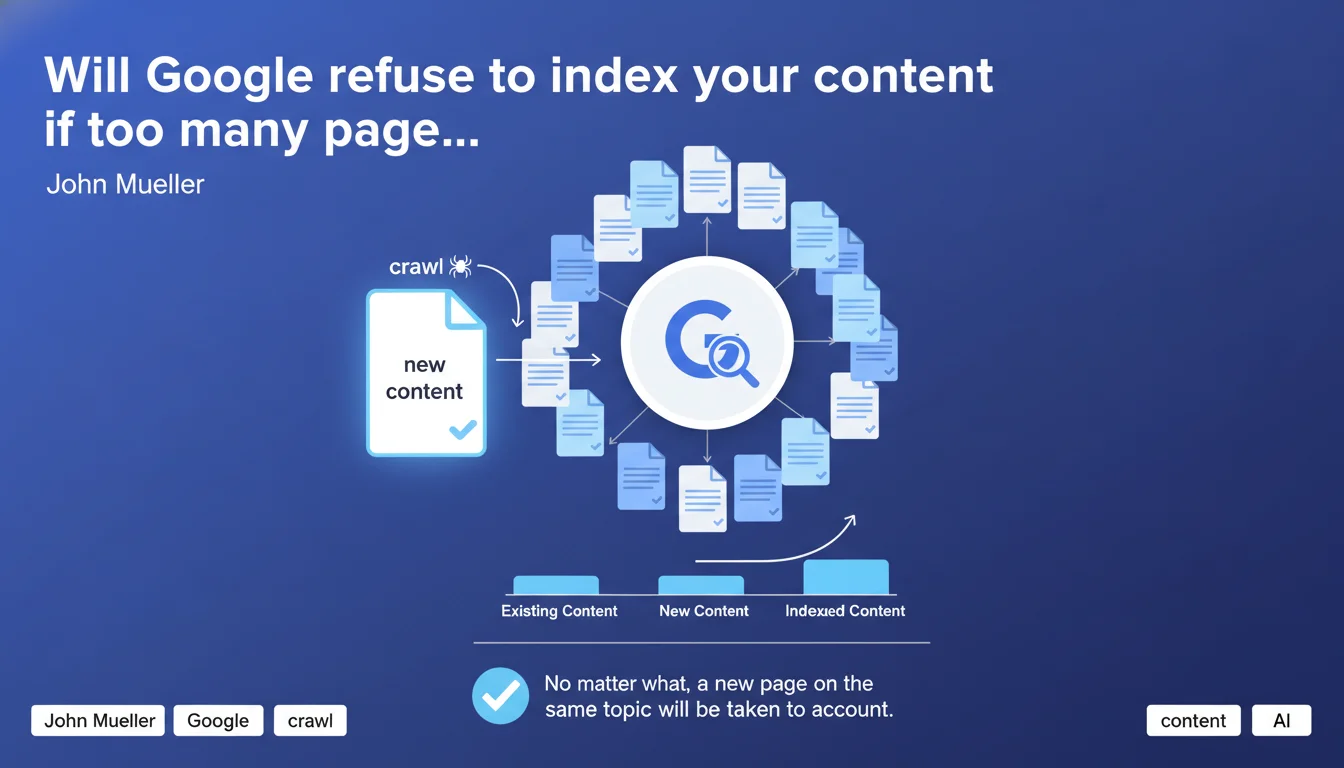
This statement from John Mueller clarifies the situation: Google crawls and indexes new pages regardless of the volume of content already present in its index on that theme. The engine doesn't say "I have enough pages on this topic, I don't want any more".
It's important to distinguish between two concepts: indexing on one hand, and ranking on the other. A page can be indexed without necessarily being well positioned, especially on ultra-competitive topics.
- Indexing is not conditioned by the number of existing pages on a subject
- Each new page is evaluated on its own merits
- The Google News distinction is different: it imposes selection criteria for sources
- Saturation affects positioning, not indexing
SEO Expert opinion
This position is consistent with field observations over the years. We indeed observe that Google indexes thousands of pages on ultra-competitive topics like "car insurance" or "lose weight", even from sites with little authority.
The critical nuance lies in the distinction between indexing and visibility. Being indexed guarantees no traffic. On saturated topics, only pages bringing real added value, from sites with solid thematic authority, will manage to position themselves in the first 3 pages of results.
The Google News case mentioned illustrates well that certain Google ecosystems apply source selection filters. But for classic organic search, no thematic quota exists at the indexing level.
Practical impact and recommendations
- Don't self-censor on competitive topics: your content can be indexed even if the subject is saturated
- Focus on qualitative differentiation rather than fear of saturation
- Conduct a thorough competitive analysis before targeting a topic: evaluate the authority of positioned sites, not just the volume of existing content
- Prioritize unique angles and depth of expertise to stand out on topics covered thousands of times
- Develop your sectoral thematic authority through coherent internal linking and regular production in your niche
- In ultra-saturated markets, consider long-tail strategies and less competitive sub-niches
- Measure success by positioning and traffic, not indexing alone
💬 Comments (0)
Be the first to comment.