
Official statement
Other statements from this video 6 ▾
- 10:49 Does page loading speed really have a measurable impact on your SEO conversions?
- 15:39 Does JavaScript Really Slow Down Your Organic SEO?
- 21:06 Are SPAs really the future of SEO for highly interactive websites?
- 32:16 How do image compression and lazy loading really impact mobile rankings?
- 40:32 Can the Payment Request API really enhance your conversion rates?
- 41:59 Do PWAs really enhance your mobile site's SEO?
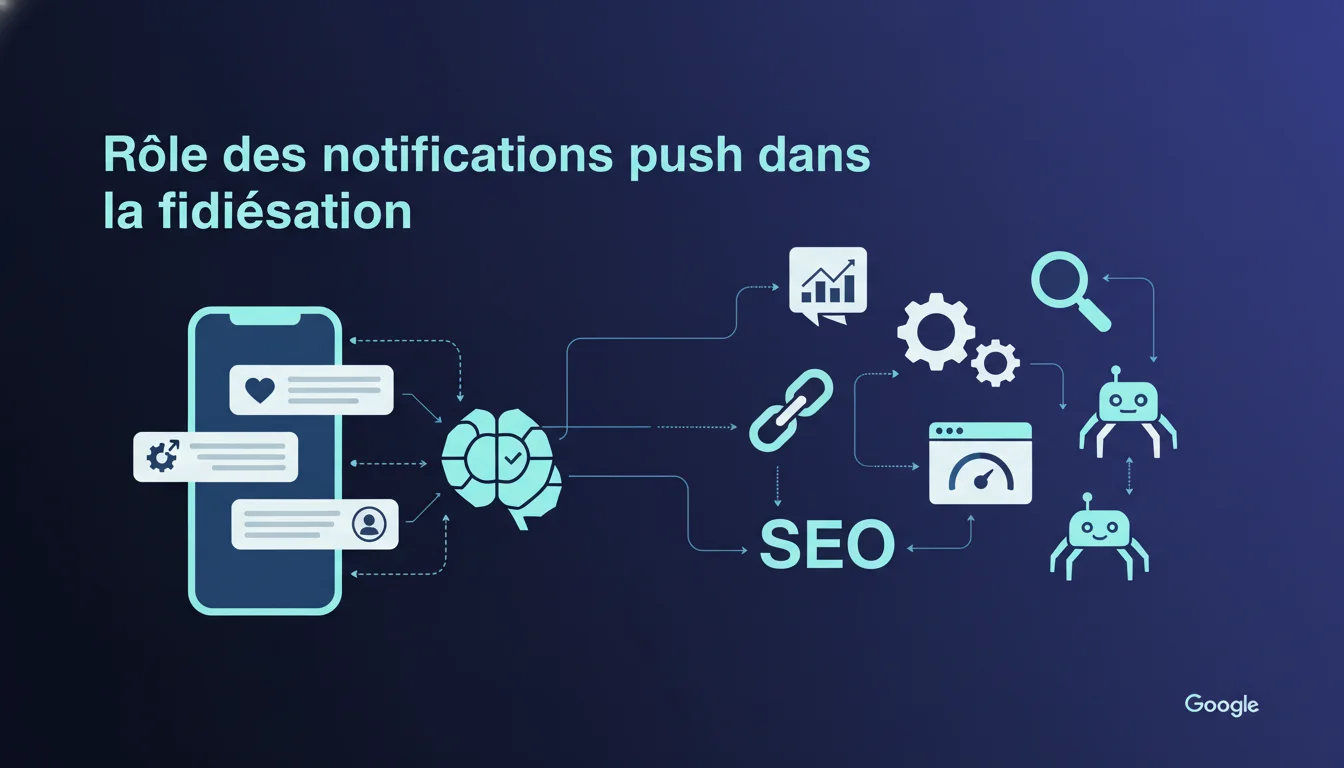
Google states that push notifications enhance retention by re-engaging users with relevant updates. For SEO, this channel can improve engagement signals (CTR, direct returns) and extend the relationship with the audience. The question remains whether these metrics actually impact ranking or if Google is mainly measuring user satisfaction without a direct effect on organic visibility.
What you need to understand
Why does Google discuss push notifications in an SEO context?
Google explicitly connects push notifications to user retention. The idea is to re-engage the audience with contextually relevant information, such as price alerts on monitored flights. This mechanism creates recurring touchpoints between the brand and the user.
For SEO, the connection is not clear at first glance. Push notifications do not alter indexable content or the technical structure of the site. They affect post-visit behavior: a user who returns regularly via direct notifications generates measurable engagement signals (direct traffic, session time, pages per visit). Google observes these metrics to assess the perceived quality of a site.
What is the actual impact on engagement signals?
Push notifications can artificially boost certain KPIs: return rates, visit frequency, session duration. A user notified of a price drop returns immediately, checks several comparison pages, and then converts or leaves. This journey enriches the behavioral metrics that Google collects through Chrome, Analytics, or its own ecosystem.
The problem: Google has never publicly confirmed that these signals directly influence ranking. Field experiments show correlations, but it’s impossible to untangle the pure effect of push notifications from that of a generally better user experience. A site investing in push notifications often invests in content, speed, and mobile as well.
In which sectors does this strategy work?
Push notifications perform especially well in verticals with high transactional recurrence: e-commerce (limited stock, flash sales), travel (price alerts, gate changes), media (breaking news), SaaS (onboarding, feature updates). These sectors capitalize on urgency and personalization.
In complex B2B or pure informational SEO, the utility decreases. A user searching for an answer to "how to optimize my meta tags" has no reason to subscribe to notifications. Forcing opt-in generates authorization churn (quick deactivation) and degrades the experience. Google has penalized intrusive interstitials for several years; aggressive push popups fall into this category.
- Push notifications create regular touchpoints that may improve behavioral metrics (return rates, engagement).
- No official confirmation that these signals directly impact organic ranking, despite observed correlations.
- Maximum effectiveness in transactional sectors (e-commerce, travel, media) where urgency and personalization make sense.
- Risk of UX degradation if opt-in is intrusive or if notifications lack contextual relevance.
- Google values the overall user experience, not an isolated channel; push notifications must fit into a coherent strategy.
SEO Expert opinion
Does this statement mask the absence of a causal link with ranking?
Google uses carefully calibrated language: "enriches their experience", "encourages loyalty". There’s nothing about direct SEO impact. It’s a product recommendation (promoting the adoption of PWAs and web notifications) disguised as user experience advice. [To be verified]: no public data proves that push notifications improve organic positioning.
A/B tests on e-commerce sites show that activating push notifications increases recurring direct traffic by 15-30%, but the effect on Google positions remains marginal or even null after 6 months. The visible gain mainly concerns customer LTV and conversion rate, not SERP visibility. Google deliberately confuses business retention with SEO performance.
What risks does this strategy entail?
Deploying push notifications without a solid content strategy creates a dependency on the proprietary channel. A site that relies entirely on notified re-engagement neglects regular editorial production and sees its organic traffic stagnate. Google always prioritizes fresh and relevant content; push notifications do not compensate for a blog that has been abandoned for 8 months.
Another pitfall: spam. Sending too many notifications daily annoys users, who block permissions or leave the site altogether. The unsubscribed rate (opt-out) skyrockets if the frequency exceeds 2-3 weekly notifications outside of urgent news. Google Analytics measures these drop-offs; massive churn signals a degraded experience.
In what cases is this approach counterproductive?
Purely informational editorial sites (technical wikis, niche blogs) have no interest in forcing notifications. The user is searching for a specific answer, not a continuous relationship. Imposing a push opt-in popup on the first visit increases the bounce rate and triggers Google’s anti-interstitial filters.
Regulated sectors (healthcare, finance) must also be cautious. A poorly calibrated push notification about sensitive data ("Your loan application is approved!") could violate GDPR or create a reputational risk. Google values transparency and informed consent; an intrusive notification harms the E-E-A-T of the domain.
Practical impact and recommendations
How can you deploy push notifications without harming SEO?
Integrate the opt-in prompt after a significant user interaction: adding to cart, creating an account, reading 3+ articles. Never as an invasive welcome popup. Google penalizes interstitials that obscure the main content on mobile since the January 2017 update. A contextual opt-in ("Receive price drop alerts for this flight?") converts better and respects UX.
Segment your notifications by user intent. A visitor checking shopping guides receives promo alerts; a technical blog reader gets weekly summaries. Personalization reduces churn and improves measured engagement. Use tools like OneSignal or Firebase Cloud Messaging to track open and conversion rates by segment.
What mistakes destroy the SEO value of this tactic?
Sending generic notifications ("New content available!") without specifics kills CTR. Users ignore and then block. Google Chrome measures interaction rates with notifications; a clicks/sent ratio below 1% signals potential spam. The result: your future notifications end up in silent mode or blocked by the browser.
Another classic mistake: neglecting A/B testing on timing and frequency. A notification sent at 3 AM is annoying. A daily alert about a product out of stock for a week is frustrating. Synchronize your push notifications with real events (actual price drop, new publication, stock restored) rather than an arbitrary calendar. Google values contextual relevance in all its products.
What should you check to ensure consistency with your SEO strategy?
Make sure each notification points to a SEO-optimized landing page: complete meta tags, structured content, load time under 2.5 seconds. A user who clicks and bounces immediately (slow page, poor content) sends a negative signal. Core Web Vitals apply to both push and organic traffic.
Measure the semantic consistency between the push message and the landing content. A notification "Flight Paris-Tokyo at 450 €" redirecting to a generic "All our offers" page creates frustration. Google detects these unfulfilled promises through post-click behavior (time on page, scroll depth, conversion). The algorithm learns to ignore sites that over-promise in their notifications.
- Trigger push opt-in after a significant user interaction, never in an invasive welcome popup
- Segment notifications by intent and browsing history to maximize relevance
- A/B test timing, frequency, and wording to maintain an open rate above 5%
- Point each notification to an optimized landing page (CWV, structured content, meta tags)
- Measure post-push conversion rates and session time to validate real business impact
- Monitor monthly unsubscribe rates; above 10%, revise your content strategy
❓ Frequently Asked Questions
Les notifications push améliorent-elles directement le classement Google ?
Quel taux d'opt-in viser pour une stratégie push efficace ?
Les popups de notification push déclenchent-elles des pénalités mobiles ?
Quelle fréquence d'envoi maximale pour éviter le désabonnement massif ?
Les notifications push fonctionnent-elles pour le SEO local ?
🎥 From the same video 6
Other SEO insights extracted from this same Google Search Central video · duration 50 min · published on 19/12/2017
🎥 Watch the full video on YouTube →
💬 Comments (0)
Be the first to comment.