
Official statement
Other statements from this video 9 ▾
- 3:43 3 secondes de chargement : pourquoi Google fixe-t-il ce seuil critique pour vos conversions ?
- 10:00 Pourquoi AMP interdit-il le JavaScript personnalisé et comment ça impacte votre SEO ?
- 12:04 L'expérience AMP est-elle vraiment le parcours utilisateur idéal selon Google ?
- 13:24 PWA et AMP : faut-il choisir entre fonctionnalités avancées et vitesse de chargement ?
- 16:11 Comment installer un service worker sur les pages AMP en cache pour améliorer la performance ?
- 34:25 Le préchargement AMP par Google cache-t-il un levier SEO sous-exploité pour vos pages mobiles ?
- 36:45 AMP et PWA : votre stratégie mobile tient-elle la route face aux limitations navigateurs ?
- 53:34 Les caches tiers AMP peuvent-ils améliorer votre référencement sans pénalités ?
- 71:50 Les publicités AMP se chargent-elles vraiment aussi vite que le contenu ?
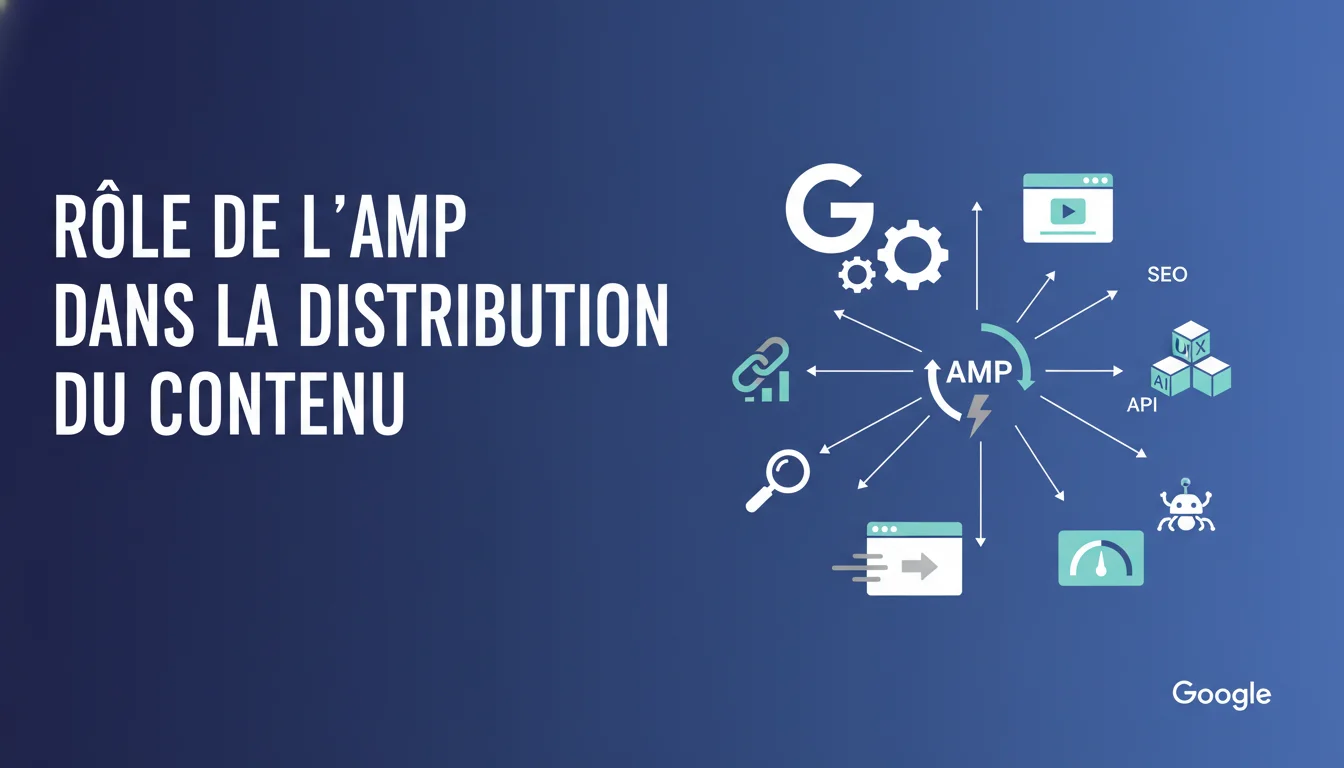
Google claims that AMP pages benefit from accelerated distribution and better visibility through Search, generating more engagement than standard pages. Specifically, this implies an advantage in the Top Stories carousel and potentially in mobile SERPs. It remains to be seen whether this advantage endures against Core Web Vitals and the Page Experience Update that transformed the scene.
What you need to understand
What is the technical promise behind AMP?
AMP (Accelerated Mobile Pages) relies on a lightweight version of HTML with strict JavaScript restrictions and aggressive preloading. Google caches these pages on its CDN servers, allowing for almost instantaneous display from search results. This architecture sacrifices flexibility for raw speed.
Google's statement emphasizes distribution through platforms, particularly Search. Historically, this referred to the mobile Top Stories carousel reserved for AMP pages until mid-2021. Since then, this exclusivity has been lifted in favor of the Page Experience criterion, but Google continues to promote AMP as a means of enhancing visibility.
What does Google mean by 'better visibility and engagement'?
Visibility would stem from preferential treatment in certain SERP features, particularly mobile carousels. Engagement, on the other hand, would mechanically arise from loading times under 1 second — a critical threshold for mobile bounce rates.
The problem: Google provides no comparative figures. It's unclear if 'better engagement' means a 5% or 50% boost in CTR. The assertion remains vague and unverifiable without access to segmented Search Console data on AMP vs. non-AMP across a representative sample.
Does this promise still hold true today?
The AMP advantage has considerably eroded since 2021. Optimized Core Web Vitals traditional pages can now compete in Top Stories. Modern frameworks (Next.js, Nuxt) can achieve comparable performance without AMP constraints.
A legitimate use case remains: sites with significant technical debt where implementing AMP is quicker than revamping the entire stack. However, this short-sighted approach creates a technical dependency and limits the functional scalability of the site.
- AMP guarantees maximum speed via Google's cache and strict HTML/JS restrictions
- The Top Stories exclusivity has vanished: fast non-AMP pages are now eligible
- Engagement depends on loading time, not on the AMP format itself
- No quantitative data provided by Google to support the engagement advantage
- Decision-making now hinges on technical cost: fast AMP vs. conventional progressive optimization
SEO Expert opinion
Is this statement consistent with real-world observations?
Yes and no. Sites that adopted AMP between 2016-2019 did see an explosion in mobile traffic from the Top Stories carousel — some publishers reported gains of 30-60%. But this performance was tied to an artificial monopoly, not an inherent superiority of the format.
Since the opening of Top Stories to fast non-AMP pages, real-world feedback has shown that performances are converging. A site with an excellent CWV score achieves comparable results without AMP. In fact, several major media outlets have abandoned AMP without significant traffic loss, and some even improved their ad revenues through less constrained monetization.
What nuances should be added to this claim?
Google mentions 'broad distribution' but fails to clarify that this distribution only concerns a fraction of queries: news, recipes, certain e-commerce content. For a B2B site, a corporate blog, or a SaaS platform, AMP provides no observable distribution advantage.
The superior engagement is presented as a mechanical outcome, but we must distinguish correlation from causality. Users clicking on an ultra-fast AMP result may simply have stronger intent, regardless of format. [To verify]: no public Google study compares engagement with equivalent intent between AMP and non-AMP.
In what cases does AMP remain relevant?
For pure media companies with legacy infrastructure and limited technical teams, AMP may still serve as a performance patch. Implementing a basic AMP template is objectively faster than refactoring a WordPress architecture overloaded with plugins.
A second scenario: sites needing a guaranteed presence in Google's mobile features (Discover, carousels) without the resources to finely optimize CWV. AMP provides an acceptable performance baseline. However, this approach is defensive, not ambitious: it accepts functional limitations (complex forms, rich experiences) as the price of speed.
Practical impact and recommendations
What should you do if you are already using AMP?
The first step: audit your AMP traffic vs. canonical in Search Console. Segment by page type, device, country. If your AMP traffic mainly comes from Discover or Top Stories, you still have potential ROI. If it's regular search traffic, AMP likely delivers nothing that optimized CWV wouldn't achieve.
The second step: compare actual engagement metrics. In GA4, create user segments for AMP vs. non-AMP and compare session duration, pages per session, conversions. If the gap is minimal (<10%), you are paying the maintenance cost for AMP for negligible gains.
How to decide between optimizing AMP or migrating to fast traditional pages?
Ask yourself three questions. First: does your team master advanced CWV optimizations (lazy loading, code splitting, resource hints)? If not, maintaining AMP may be more efficient. Second: do you have critical features incompatible with AMP (advanced forms, complex paywalls, rich experiences)? If so, the cost of code duplication becomes prohibitive.
Third: what is your dependency on Discover/Top Stories traffic? If these sources account for <20% of your total traffic, abandoning AMP becomes defensible. If more, test optimized non-AMP pages on a sample before fully switching.
What mistakes to avoid in AMP implementation?
A common mistake: creating duplicate content without correct canonical tags. Your AMP page must point to the canonical version, and vice versa. Use Search Console to track AMP-canonical association errors that fragment your ranking signals.
Another pitfall: neglecting the optimization of the canonical page by solely relying on AMP. If your desktop version is a performance disaster, you lose users who don’t go through AMP. The smart hybrid approach optimizes both but doubles the maintenance cost.
- Monthly audit of AMP/canonical traffic distribution in Search Console
- Compare engagement metrics (GA4) between AMP and non-AMP versions
- Check for AMP-canonical association errors in Search Console
- Test optimized CWV non-AMP pages on 10-20% of content as a benchmark
- Evaluate the technical maintenance cost of a dual stack vs. single optimization
- Measure actual dependency on Discover/Top Stories sources in your analytics
❓ Frequently Asked Questions
AMP reste-t-elle obligatoire pour apparaître dans Google Actualités ?
Une page AMP se positionne-t-elle mieux qu'une page classique rapide ?
Peut-on mesurer précisément l'impact d'AMP sur l'engagement utilisateur ?
Quels sont les coûts cachés du maintien d'une infrastructure AMP ?
Dans quel cas abandonner AMP pourrait nuire au trafic ?
🎥 From the same video 9
Other SEO insights extracted from this same Google Search Central video · duration 58 min · published on 14/12/2016
🎥 Watch the full video on YouTube →
💬 Comments (0)
Be the first to comment.