
Official statement
Other statements from this video 9 ▾
- 3:43 3 secondes de chargement : pourquoi Google fixe-t-il ce seuil critique pour vos conversions ?
- 10:00 Pourquoi AMP interdit-il le JavaScript personnalisé et comment ça impacte votre SEO ?
- 12:04 L'expérience AMP est-elle vraiment le parcours utilisateur idéal selon Google ?
- 16:11 Comment installer un service worker sur les pages AMP en cache pour améliorer la performance ?
- 29:55 L'AMP booste-t-elle vraiment la visibilité et l'engagement par rapport aux pages classiques ?
- 34:25 Le préchargement AMP par Google cache-t-il un levier SEO sous-exploité pour vos pages mobiles ?
- 36:45 AMP et PWA : votre stratégie mobile tient-elle la route face aux limitations navigateurs ?
- 53:34 Les caches tiers AMP peuvent-ils améliorer votre référencement sans pénalités ?
- 71:50 Les publicités AMP se chargent-elles vraiment aussi vite que le contenu ?
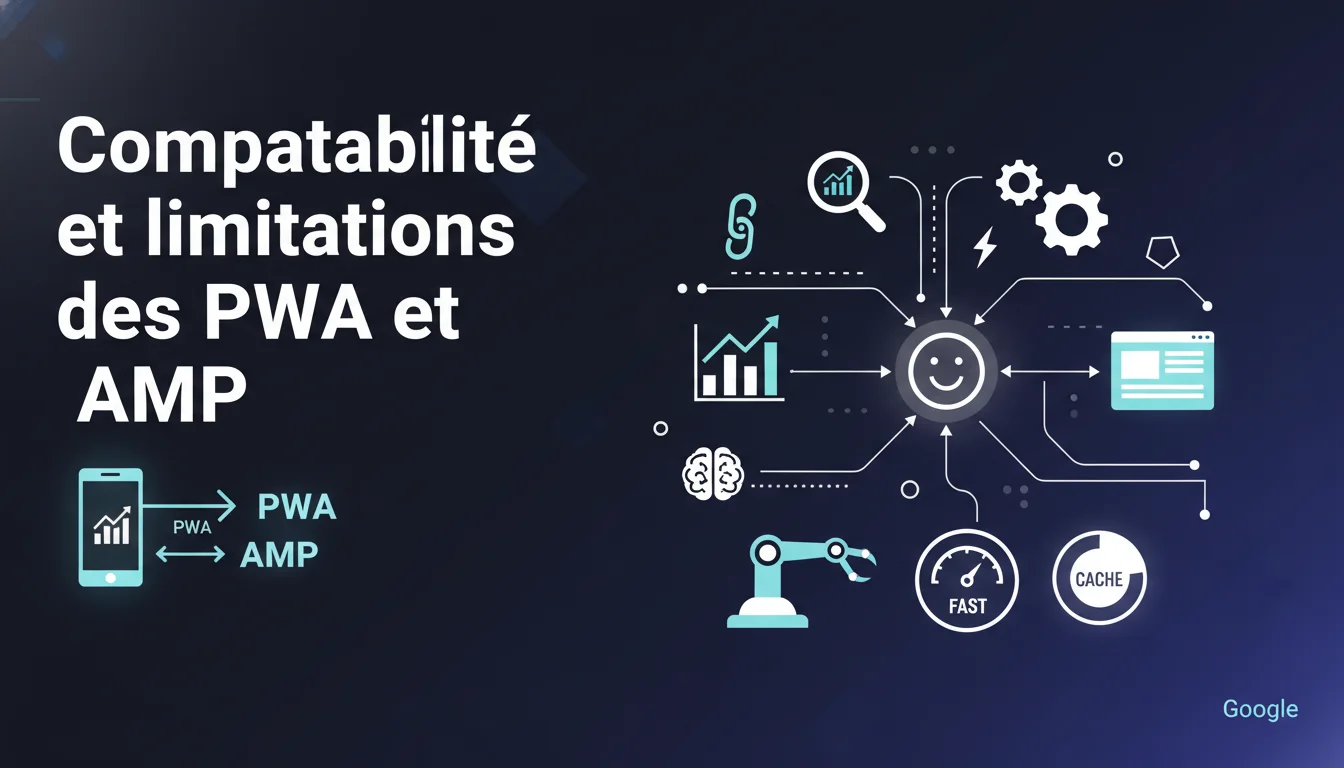
Google claims that PWAs offer advanced features (offline mode, push notifications) but have a slow initial load, while AMP loads instantly but does not allow custom scripts or service workers. For SEO, this means that neither technology combines all the advantages: speed AND interactivity. The question then becomes which limitation weighs less heavily based on your business context.
What you need to understand
What are the real differences between PWA and AMP in terms of performance?
PWAs are web applications that function like native apps: they can be installed on the home screen, send push notifications, and work offline thanks to service workers. The downside? The initial load is slow because the browser must download the entire application shell before displaying anything.
AMP, on the other hand, prioritizes raw speed: pre-loading, aggressive caching on Google’s side, and strict restrictions on third-party resources. The result: almost instant display. But this speed comes at a cost: no custom JavaScript, no service workers, and no advanced features. You are in a heavily constrained environment.
Why does Google maintain these two opposing technologies?
Because the use cases are different. AMP was designed for editorial content that is accessed occasionally: news articles, blogs, recipes. The user arrives, reads, and leaves. The speed of the first display is critical, interactivity is not.
PWAs target recurring experiences: e-commerce, SaaS, business applications. The user comes back regularly, installs the app, and expects rich features. The initial load matters less than the smoothness of subsequent visits and functional richness.
How does this impact organic search ranking?
Google indexes and crawls both formats without any official algorithmic preference. However, the Core Web Vitals signals are different: AMP ensures an excellent LCP from the first load, while a poorly optimized PWA can drag down its initial score even if subsequent visits are smooth.
On the UX side, AMP often generates a lower bounce rate on mobile (due to speed), but lower engagement (no notifications, no offline mode). PWAs can retain users better if the app is installed, but the risk of abandonment on the first load is real.
- PWA: offline mode, push notifications, home screen installation, but slow first load and high technical complexity
- AMP: almost instant loading, favored in Google News carousels (historically), but no JS customization and no service workers
- Neither technology combines initial speed AND advanced features: it is primarily a business trade-off
- The Core Web Vitals measure the two formats differently: LCP, FID, CLS heavily depend on the chosen architecture
- Google does not impose PWA or AMP for SEO, but speed has been a mobile ranking factor for years
SEO Expert opinion
Is this statement consistent with real-world observations?
Yes, it is actually one of the few Google statements that are fully aligned with practitioner reality. Well-coded PWAs provide an exceptional experience... on the second load. The first remains slow, especially on mobile 3G/4G. Service workers take time to set up, the application shell is heavy, and the browser must download everything before displaying anything.
On the AMP side, speed is undeniable, but the technical constraints are real. It’s impossible to integrate a custom chat, a product configurator, or even a simple complex cookie consent banner. As a result, many sites have abandoned AMP after testing it, frustrated by the limitations.
What nuances should we add to this binary opposition?
Google presents PWA and AMP as two separate paths, but nothing prevents combining both. Some sites use AMP for article pages (maximum speed) and a PWA for the customer account space or mobile app (rich features). This is technically feasible, even if it complicates the architecture significantly.
Another nuance: since Google removed the AMP badge from mobile results and reduced AMP advantages in News carousels, the strategic interest in AMP has diminished. Many pure players are now leaning toward highly optimized standard sites (critical CSS, aggressive lazy loading, CDN) that can compete in speed without AMP constraints.
When does this rule not apply or become obsolete?
If your site is 100% static (blog, portfolio, simple showcase), neither PWA nor AMP is necessary. A well-optimized traditional site with a good CDN and lazy loading can perform equally well or even better without the technical debt.
If you are in a highly competitive market where every millisecond counts (travel, finance, comparison), raw speed takes precedence. AMP may then make sense, but only if you accept the functional limitations. [To be verified]: some publishers claim that AMP converts better due to speed, but public data is lacking to systematically support this correlation.
Practical impact and recommendations
What should you do concretely if you want to decide between PWA and AMP?
First ask the business question: do your users come back regularly? Do they need advanced features (account, cart, notifications)? If so, PWA. If your traffic is mostly one-off (Google arrival, reading, exit), AMP may make sense, but only if you are within the News ecosystem or if initial speed is critical.
The second criterion: your tech team. A well-made PWA requires solid front-end skills (service workers, caching strategies, manifest). AMP is simpler to deploy, but you will have to renounce any advanced customization. If you don’t have the resources to maintain a complex PWA, it is better to optimize a traditional site.
What mistakes should you avoid during implementation?
Mistake #1: deploying a PWA without optimizing the initial load. The service worker is useless if the user bounces before it is installed. You need to combine PWA with code splitting, lazy loading, and a minimal application shell.
Mistake #2: thinking AMP is sufficient for the entire site. AMP works well for content pages but becomes unmanageable for transactional functionalities. Don’t force AMP everywhere: reserve it for pages where initial speed is crucial.
How can I check that my site is correctly utilizing these technologies?
For a PWA, use Lighthouse (PWA tab in Chrome DevTools): it checks the manifest, service worker, HTTPS, and installability criteria. A PWA score below 80/100 indicates structural issues.
For AMP, validate your pages with the official AMP tool and monitor the Search Console (AMP section). Note: even if your pages are technically valid, ensure that the Core Web Vitals remain green. A poorly coded AMP page can still be slow.
- Audit your current Core Web Vitals (LCP, FID, CLS) to identify if speed is truly an issue
- Test the initial load in simulated 3G (Chrome DevTools): if you exceed 3 seconds, a PWA alone will not suffice
- Check if your users return regularly (analytics): high return rate = relevant PWA, one-off traffic = AMP or optimized traditional site
- Assess functional complexity: if you need custom JS, complex cookies, or custom service workers, AMP is excluded
- Measure the real business impact: test PWA or AMP on a subset of pages and compare conversion, engagement, and bounce rate
- Document your caching strategy (service worker) to avoid serving stale content after an update
❓ Frequently Asked Questions
Peut-on combiner PWA et AMP sur un même site ?
Google favorise-t-il AMP dans son algorithme de classement ?
Une PWA améliore-t-elle vraiment le référencement ?
Pourquoi le premier chargement d'une PWA est-il plus lent qu'un site classique ?
AMP est-il encore pertinent après la suppression du badge dans les résultats Google ?
🎥 From the same video 9
Other SEO insights extracted from this same Google Search Central video · duration 58 min · published on 14/12/2016
🎥 Watch the full video on YouTube →
💬 Comments (0)
Be the first to comment.