
Official statement
What you need to understand
Why do some webmasters disable right-click on their pages?
Some website owners believe they are protecting their content by disabling right-click and text selection with the mouse. This practice theoretically aims to prevent the theft of content, images, or text.
However, this measure is purely cosmetic and offers no real protection. The source code remains accessible via the browser, developer tools, or simply by disabling JavaScript.
What is Google's official position on this practice?
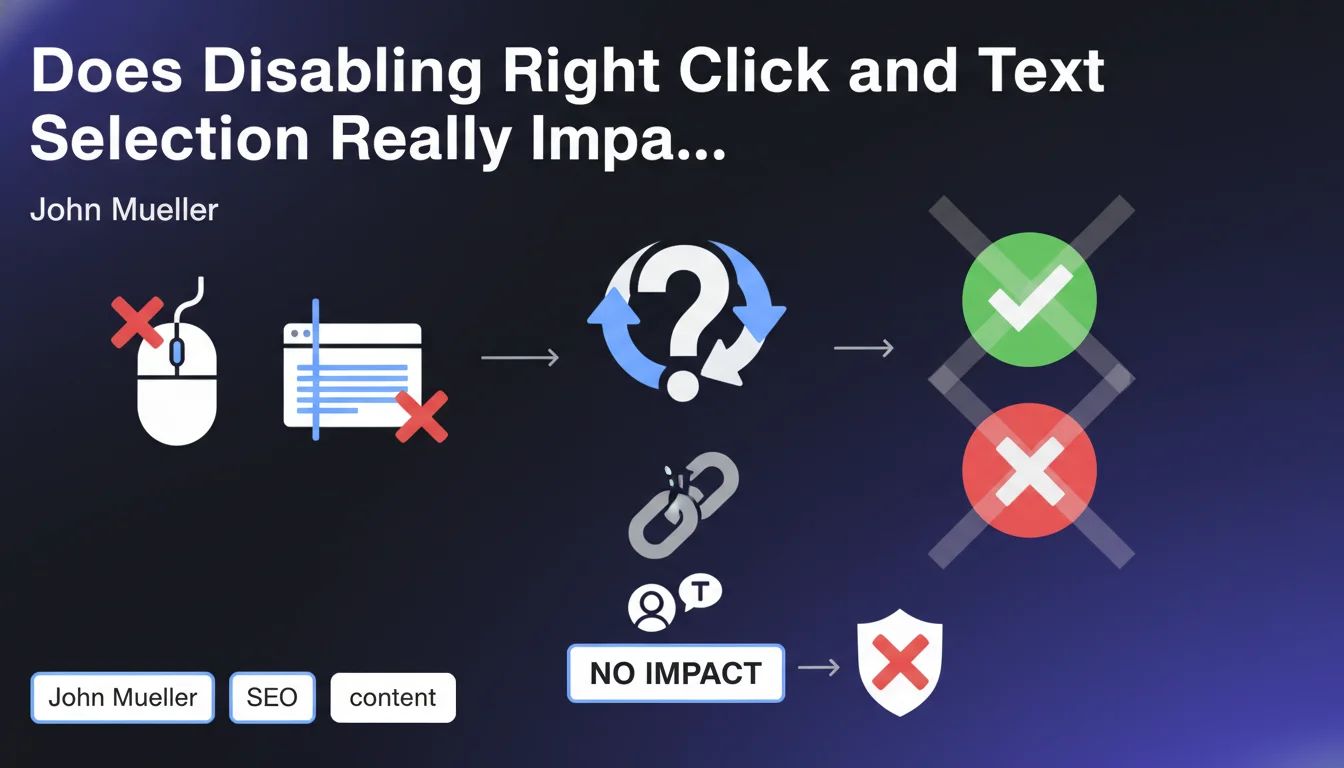
John Mueller was very clear: disabling right-click has no SEO impact, neither positive nor negative. Google does not penalize this practice, but does not reward it either.
The search engine focuses on content quality and relevance, not on interaction restrictions with the page. These JavaScript elements do not influence the algorithmic evaluation of content.
What are the real effects of this restriction on users?
This practice significantly degrades user experience. Visitors cannot copy an address, a phone number, or quote a passage to share it.
- No impact on Google SEO rankings
- False sense of content protection
- Restriction easily bypassed by any user
- Degradation of user experience without real benefit
- Content remains fully accessible via source code
SEO Expert opinion
Is this statement consistent with real-world observations?
Absolutely. In my 15 years of practice, I have never observed any correlation between disabling right-click and SEO performance. Sites that use it are neither advantaged nor directly penalized.
However, there is a measurable indirect effect: UX degradation can increase bounce rate and reduce time spent on the page. These behavioral signals can influence SEO in the long term.
What indirect risks does this practice pose for SEO?
The main danger lies in the negative perception by users. A visitor frustrated by these restrictions will leave the site more quickly and will be less inclined to create natural links or share the content.
Moreover, this approach often reveals a lack of understanding of web best practices. Sites that employ it frequently present other more serious technical problems that actually affect SEO.
In what cases might this restriction seem justified?
Honestly, in no real case. Even for premium content or protected images, there are much more effective solutions: watermarking, login-based protection, DRM for media, or Creative Commons licenses.
Disabling right-click is an obsolete approach to the web, dating from the 2000s. It reflects a misunderstanding of real protection mechanisms and current user expectations.
Practical impact and recommendations
What should you do if your site currently uses this feature?
Remove it immediately. This restriction provides no benefit and frustrates your visitors. Identify the responsible JavaScript scripts and remove them from your code.
Focus your efforts on real protection mechanisms if necessary: robust authentication, image watermarking, or clear terms of use. These approaches are infinitely more effective.
How can you improve user experience while protecting your content?
Favor transparency and accessibility. Quality content will naturally be shared and cited, which generates valuable backlinks for your SEO.
If you fear plagiarism, use duplicate content monitoring tools and assert your rights after the fact. This is much more effective than illusory technical restrictions.
- Audit your code to identify any disabling of right-click or selection
- Remove JavaScript scripts blocking these native functionalities
- Test user experience after removal on different browsers
- Verify that your content is easily shareable and quotable
- Implement real protection solutions if necessary (watermarking, authentication)
- Monitor duplicate content with specialized tools rather than restrictions
- Measure the impact on your engagement metrics (bounce rate, time on page)
What other SEO priorities truly deserve your attention?
Rather than wasting time with these false protections, focus on truly impactful SEO fundamentals: loading speed optimization, information architecture, internal linking, content quality, and mobile experience.
These elements require deep technical expertise and a comprehensive strategic vision. Modern SEO optimization involves many simultaneous dimensions, from semantic analysis to technical performance.
💬 Comments (0)
Be the first to comment.