
Official statement
What you need to understand
What exactly are rich results and why are they so important?
Rich results (or rich snippets) are enhanced displays in Google's search results pages. They include review stars, product images, recipes with photos, events, FAQs, and many other visual formats.
These displays occupy more space in the SERPs and generate significantly higher click-through rates. For an e-commerce or content site, losing access to rich results represents a major competitive disadvantage.
What is Google's official position regarding adult sites?
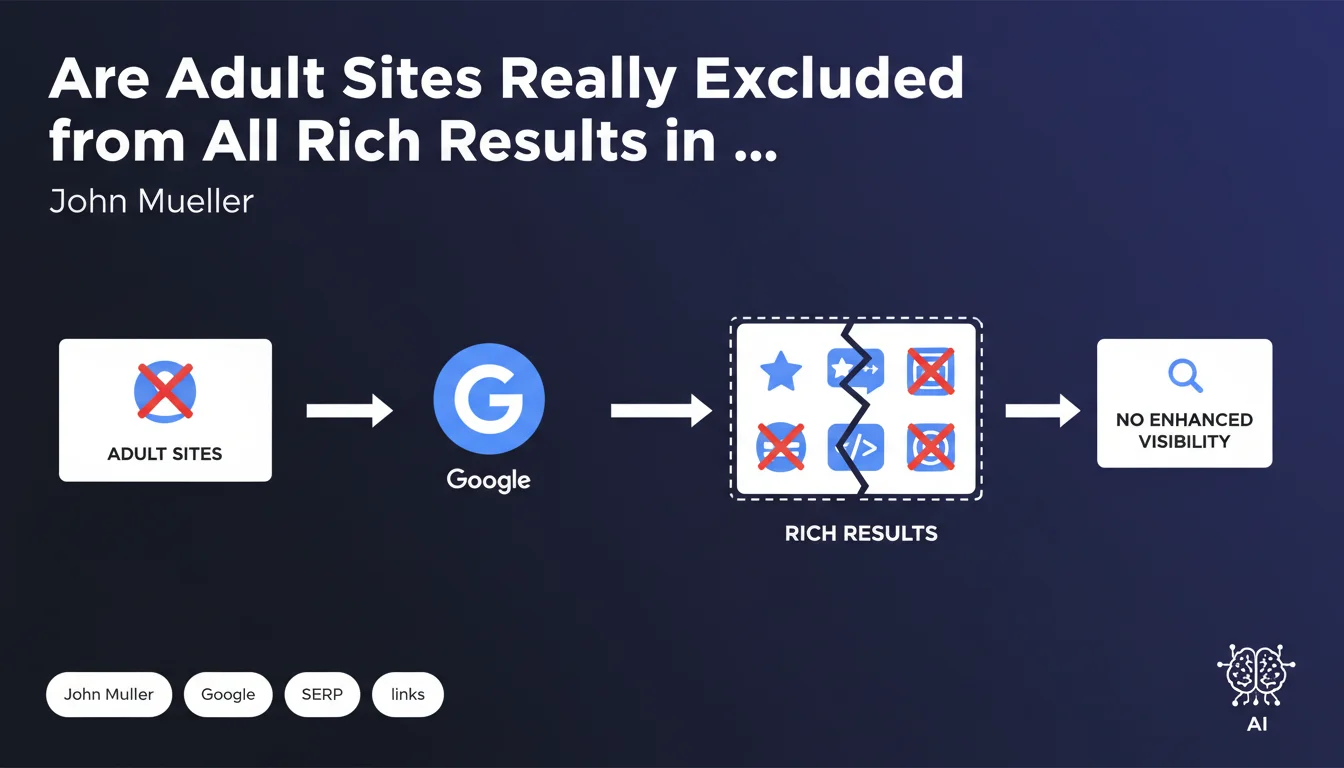
According to John Mueller, adult content sites would have access to no rich results. This statement goes beyond Google's written guidelines, which explicitly mention only restrictions on reviews/ratings and products.
There is therefore a significant gray area between what is officially documented and what is applied in practice by Google's teams. This ambiguity creates uncertainty for webmasters in the sector.
Which types of rich results are affected by this restriction?
The statement suggests that all types of rich snippets would be inaccessible: FAQ, HowTo, Recipes, Events, Enhanced Videos, Articles with prominent images, and even enhanced Breadcrumbs.
- Product and Review structured data are explicitly prohibited in the official documentation
- Other types (FAQ, HowTo, Article, VideoObject, etc.) are not officially mentioned as prohibited
- Mueller's statement suggests a stricter policy in practice than what is documented
- This restriction directly impacts the visibility and CTR of the affected sites in organic results
SEO Expert opinion
Is this statement consistent with real-world observations?
My experience shows a variable application of this rule. Some adult sites manage to obtain rich results for informational content (FAQs, educational articles), while others are systematically excluded.
It appears that Google applies a contextual analysis rather than a binary rule. A site offering educational content on sexual health with some adult pages may be treated differently than a pure pornographic site. The proportion and nature of adult content seem to influence the decision.
What important nuances should be added to this statement?
The very definition of "adult site" remains vague and subjective. Google does not provide precise criteria: does it refer to explicit content only, lingerie, suggestive content, or sex education?
Some rich results like Breadcrumbs and Organization logos (Organization schema) sometimes seem to display even for borderline sites. There is probably a hierarchy in the restrictions, with some types being more tolerated than others.
In what cases might this rule not apply strictly?
Sites with clear segmentation between adult and non-adult content may potentially benefit from rich results on their non-adult sections. For example, a lifestyle magazine with a separate adult section.
Sites with an educational or medical focus dealing with sexuality in an informative way (sexual health, education) sometimes seem to escape the strict "adult site" classification. Context and editorial intent matter as much as the content itself.
Practical impact and recommendations
How can you tell if your site is classified as "adult" by Google?
Unfortunately, Google provides no explicit notification of this classification. You must monitor the absence of rich results despite correct implementation of structured data.
Use Google Search Console's Rich Results Test to verify that your markup is technically valid. If it is but never appears in the SERPs, you are probably classified as an adult site.
- Regularly check your actual search results (not just testing tools)
- Compare with competitors: if they have rich snippets and you don't, it's revealing
- Analyze your Search Console to detect manual actions or messages concerning content
- Test with non-adult content in a separate section of the site
What should you do concretely if your site is affected?
If your business is legitimately adult, you must accept this limitation and optimize other SEO levers: loading speed, content quality, backlinks, user experience.
For mixed sites, consider a subdomain or separate domain architecture to isolate adult content from the rest. This separation can allow non-adult sections to benefit from rich results.
What mistakes should you absolutely avoid?
Don't waste time implementing complex structured data if you are clearly an adult site. Google won't display it, and it provides no direct SEO benefit in this case.
Avoid attempts at cloaking or manipulation to bypass the classification. Google detects these practices and could apply penalties more severe than simply not showing rich results.
In summary: The restriction on rich results for adult sites is broader in practice than what the official documentation indicates. If your site is affected, focus your SEO efforts on other more impactful ranking factors.
Managing these classification issues and SEO optimization in constrained contexts requires in-depth technical expertise and a thorough understanding of algorithmic subtleties. Given the complexity of these challenges and the gray areas in Google's guidelines, guidance from an experienced SEO agency can prove valuable in developing a strategy tailored to your specific situation and maximizing your visibility despite the constraints.
💬 Comments (0)
Be the first to comment.