
Official statement
What you need to understand
What exactly is this site reputation abuse policy?
The reputation abuse policy launched in May 2024 by Google targets sites that host low-quality third-party content without adequate supervision. The goal is to exploit the authority of an established domain to manipulate rankings.
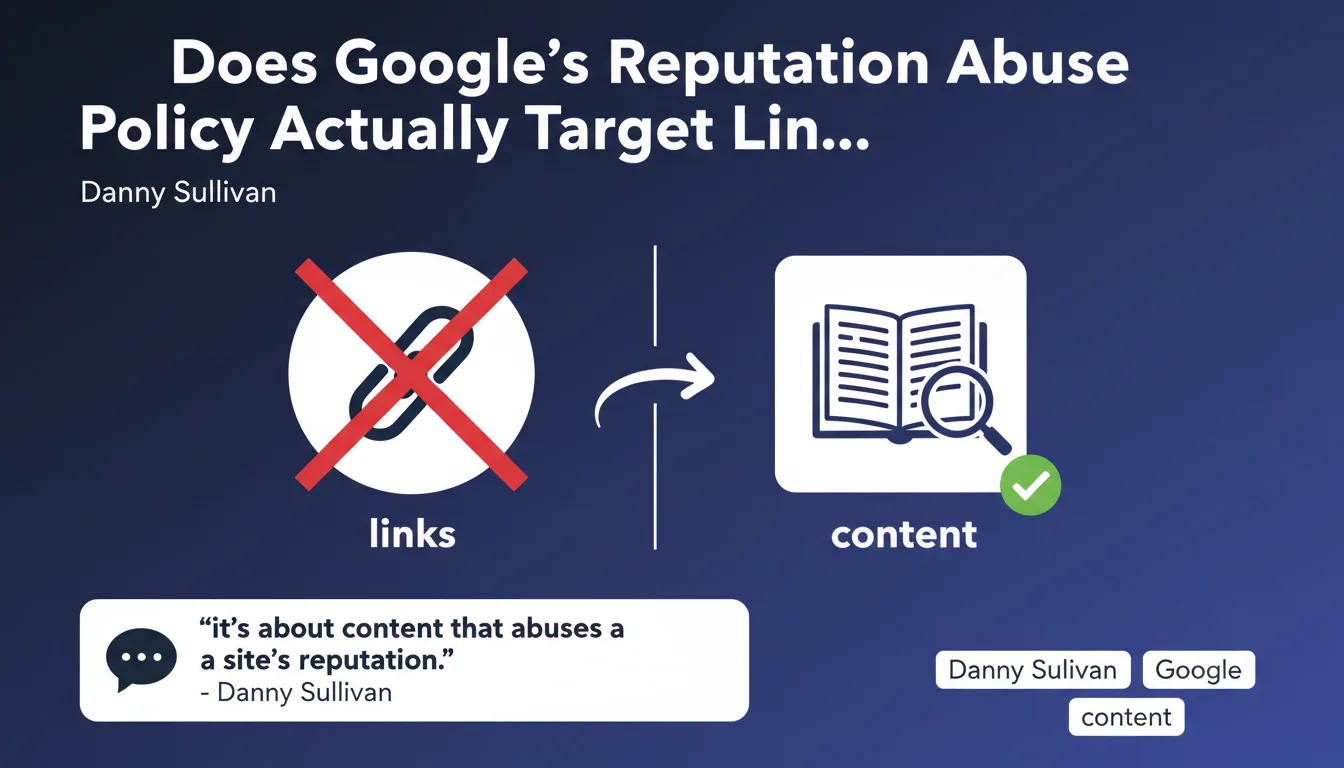
Contrary to what some might think, this policy focuses exclusively on published content, and not on netlinking practices. Danny Sullivan clarified this point to avoid any confusion in the SEO industry.
Why was this clarification from Google necessary?
Many SEO professionals were confusing this policy with penalties related to artificial links. This confusion was understandable because reputation abuse may seem close to abusive link building.
Google therefore clarified that only hosted content is concerned: unmonitored sponsored articles, entire sections of the site rented to third parties, or advertising content disguised as editorial content.
What types of content does this policy target?
Parasite content is the main target: third-party articles published on reputable domains without real added value for the users of the host site. These contents exploit the trust and authority of the main domain.
- Sections of news sites rented to advertisers for promotional content
- Massive sponsored publications without editorial supervision
- Subdomains or entire directories operated by third parties
- Automatically generated content hosted on authoritative domains
- Content partnerships where the host site exercises no quality control
SEO Expert opinion
Is this distinction between content and links really that clear in practice?
The theoretical separation is clear, but in reality, content and links are often intertwined. A hosted sponsored article generally contains links, and that's sometimes precisely the reason for its publication.
However, Google judges here the reputation abuse through the content itself. If a quality third-party article is hosted with appropriate links and editorial supervision, it should not be penalized by this specific policy.
What nuances should be added to this official statement?
The boundary remains blurry for certain edge cases. A site that hosts quality third-party content with editorial supervision should not be concerned, even if this content contains links.
On the other hand, a site that massively rents entire sections without quality control will be targeted, regardless of the links present. The key criterion is real editorial supervision and the relevance of the content for the host site's audience.
Does this policy apply uniformly to all types of sites?
News sites and established media are particularly scrutinized, as they are the ones who have most developed these sponsored content hosting practices. Their high domain authority makes the abuse more impactful on search results.
Smaller sites are not exempt, but the risk is proportional to their authority perceived by Google. A small blog occasionally accepting a quality guest article runs little risk compared to a national media outlet renting entire sections.
Practical impact and recommendations
How can I check if my site risks being penalized by this policy?
Start by auditing all third-party content present on your domain. Identify sponsored articles, external contributions, and any content produced by partners without supervision from your editorial team.
For each identified content, ask yourself these questions: does this content provide real value to my audience? Is it consistent with my editorial line? Did I exercise quality control before publication?
- Inventory all third-party, sponsored or partnership content on your domain
- Evaluate the editorial relevance of each content for your main audience
- Verify the existence of a quality validation process before publication
- Identify sections or subdomains potentially rented to third parties
- Remove or improve content that exploits your reputation without added value
- Document your editorial supervision for legitimate partnership content
What should I do if my site currently hosts problematic third-party content?
The first action is to remove the most abusive content: those published without any supervision, completely off-topic, or clearly intended solely to manipulate rankings. Don't wait for a manual penalty.
For content in the gray zone, improve editorial supervision. Add clear disclaimers, verify quality, ensure relevance for your audience. If content cannot be justified editorially, remove it.
What practices should be adopted for future content collaborations?
Establish a strict editorial process for all third-party content. Even for sponsored articles, maintain quality standards aligned with your editorial line and your audience's expectations.
Favor partnerships where you maintain total control over the published content. Refuse proposals where the partner requires publication without possible modifications on your part.
- Create a clear editorial charter for acceptable third-party content
- Implement a validation process before any external publication
- Limit the volume of sponsored content relative to your own editorial content
- Ensure strict thematic relevance with your area of expertise
- Add transparent mentions for partnership content
- Avoid entire sections dedicated only to third-party content
- Regularly monitor the performance and reception of this content
💬 Comments (0)
Be the first to comment.