
Official statement
Other statements from this video 8 ▾
- 7:17 Can goo.gl short links truly enhance your mobile deep linking strategy?
- 11:56 Is mobile-friendliness still a key ranking factor for your site?
- 14:10 Does mobile speed really escape mobile-friendly ranking criteria?
- 15:03 Is it really necessary to use the 'Vary: User-Agent' header on all your adaptive pages?
- 16:33 PageSpeed Insights vs Mobile-Friendly Test: Why does Google use two different tools?
- 21:01 Do you really need a separate mobile sitemap when you have distinct URLs?
- 23:42 How do local listings really affect your positions in the SERPs?
- 30:03 Does Google really punish link networks quietly?
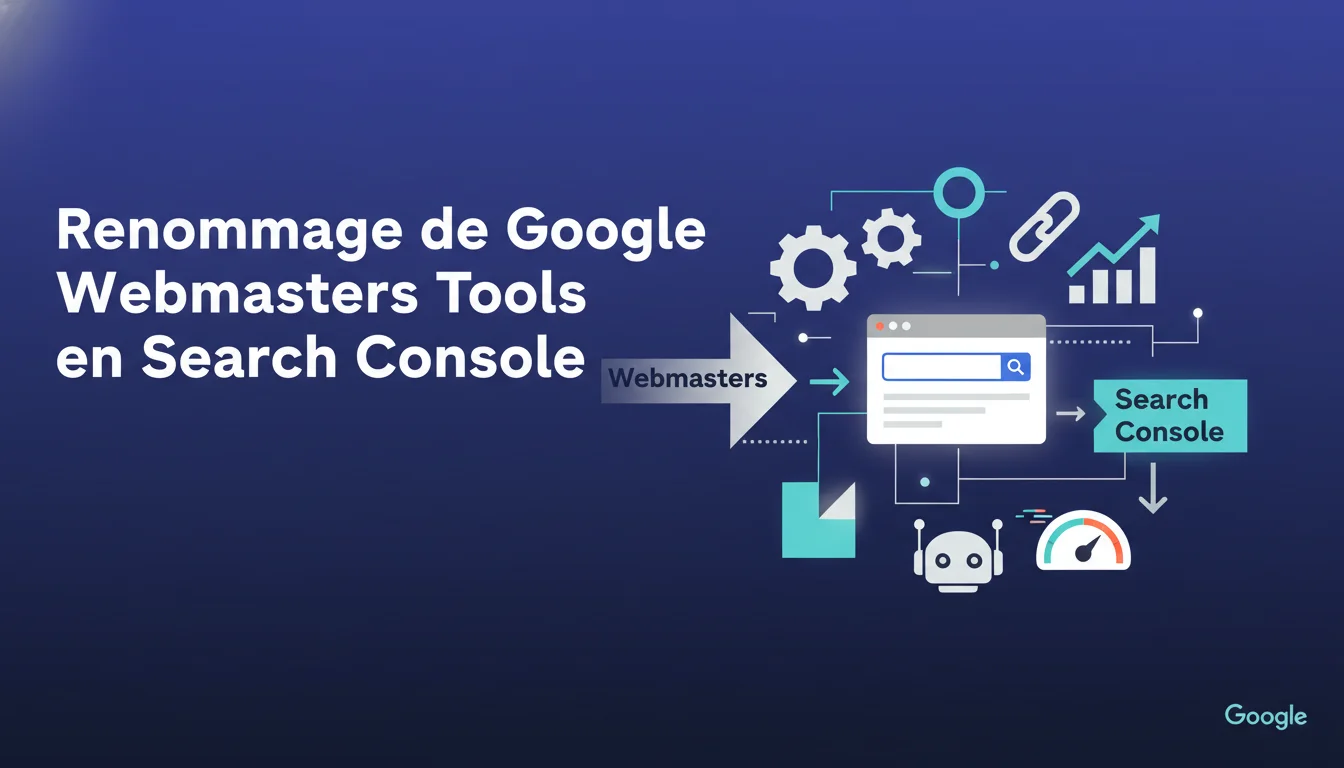
Google replaced the term 'Webmaster Tools' with 'Search Console' to reflect a broader audience: web developers, app creators, marketing managers. This name change does not alter the tool's features but signals an intention to open up beyond the strictly technical sphere. For SEOs, it reinforces that mastering this tool remains essential, regardless of their roles.
What you need to understand
What does this name change really mean?
The shift from Webmaster Tools to Search Console corresponds to an evolution in how Google perceives its users. The old name referred to a time when only pure technicians managing servers and robots.txt files manipulated the tool.
Now, Google acknowledges that its interface is used by various profiles: SEO managers, digital project managers, front-end developers, marketing teams. The term 'console' suggests a centralized dashboard, less associated with 'server tinkerer' than 'webmaster'.
What are the practical implications for an SEO?
No functionality disappears with this renaming. The index coverage reports, search performance data, security alerts, and sitemap files remain unchanged. What changes is the open philosophy of the tool.
Google wants more people to understand how their site performs in search. This encourages a democratization of technical SEO, but also a potential dilution of expertise: anyone can access the Search Console, but not everyone interprets the data correctly.
Does this renaming indicate future functional developments?
The choice of the term 'Search Console' instead of 'Webmaster Console' or 'SEO Console' is significant. Google is broadening the scope beyond the classic web: mobile applications can be tracked via the tool, structured data is gaining importance, and the Search Console API integrates into automated workflows.
This renaming coincides with a time when Google diversifies its search surfaces: images, videos, news, product listings. The Search Console becomes the single control point for all these entries, not just traditional HTML pages.
- Name change only: no features removed or added at the announcement
- Broad audience: developers, marketers, content creators beyond traditional webmasters
- Open philosophy: Google wants to democratize access to search data
- Evolution of scope: mobile applications, structured data, various search surfaces
- No immediate impact on daily SEO practices
SEO Expert opinion
Does this statement reflect a real strategy or is it just a cosmetic facelift?
The renaming occurs in a context where Google seeks to break down the barriers of SEO from the purely technical sphere. The term 'webmaster' felt outdated; it harked back to the 2000s when managing a site required sharp server skills.
But let's be honest: this name change is also a communication exercise. Google has a vested interest in more actors understanding the mechanisms of search because it reduces support tickets and facilitates the adoption of the standards it promotes (HTTPS, mobile-first, Core Web Vitals). [To be verified]: one might wonder if this opening dilutes SEO expertise in favor of a more superficial approach.
What inconsistencies do we observe between the discourse and the ground reality?
Google claims to want to reach a broader audience, but the Search Console interface remains complex and technical for a layperson. Indexing error messages, coverage graphs, nuances between 'crawled but not indexed' and 'alternative page with appropriate canonical tag' require true interpretive skills.
The renaming does not come with a redesign to make the tool accessible to marketing or creative profiles. It's a paradox: Google claims to address everyone, but the tool is still designed for technicians. Experienced SEOs see no difference, and newcomers remain lost.
Does this change indicate a marginalization of the webmaster role?
Yes and no. The role of a webmaster in the strict sense (server management, FTP, config files) has largely disappeared in favor of hybrid profiles: front-end developers doing SEO, marketing managers manipulating headless CMS, SEO consultants coding Python scripts to automate log analysis.
In this sense, Google acknowledges a market reality. However, there is a risk: by trying to cast a wide net, Google may devalue technical SEO expertise in favor of a more superficial view centered on marketing KPIs. The danger for practitioners is that decision-makers think accessing the Search Console is enough to 'do SEO'.
Practical impact and recommendations
What should be done concretely after this renaming?
No specific actions required on the technical side. Your access to Search Console remains unchanged, your reports as well, and your alerts will still come. What changes is potentially the internal communication: if your marketing director discovers the tool and asks about indexing errors without understanding the nuances, be prepared to educate.
Take this opportunity to train non-technical teams on basic report reading: search performance, index coverage, sitemap. The more your colleagues understand the data, the less time you spend justifying normal fluctuations in crawl or indexing.
What mistakes should be avoided in the daily use of Search Console?
The classic mistake is to overinterpret the data without cross-referencing with other sources. The Search Console shows samples, not exhaustive data. Clicks and impressions are rounded, and average positions are smoothed. Never make a strategic decision based on a single graph from the Search Console.
Another trap is ignoring messages from the Search Console on the grounds that they are technical. A security alert, a structured data issue, or a sudden drop in coverage requires prompt action. Set up email notifications to not miss anything, and address each alert within 48 hours.
How can Search Console be integrated into an effective SEO workflow?
The Search Console should be your daily control point, not a tool checked once a month. Create routines: check indexing errors on Monday, analyze emerging queries on Wednesday, verify Core Web Vitals on Friday. Automate what can be done via the Search Console API.
Integrate data from Search Console into your reporting dashboards to cross-reference with Google Analytics, server logs, and crawl tools. A discrepancy between pages crawled by Googlebot (logs) and pages indexed (Search Console) often reveals crawl budget issues or duplicate content.
- Ensure that all relevant profiles (marketing, dev, content) have access to Search Console with the right permission levels
- Configure email notifications to receive critical alerts in real-time
- Document recurring indexing errors and their solutions to train the teams
- Create query segments in the performance report to track strategic keyword groups
- Regularly export data via the API to build a history beyond the 16 months available in the interface
- Systematically cross-reference Search Console data with Google Analytics and server logs to detect inconsistencies
❓ Frequently Asked Questions
Est-ce que mes accès à Webmaster Tools ont été supprimés avec le renommage ?
Faut-il reconfigurer les propriétés et sitemaps après le passage à Search Console ?
Ce changement de nom impacte-t-il l'API Webmaster Tools ?
Pourquoi Google insiste-t-il sur les développeurs d'applications dans cette annonce ?
Le renommage annonce-t-il de nouvelles fonctionnalités SEO dans l'outil ?
🎥 From the same video 8
Other SEO insights extracted from this same Google Search Central video · duration 43 min · published on 28/05/2015
🎥 Watch the full video on YouTube →
💬 Comments (0)
Be the first to comment.