
Official statement
What you need to understand
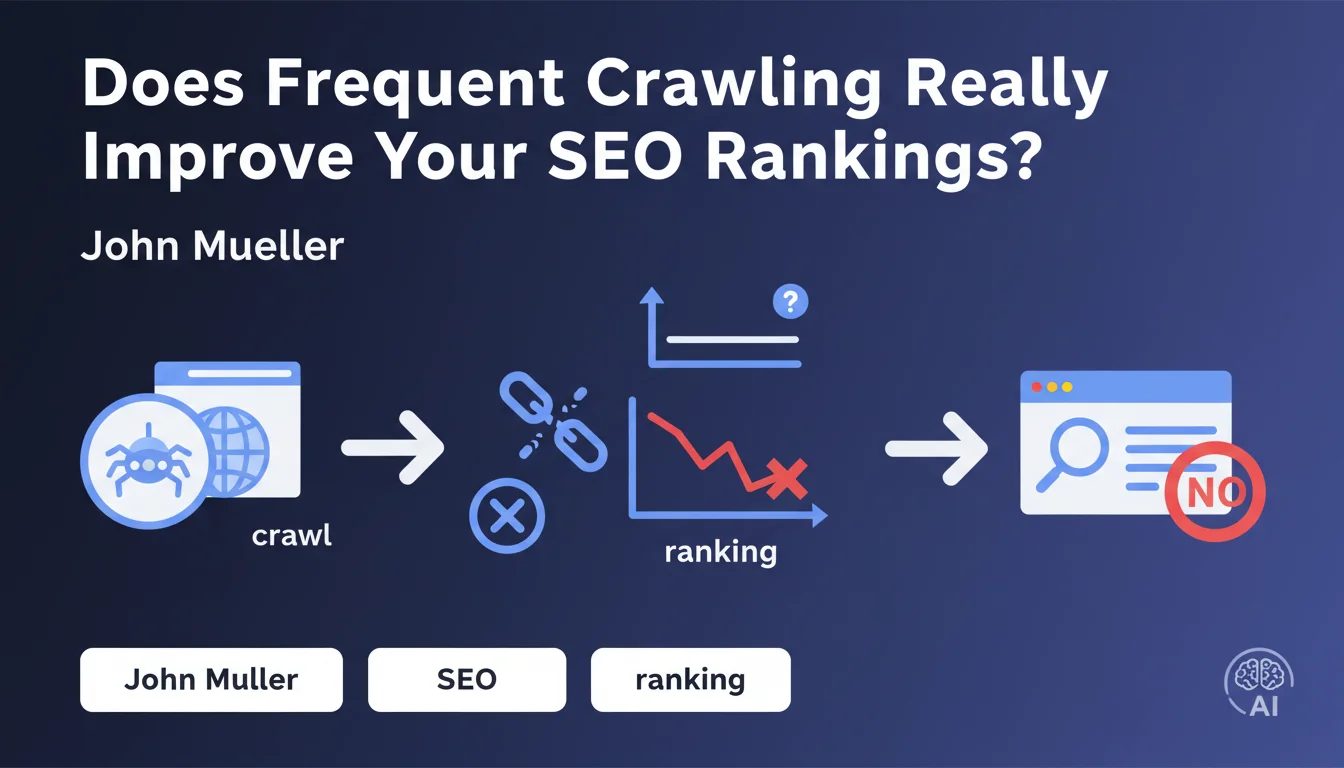
Crawl frequency is often perceived as an indicator of SEO health, but this misconception deserves to be corrected. Google has clearly established that there is no direct correlation between how regularly Googlebot visits and rankings in search results.
In reality, crawling adapts to your site's behavior. A static site with few updates will naturally be crawled less frequently than a news outlet publishing multiple articles per day. This variation is normal and in no way penalizes your visibility.
It's important to understand that crawling and ranking are two distinct processes within Google's ecosystem. The former serves to discover and index content, the latter to evaluate and rank it according to hundreds of quality criteria.
- Frequent crawling is not a ranking factor
- Crawl frequency depends primarily on your publishing rhythm
- A static site with spaced-out crawling can rank perfectly well
- Content quality always takes precedence over Googlebot's visit frequency
SEO Expert opinion
This clarification is entirely consistent with what we observe daily in our audits. Many e-commerce sites with relatively stable catalogs excel in SERPs despite infrequent crawling, while some highly active blogs struggle to generate organic traffic despite daily Googlebot visits.
However, there is an important nuance to note: while frequent crawling doesn't directly improve rankings, insufficient crawling can prevent your new strategic pages from being indexed quickly. For news sites or e-commerce platforms with time-limited promotions, this latency can represent significant lost revenue.
The real question isn't "am I being crawled often?" but rather "are my strategic pages being discovered and indexed effectively?" It's a qualitative rather than quantitative approach that should guide your strategy.
Practical impact and recommendations
- Don't panic if your crawl frequency decreases after a period of intense editorial activity
- Prioritize quality over quantity: better to publish less often with high-value content
- Optimize your crawl budget by blocking unnecessary pages (filters, excessive pagination, URL parameters)
- Use XML sitemaps to signal your priority content and its actual update frequency
- Monitor indexation rather than crawling via Search Console (coverage report)
- Fix technical errors that slow down crawling: loading times, server errors, redirect chains
- Structure your internal linking to facilitate discovery of strategic pages within 3 clicks maximum
- Avoid artificially creating content just to be crawled more often: it's counterproductive
Implementing an optimal technical architecture and a coherent content strategy requires specialized expertise and a comprehensive view of your digital ecosystem. These cross-optimizations between technical, content, and strategy aspects can prove complex to orchestrate internally, particularly if you lack dedicated resources. Working with a specialized SEO agency allows you to benefit from personalized support, regular audits, and a prioritized roadmap aligned with your actual business objectives.
💬 Comments (0)
Be the first to comment.