
Official statement
What you need to understand
What are regular expressions (regex) and why do they matter?
Regular expressions (regex) are formulas that allow you to search and filter data according to complex patterns. In the SEO context, they would enable analysis of multiple URL performances sharing common patterns.
For example, you could analyze all your product pages containing "/category-[0-9]+/" at once, or filter your pages according to specific dynamic parameters. This functionality would transform Search Console data exploitation for medium and large-sized sites.
What's the current status of this feature rollout?
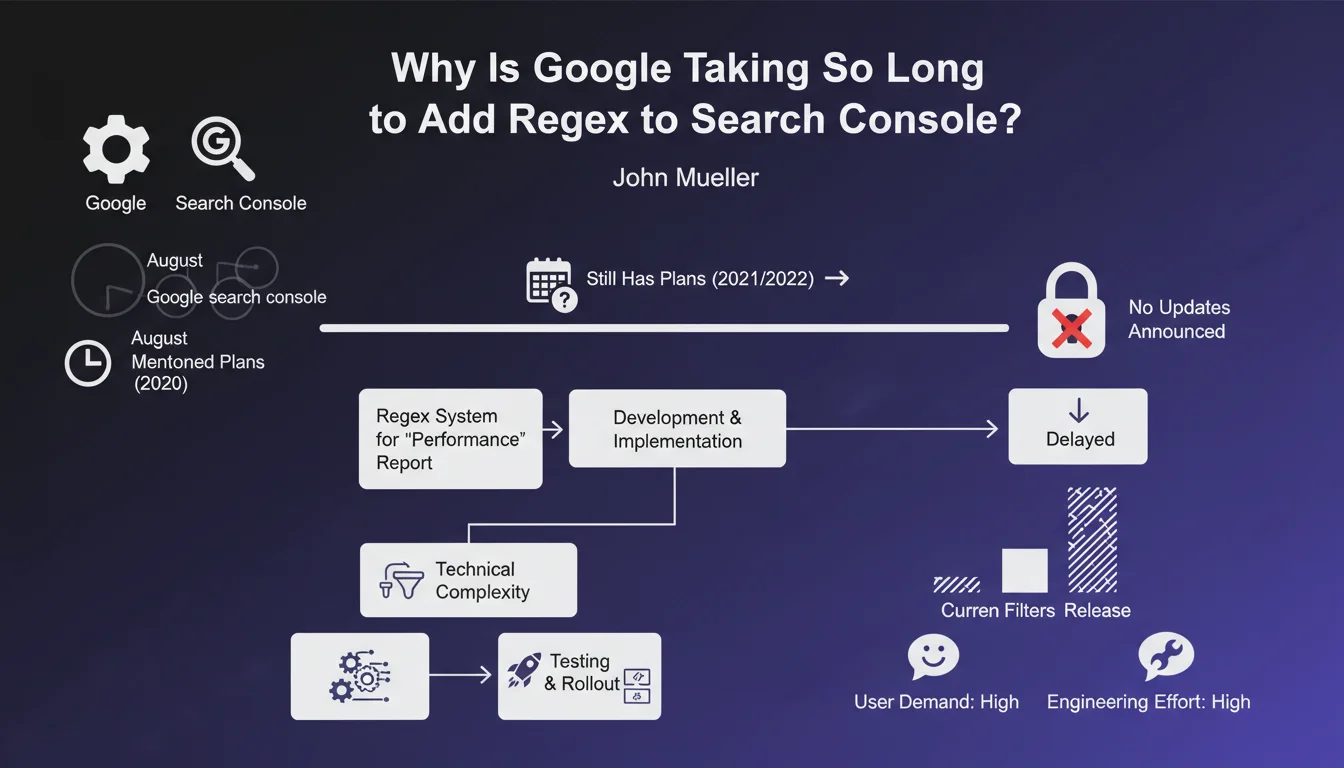
Google has confirmed that the project to integrate regex into the Performance report of Search Console remains current. Help documentation was even briefly published before being removed, indicating that development was advanced.
However, no release date has been announced. This prolonged situation suggests technical or strategic challenges in implementing this feature at scale.
What benefits can SEO practitioners expect?
This functionality would enable advanced data segmentation without exports or external processing. SEOs could quickly identify the performance of complex URL groups.
- Grouped analysis of similar page templates (product sheets, blog articles)
- Precise filtering of URLs with parameters or dynamic structures
- Rapid detection of issues affecting entire site sections
- Considerable time savings in raw data exploitation
- Reduced exports to third-party tools for data processing
SEO Expert opinion
Does this announcement align with Google's strategy?
Maintaining the project despite delays is encouraging. Google has historically favored stable features over rushed releases. The quick removal of the documentation suggests they identified performance or user experience issues.
This cautious approach makes sense: offering regex to millions of Search Console users could generate complex and costly server queries. Google likely needs to optimize the backend infrastructure before general deployment.
What risks could this feature pose?
Integration of poorly designed regex by users could create system overloads. Complex regular expressions on large data volumes can consume enormous server resources.
Google probably needs to implement safeguards: regex complexity limitations, timeouts on long queries, or usage quotas. These technical constraints explain the deployment delays.
Are there viable alternatives in the meantime?
Experienced SEOs already use the Search Console API coupled with Python scripts or Google Sheets to apply regex filters on exported data. This approach remains the most flexible currently.
Tools like Google Looker Studio (Data Studio) also allow importing Search Console data and applying advanced filters, though less powerful than true regex. These temporary solutions remain time-consuming and require technical skills.
Practical impact and recommendations
What should you do while waiting for deployment?
Don't stay stuck waiting for this feature. Develop your advanced analysis capabilities now by familiarizing yourself with the Search Console API and data exports.
Start documenting your site's URL patterns that would benefit most from regex. Identify your priority needs: analyses by categories, parameter types, facet structures.
- Map your site's URL structures requiring grouped analysis
- Identify strategic segments that would benefit from regular regex monitoring
- Test the Search Console API if you have technical skills or a developer
- Explore Google Looker Studio to create custom reports in the meantime
- Document your recurring analysis needs to be ready for deployment
How can you prepare for this feature's launch?
Train yourself now in regular expression basics. Numerous free resources exist, and this skill will serve you beyond Search Console (log analysis, redirects, etc.).
Test your regex on online tools like Regex101 with sample URLs from your site. Prepare a library of reusable patterns for your future analyses.
What mistakes should you avoid in anticipation?
Don't build your entire analysis strategy around a feature that's not yet available. Google's timelines can be long, and announced features don't always launch as expected.
Also avoid neglecting current Search Console features on the grounds that they're less powerful. Existing filters, intelligently combined, already enable highly relevant analyses.
💬 Comments (0)
Be the first to comment.