
Official statement
What you need to understand
What is Google's official stance on misinformation?
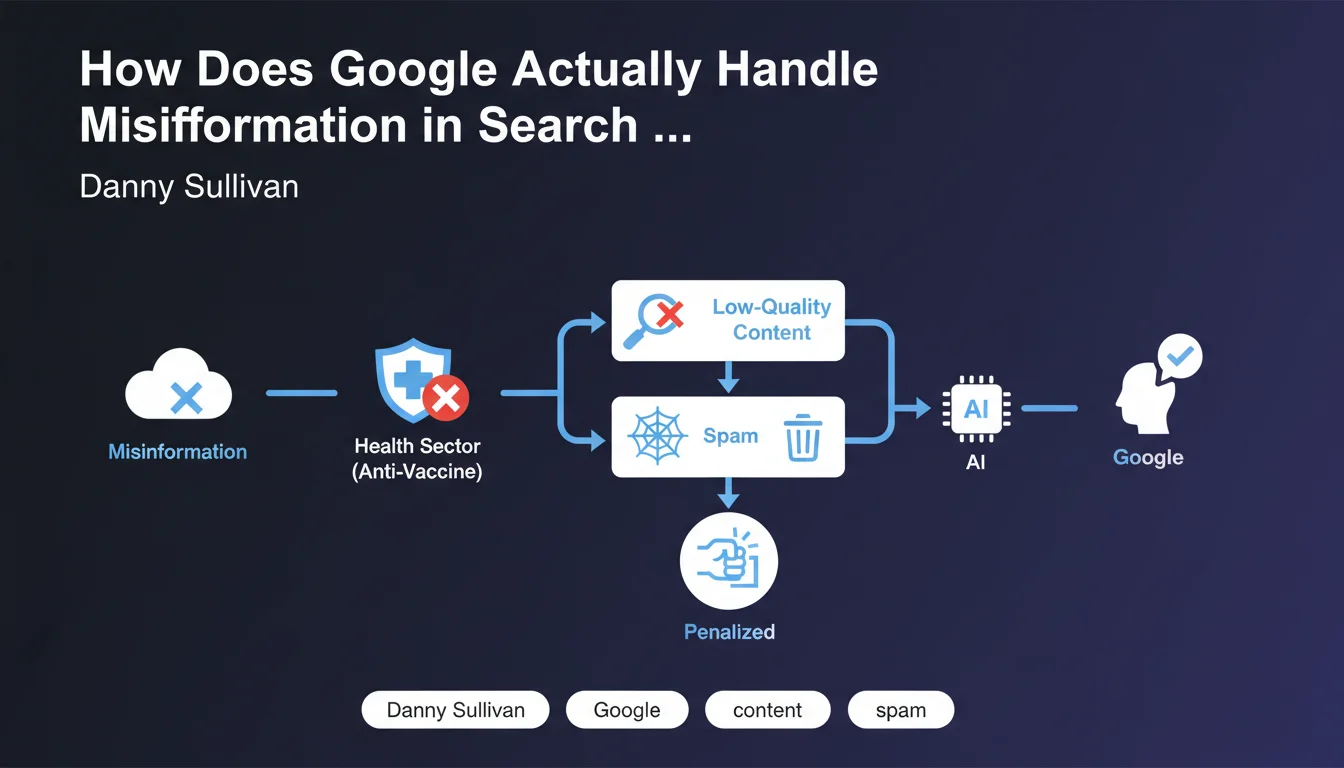
Google equates misinformation with low-quality spam, particularly in sensitive areas like health. Content spreading anti-vaccine information or other false medical claims is actively tracked by algorithms.
This approach aligns with the E-E-A-T guidelines (Experience, Expertise, Authoritativeness, Trustworthiness), where reliability is a major criterion. Google considers such content harmful and applies penalty measures similar to those used for traditional spam.
Why does Google treat misinformation like spam?
Spam and misinformation share a common objective: manipulating users to generate traffic, advertising revenue, or propagate an ideology. This content degrades user experience and trust in search results.
By treating misinformation as spam, Google can deploy its automated anti-spam systems to detect and demote these pages. This enables large-scale action without requiring systematic manual moderation.
Which areas are under particular scrutiny by Google?
YMYL (Your Money Your Life) sectors receive heightened vigilance: health, finance, safety, news. These domains can have a direct impact on users' well-being.
- Health: anti-vaccine information, fake treatments, unfounded medical advice
- Finance: financial scams, fraudulent investment advice
- News: fake news, manipulation of public opinion
- Safety: dangerous information that could cause physical harm
- Application of algorithmic penalties that can drastically reduce visibility
SEO Expert opinion
Is this statement consistent with practices observed in the field?
In practice, we do indeed observe massive deindexing of sites spreading blatant misinformation. Anti-vaccine sites notably lost up to 90% of their visibility after successive Medic and Core Updates.
However, the reality is more nuanced. Google primarily uses indirect algorithmic signals: lack of authority, absence of quality backlinks, weak E-E-A-T. Detecting "misinformation" as such remains complex and relies more on quality patterns than on semantic content analysis.
What are the limitations of this approach against misinformation?
The main challenge lies in the subjectivity of misinformation. What is considered false today may be reassessed tomorrow with new scientific discoveries. Google generally avoids positioning itself as an arbiter of truth.
Algorithms instead favor established and recognized sources: government sites, medical institutions, official organizations. This approach can create a conservative bias where legitimate dissenting opinions are also penalized.
In what cases can this rule impact legitimate sites?
Alternative medicine sites, natural health platforms, or scientific debate forums can be collaterally affected. Even well-intentioned, they may lack the E-E-A-T signals that Google prioritizes.
Small independent news sites or blogs by experts not affiliated with institutions may also suffer, even when producing factual content. Lack of perceived authority can be confused with lack of reliability.
Practical impact and recommendations
How can you protect your site from suspicion of misinformation?
The absolute priority is to strengthen your site's E-E-A-T signals. This involves tangible proof of expertise, authority, and trustworthiness, particularly on YMYL topics.
Systematically document your sources and cite verifiable references. Clearly present your authors' qualifications with detailed biographies and proof of their expertise.
- Display authors' qualifications and certifications on every article
- Cite official and recognized sources (scientific studies, institutions)
- Include detailed "About" pages with proof of expertise
- Obtain backlinks from authoritative sites in your field
- Add visible publication and update dates
- Implement Author and MedicalWebPage schema markup when relevant
- Avoid any sensationalist or clickbait language on sensitive topics
What should you do if your site covers controversial or alternative topics?
If you address topics outside the mainstream consensus, double your transparency efforts. Clearly distinguish established facts from hypotheses or personal opinions.
Use nuanced and conditional language rather than absolute statements. Present multiple perspectives and acknowledge the existence of legitimate scientific debates.
What mistakes should you absolutely avoid on YMYL content?
Never present opinions as medical facts without appropriate qualifications. Avoid phrasing like "cure cancer with..." or "vaccines cause..." without rigorous scientific context.
Don't ignore the importance of appropriate legal disclaimers. A clear warning stating that content does not replace professional medical advice is essential for all health content.
💬 Comments (0)
Be the first to comment.