
Official statement
What you need to understand
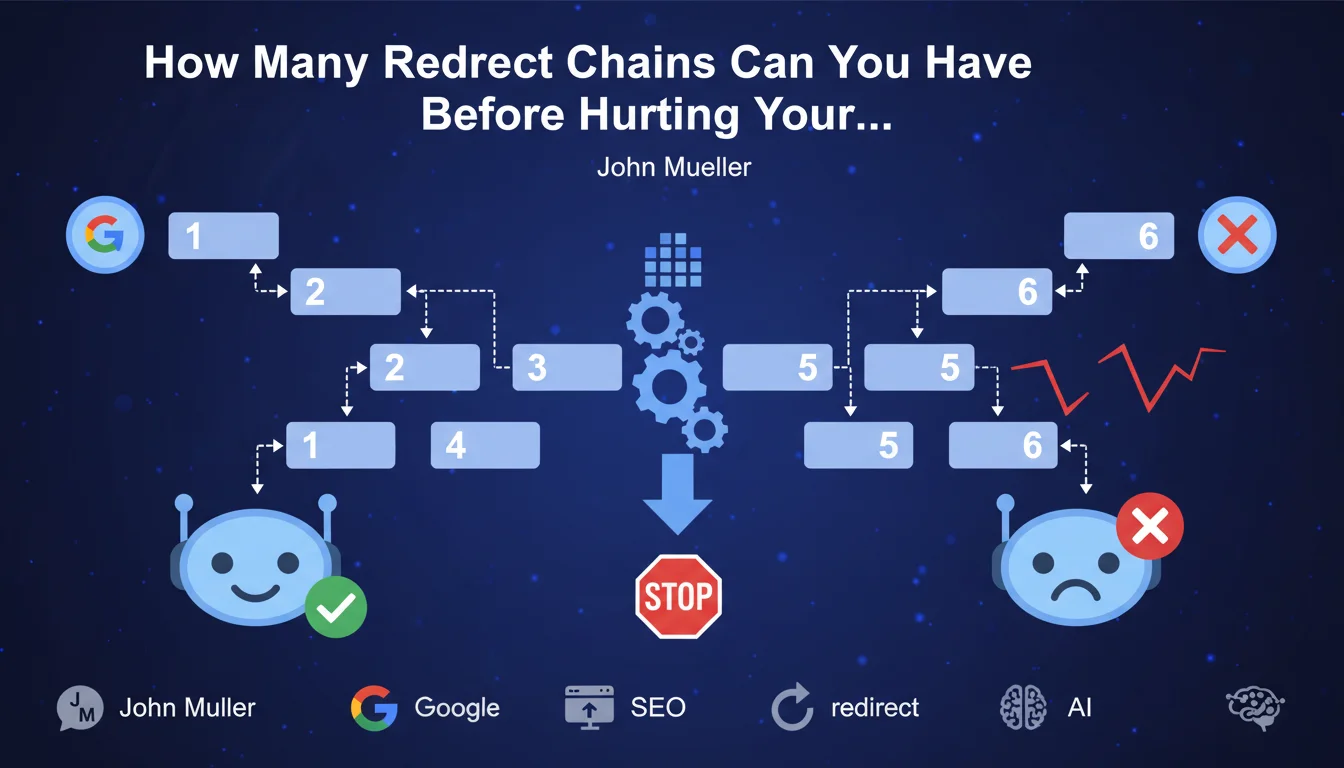
Redirect chains occur when one URL redirects to a second URL, which itself redirects to a third, and so on. This is a common situation during successive site migrations or poorly anticipated architecture changes.
Google has confirmed that Googlebot will not follow more than 5 successive redirects. Beyond this threshold, the crawler abandons and does not reach the final destination. This means the final page will not be indexed and will lose all SEO benefits.
In practice, each additional redirect in the chain represents a loss of time and crawl budget. The risk of technical errors also increases, and SEO signals (such as PageRank) progressively dilute at each stage.
- Google's official limit: 5 redirects maximum
- Expert recommendation: never exceed 2-3 redirects
- Each additional redirect dilutes the transmitted SEO signal
- Direct impact on crawl budget and loading time
- Increased risk of technical errors and infinite loops
SEO Expert opinion
While the technical limit of 5 redirects is confirmed, it would be unwise to approach it. In my 15 years of experience, I have observed that problems begin well before this theoretical limit.
The recommendation not to exceed 2 or 3 redirects maximum is based on several concrete findings. First, each redirect adds between 50 and 200ms of latency, negatively impacting user experience. Second, ranking signals gradually degrade, even though Google claims that a 301 redirect transmits almost all PageRank.
There are nevertheless legitimate cases of multiple redirects, particularly during complex migrations requiring a progressive transition. In these situations, the goal must remain to clean up these chains as quickly as possible, ideally within 3 to 6 months following the migration.
Practical impact and recommendations
Following this clarification, here are the priority actions to undertake to optimize your redirects:
- Immediately audit all existing redirect chains on your site with a crawler (Screaming Frog, Oncrawl, Botify)
- Identify and prioritize fixing all chains exceeding 2 redirects
- Update all internal links to point directly to the final URL
- During a migration, create direct redirects from the old URL to the new one, without going through intermediate URLs
- Document each redirect implemented and schedule quarterly reviews
- Set up alerts in Google Search Console to detect redirect issues
- Regularly clean up old redirects that are no longer necessary (after log verification)
- Train technical teams on best practices to avoid creating new chains
💬 Comments (0)
Be the first to comment.