
Official statement
What you need to understand
What Is Domain Name History and Why Does It Impact SEO?
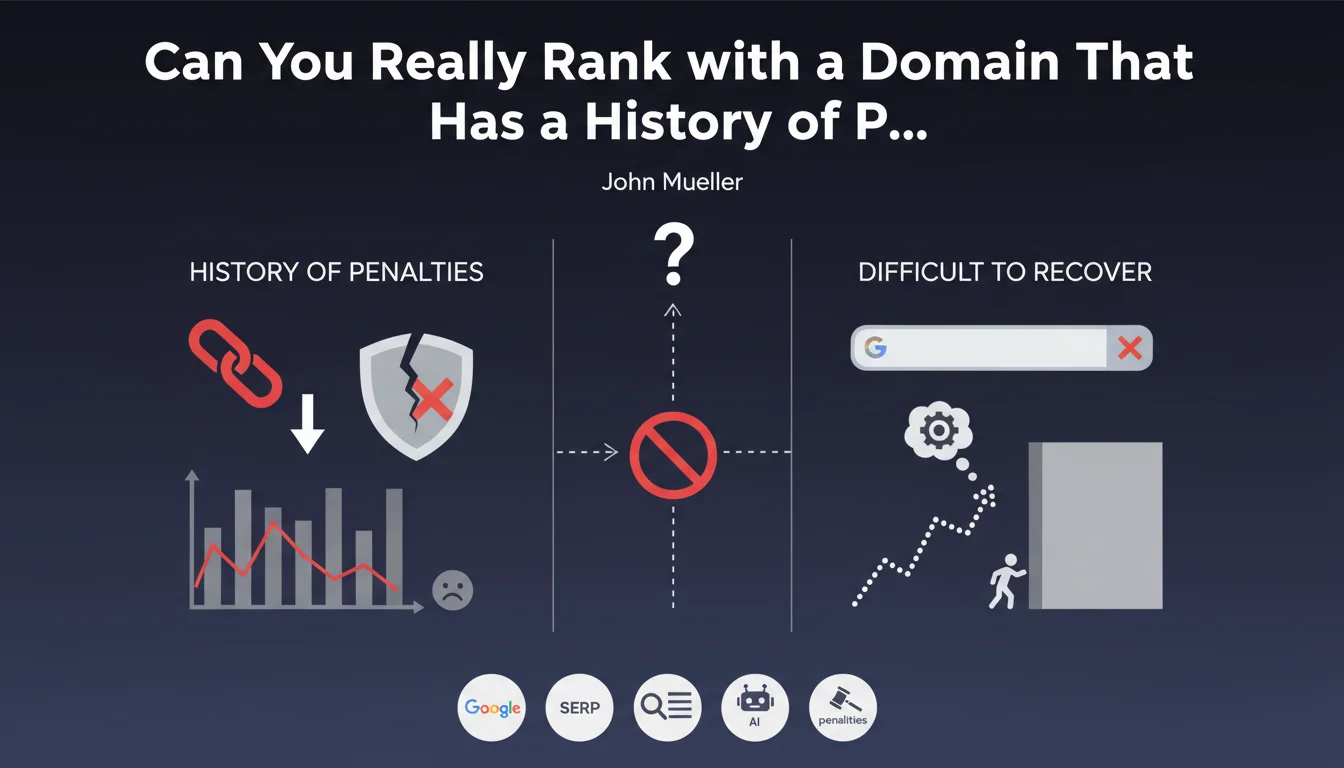
When a domain name has been used for years for practices contrary to Google's guidelines, it accumulates a history of penalties. These sanctions can be manual or algorithmic and leave a lasting imprint in Google's index.
Even after a change of ownership or a complete site redesign, Google retains the memory of this history. The search engine remains suspicious and applies a form of persistent distrust toward this domain, making SEO extremely difficult.
Why Does John Mueller Say It's Difficult to Convince Google?
John Mueller's statement is unequivocal: after decades of abuse, it becomes almost impossible to prove to Google that a site has radically changed. The algorithms are designed to identify manipulation patterns and retain these negative signals.
This position reflects Google's desire to protect the quality of its results. Accepting the rehabilitation of a penalized domain too easily would open the door to repeated manipulation by malicious actors.
Do Keywords in the Domain Name Still Have Value?
John Mueller takes advantage of this discussion to clarify a persistent myth: having exact match keywords in the domain (Exact Match Domain) no longer offers a significant advantage for several years now.
This strategy, popular in the 2000-2010 era, has been progressively neutralized by Google. EMDs no longer constitute a ranking factor and can even arouse suspicion if the content is not up to par.
- The negative history of a domain persists even after a change of ownership
- Google maintains a long memory of penalties applied over several years
- Exact Match Domains no longer provide an advantage in 2024
- It takes approximately 5 months minimum before seeing if a penalized domain can recover
- Algorithmic distrust is automatically applied to domains with a heavy past
SEO Expert opinion
Is This Statement Consistent with Real-World Observations?
My 15 years of experience completely confirm John Mueller's statements. I have supported several projects that attempted to purchase expired domains with a good link profile, only to ultimately find that they were burned. The results are systematically disappointing.
Some domains remain in a form of algorithmic purgatory for years. Even with impeccable content and quality backlinks, they never get past page 3 or 4 on their target queries. The ROI becomes catastrophic.
Are There Exceptions Where a Penalized Domain Can Recover?
Yes, but they are rare and require very specific conditions. A domain with a recent manual penalty (less than a year old) that is clearly identified can sometimes be rehabilitated after correction and submission of a reconsideration request.
Minor algorithmic penalties, such as a minor Penguin, can also dissipate over time with link profile cleanup. But for a domain with decades of abuse, the chances of recovery are less than 5% based on my observations.
What Are the Recommended Alternatives to Purchasing Penalized Domains?
In 95% of cases, starting with a new, clean domain name is the most profitable strategy in the medium term. Certainly, you start from zero in terms of authority, but you build on a healthy foundation without toxic legacy.
If you absolutely must target an expired domain for its backlinks, focus on domains never penalized, with a coherent thematic history and recent expiration (less than 6 months). The risk premium must be carefully calculated.
Practical impact and recommendations
What Should You Do If You Already Own a Domain with a History of Penalties?
First step: assess the severity of the situation. Consult Google Search Console to identify active manual penalties. Analyze the history via Wayback Machine to understand the extent of past practices.
If you find decades of abuse (massive spam, link farms, fraudulent content), the rational decision is often to abandon this domain and migrate to a new one. Investing months of effort for an uncertain result makes no economic sense.
For borderline cases, attempt a complete rehabilitation: remove all problematic content, disavow toxic links, create exceptional quality content, and document your actions in a reconsideration request if a manual penalty exists.
How Do You Evaluate a Domain Before Purchase to Avoid These Traps?
Before purchasing any expired domain, conduct a thorough audit. Check the complete history on Wayback Machine going back 5 to 10 years. Identify suspicious thematic changes or poor quality content.
Use tools like Ahrefs or Majestic to analyze the backlink profile. A ratio of over-optimized anchor texts or links from known networks are major red flags.
Test the domain in Google with queries like "site:domain.com". If no pages appear or if the results are abnormally low despite an old history, it's probably a sign of a penalty.
What Strategy Should You Adopt to Build a Sustainable SEO Presence?
The main lesson from this statement is clear: always prioritize the quality of foundations rather than shortcuts. A new domain with a solid content strategy will outperform a penalized domain in 12-18 months.
Invest in memorable branding rather than in an EMD stuffed with keywords. Google increasingly values authentic brands with a real value proposition and an engaged community.
- Systematically audit a domain's history before purchase (Wayback Machine, link profile, penalties)
- Prioritize a new brandable domain rather than a risky expired domain
- Avoid Exact Match Domains that no longer provide SEO value in 2024
- If your domain has a heavy history, calculate the ROI of migrating to a new domain
- Document all your cleanup actions if you attempt rehabilitation
- Test current visibility with "site:" queries before committing
- Build for the long term with white hat practices rather than seeking quick gains
💬 Comments (0)
Be the first to comment.