
Official statement
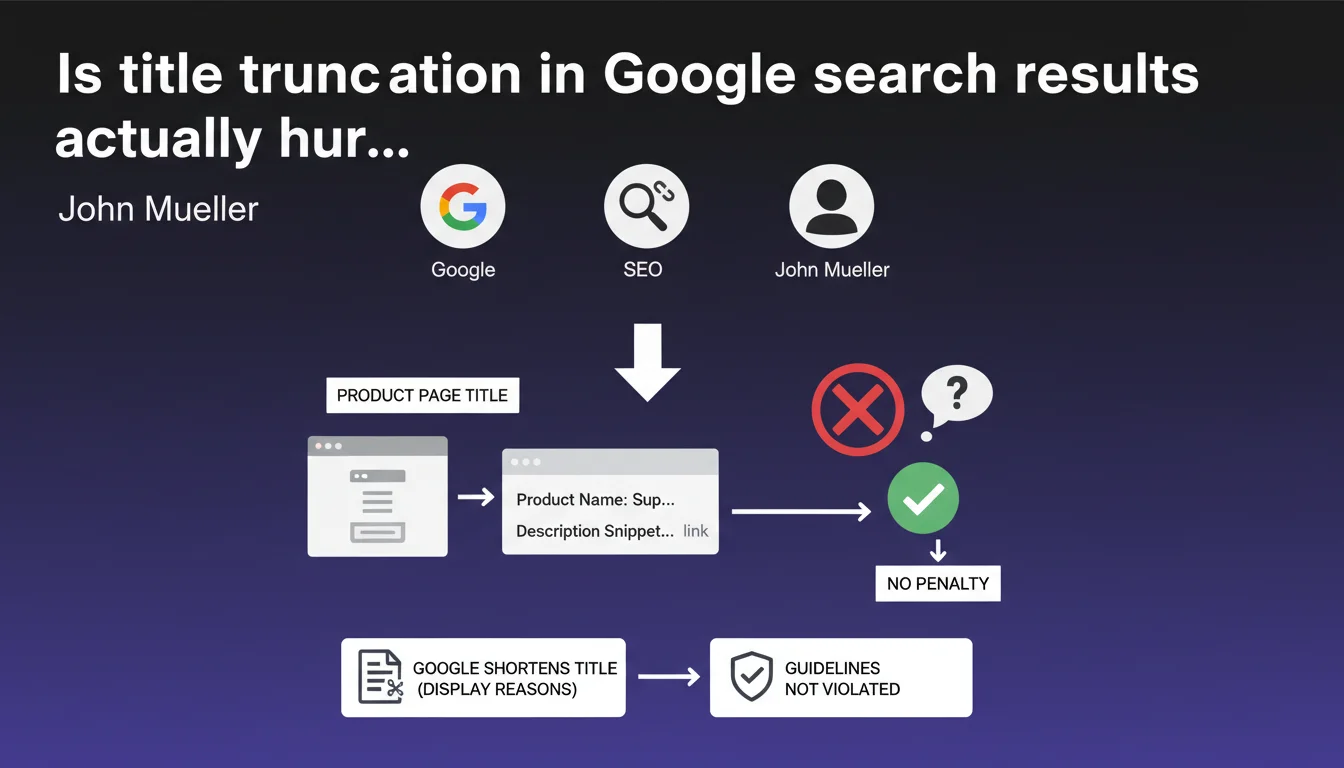
Google can truncate your product titles in search results without impacting your rankings. Mueller confirms: it's a display choice, not a penalty. Your full HTML title remains indexed, only the display varies based on search context.
What you need to understand
Why does Google truncate certain titles in the SERPs?
Google adjusts title display to optimize user experience based on search context. Screen width, original title length, and relevance to the search query all influence this truncation.
What many don't realize: Google doesn't just cut off at character 60. The algorithm can partially rewrite the title, add ellipses, or even display different portions of your title depending on the query. It's dynamic.
Does this truncation affect indexation?
No. Your complete title tag remains indexed and factored into rankings. The truncated display only affects visual presentation in search results.
Mueller clarifies: this is not a guideline violation. Your title optimization efforts aren't wasted, even if users only see a shortened version on screen.
What's the difference between truncation and title rewriting?
Truncation simply cuts off text that's too long. Rewriting, on the other hand, replaces your title with another snippet from the page that Google deems more relevant for that specific query.
Both phenomena coexist but follow different logic. Truncation = space issue. Rewriting = perceived relevance issue.
- Your complete title tag is always indexed and factored into rankings
- Truncation is a display adjustment, not an algorithmic penalty
- Google can truncate OR rewrite your titles depending on search context
- Optimal length remains 50-60 characters to maximize full display
- Keywords placed at the beginning of the title have better visibility odds
SEO Expert opinion
Is this statement consistent with what we observe in the field?
Yes, but with a major caveat. While pure truncation doesn't penalize, Google's automatic title rewriting remains a major friction point since it intensified.
Mueller is specifically talking about truncation — cutting a title that's too long. But in practice, Google doesn't just cut: it reformulates, pulls from H1s, extracts text snippets. That's a different story altogether.
What concrete risks for your product pages?
The real problem isn't algorithmic penalty, it's click-through rate. A title truncated in the wrong place can destroy your CTR, especially if differentiating keywords disappear.
Real example: "Nike Air Zoom Pegasus 40 Running Shoes for Men" becomes "Nike Air Zoom Pegasus 40 Running..." — you lose the exact model and gender targeting. Users click elsewhere.
Should you ignore title length then?
Absolutely not. Saying "it's not penalizing" doesn't mean "it has no consequences". [To verify]: Mueller gives no numerical guidance on the threshold where Google decides to rewrite rather than simply truncate.
The boundary between acceptable truncation and aggressive rewriting remains murky. From my experience: beyond 65-70 characters, the risk of complete rewriting increases significantly, especially if your title contains keyword stuffing or repetitions.
Practical impact and recommendations
How do you optimize your product titles to minimize visual truncation impact?
Place critical information first: model, brand, main differentiator. Secondary details (color, size, year) can be truncated without major damage.
Aim for 50-60 characters for full display on desktop and mobile. Beyond that, accept that the end will be cut and structure your titles accordingly.
What mistakes should you avoid when writing your title tags?
Never end a title with your most important information. If you sell products with specific references, put them first: "Nike Air Zoom Pegasus 40 – Men's Running Shoes" rather than "Men's Running Shoes Nike Air Zoom Pegasus 40".
Avoid repetitions and keyword stuffing. Google may interpret this as a low-quality signal and decide to completely rewrite your title, not just truncate it.
- Audit your strategic product pages with a tool that simulates actual SERP display (Screaming Frog, SEMrush, or manual preview)
- Identify titles where truncation cuts off critical information (product references, USP, models)
- Restructure your title templates to place essential info in the first 50 characters
- Test CTR impact with title variations through A/B testing (Google Search Console can provide clues)
- Monitor aggressive rewrites: if Google consistently ignores your titles, it's a title/H1/content alignment signal to revisit
- On mobile, verify actual display — desktop simulators aren't enough
💬 Comments (0)
Be the first to comment.