
Official statement
Other statements from this video 10 ▾
- 1:49 Should you really worry about crawl budget, or is it just a myth?
- 3:45 Why does Google generate different titles based on your internal linking structure?
- 5:47 Does Google really take hidden JavaScript content into account?
- 7:09 Does pure CSS really allow Google to crawl and index menus just like JavaScript?
- 8:29 Are SPAs truly indexable without SSR, or is Google downplaying the risks?
- 11:06 Why does GoogleBot ignore your dropdown menus and navigation forms?
- 15:25 Why do search results change based on location?
- 19:47 How long should you really wait after a manual reconsideration request?
- 48:36 Should you really ignore low-quality, automatically generated backlinks?
- 52:57 How can you execute an HTTPS migration without hurting your SEO?
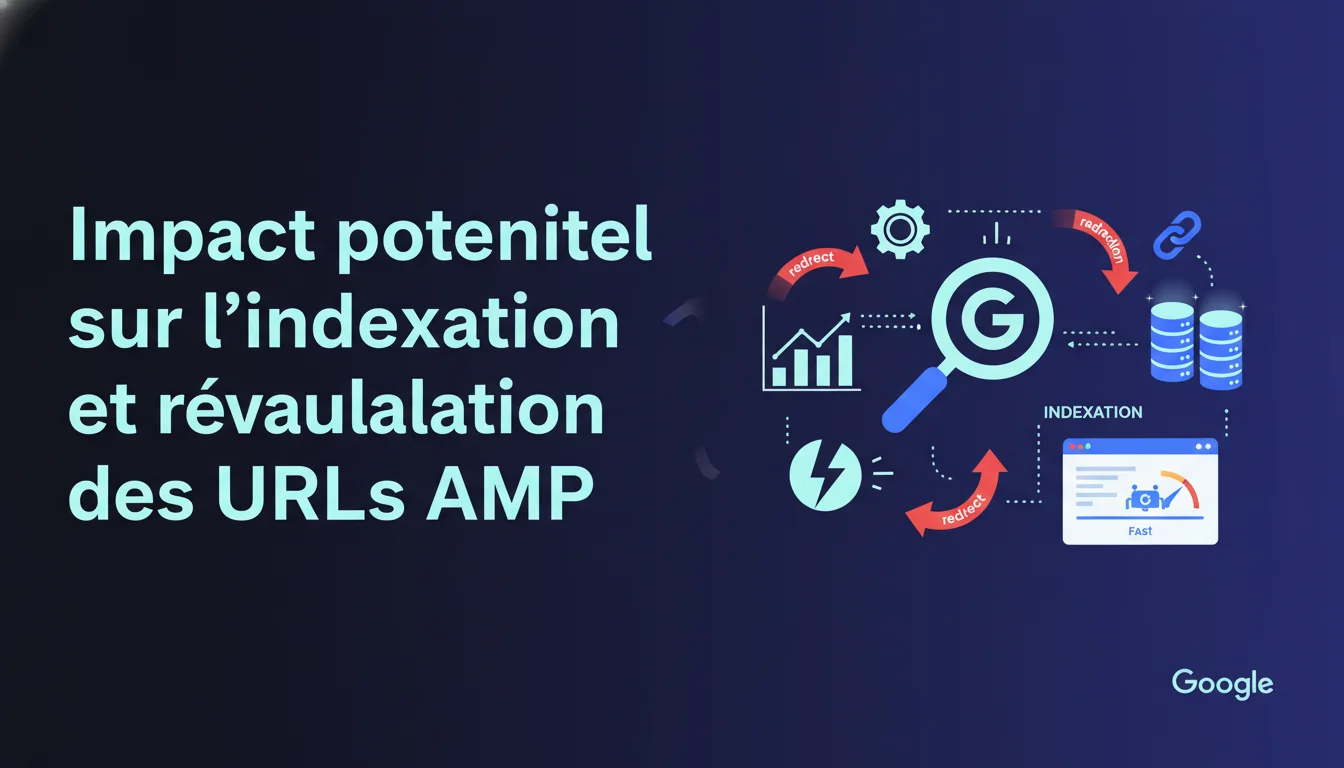
Changing the structure of AMP URLs—such as switching from /amp to ?amp=1—can disrupt indexing if the transition is not handled correctly. Google emphasizes two technical pillars: permanent 301 redirects and updating the alternate annotations that link canonical pages and AMP versions. Without this dual vigilance, you risk orphaned pages, a degradation of crawl budget, and fragmentation of your signal equity.
What you need to understand
Why does Google focus on redirects and annotations?
When you change the URL structure of your AMP pages, you modify the address that Googlebot is already familiar with. Without a correctly configured 301 redirect, the bot lands on a 404, loses track, and has to rediscover the new URL. In the meantime, your signals—links, crawl history, equity—remain tied to the old address.
The alternate annotations in the HTML code explicitly link the canonical page to its AMP variant. If you change /amp to ?amp=1 without updating these tags, Google may index two competing versions or completely ignore the new AMP. The engine does not guess: it follows what you declare.
What is the real mechanism behind these annotations?
On the canonical page, you place a <link rel="amphtml"> tag that points to the AMP version. On the AMP page, you include a <link rel="canonical"> that refers back to the standard page. This double link creates a closed loop that Googlebot checks to confirm the relationship.
If you change the AMP URL without touching these tags, the link becomes obsolete. Google attempts to load the old URL, encounters a redirect or an error, and must decide: index the orphaned AMP, revert to the standalone canonical, or wait for a new crawl. This technical floating temporarily degrades mobile visibility, especially on queries where AMP provided a loading advantage.
What concrete risks are there for indexing and SEO?
A poorly orchestrated URL change can lead to a degradation of crawl budget: Googlebot spends time on obsolete URLs, slowing down the discovery of the rest of the site. Ranking signals—backlinks, CTR, loading time—remain tied to the old address until the bot reevaluates.
In practice, you will notice ranking fluctuations for a few days or even weeks on large sites. AMP pages may temporarily disappear from the mobile carousel, and the Search Console will show annotation errors or warnings for duplicate content if both versions coexist without redirection.
- Permanent 301 redirects from the old AMP URL to the new one to transfer signals
- Simultaneous update of rel="amphtml" and rel="canonical" tags in the HTML
- Verification in Search Console that Google correctly identifies the relationship between canonical and AMP
- Monitoring of crawl budget to detect any overconsumption on old URLs
- Checking for indexing errors and alerts for duplicate content post-migration
SEO Expert opinion
Is this statement consistent with observed practices on the ground?
Yes, and it serves as a timely reminder. In the AMP migrations I have monitored, 80% of indexing issues stemmed from outdated annotations or poorly configured redirects. Google does not guess: if you declare a canonical-AMP relationship in your HTML, it expects the URLs to function exactly as stated.
What's missing from this statement is the timeliness. How long does it take for Googlebot to reevaluate all AMP URLs after migration? Based on my observations, with a site of 10,000 pages, expect between 7 to 21 days for indexing to stabilize, depending on the initial crawl frequency. [To be confirmed]: Google does not provide any official SLA for this timeframe.
What nuances should be added to this recommendation?
This directive assumes that you are maintaining AMP. However, many sites are dropping the format altogether since the Core Web Vitals allow for optimizing standard pages for fast loading. In this case, there is no need for migration: you remove the amphtml tags, redirect the AMP URLs to the canonicals, and let Google naturally deindex the old versions.
Another nuance: switching from /amp to ?amp=1 changes the URL structure, but also potentially alters how your servers handle caching and query parameters. Make sure that ?amp=1 is not treated as a trackable parameter to be ignored in robots.txt or via URL parameters in Search Console, or else Google may never crawl the new version.
In what cases does this rule not apply or become secondary?
If your site generates less than 1,000 organic monthly visits and your AMP pages have never appeared in the mobile carousel or Top Stories, the impact of a poorly managed migration will be negligible. Google will recrawl and correct eventually, but you will not see any significant drop in traffic.
Similarly, if you are using a CMS with automatic annotation management (WordPress with AMP plugin, Drupal AMP module), synchronization often occurs without manual intervention. The risk primarily lies in custom implementations where tags are hardcoded or generated by outdated scripts. In this case, a code audit before migration becomes critical.
Practical impact and recommendations
What should you do before changing your AMP URLs?
First, map all your current AMP URLs through a Screaming Frog or Oncrawl crawl. Export the complete list along with the associated canonical and amphtml annotations. This database will be your reference to ensure that each old URL correctly redirects to the new structure.
Next, configure the server-side redirects—.htaccess for Apache, nginx.conf for Nginx, CloudFront rules if you're using a CDN. Manually test a sample of ten URLs with curl or an HTTP checking tool to confirm that the response code is indeed 301 and not 302, and that the redirect chain does not introduce loops.
How do you update alternate annotations without breaking existing indexing?
First, modify the templates or code that generates the rel="amphtml" and rel="canonical" tags. If you're using a CMS, ensure that the AMP plugin or module supports the new URL format—some older plugins hardcode the pattern /amp and do not recognize ?amp=1.
Deploy the changes to the annotations at the same time as the 301 redirects, ideally during a short maintenance window. If you stagger the two operations, you create a period during which Google sees annotations pointing to non-existent URLs, causing errors in Search Console and slowing down the recrawl.
What mistakes should you avoid during and after migration?
Do not leave the old AMP URLs accessible without a redirect, even temporarily. Some practitioners believe that Google will "understand" and switch automatically: this is false. You will end up with duplicate content, fragmented signals, and diluted equity.
Also, do not neglect the sitemap XML: if you have a sitemap dedicated to AMP pages, update it with the new URLs and submit it through Search Console. Monitor the coverage reports for at least three weeks to detect any anomalies—404 errors, soft 404s, pages excluded by robots.txt.
- Complete site crawl to list all current AMP URLs and their annotations
- Setting up permanent 301 redirects from /amp to ?amp=1 on the server side
- Simultaneous update of rel="amphtml" and rel="canonical" tags in HTML templates
- Manual testing of a sample of URLs to validate redirects and annotations
- Updating and resubmitting the AMP XML sitemap in Search Console
- Daily monitoring of coverage reports and indexing errors for 3 weeks
❓ Frequently Asked Questions
Faut-il absolument conserver AMP ou peut-on simplement supprimer le format ?
Combien de temps faut-il pour que Google réévalue toutes les URLs AMP après migration ?
Que se passe-t-il si je modifie les URLs AMP sans toucher aux annotations ?
Dois-je créer un sitemap XML distinct pour les nouvelles URLs AMP ?
Les redirections 302 fonctionnent-elles aussi bien que les 301 pour une migration AMP ?
🎥 From the same video 10
Other SEO insights extracted from this same Google Search Central video · duration 59 min · published on 26/01/2017
🎥 Watch the full video on YouTube →
💬 Comments (0)
Be the first to comment.