
Official statement
What you need to understand
What is Google's official stance on multiple niche sites?
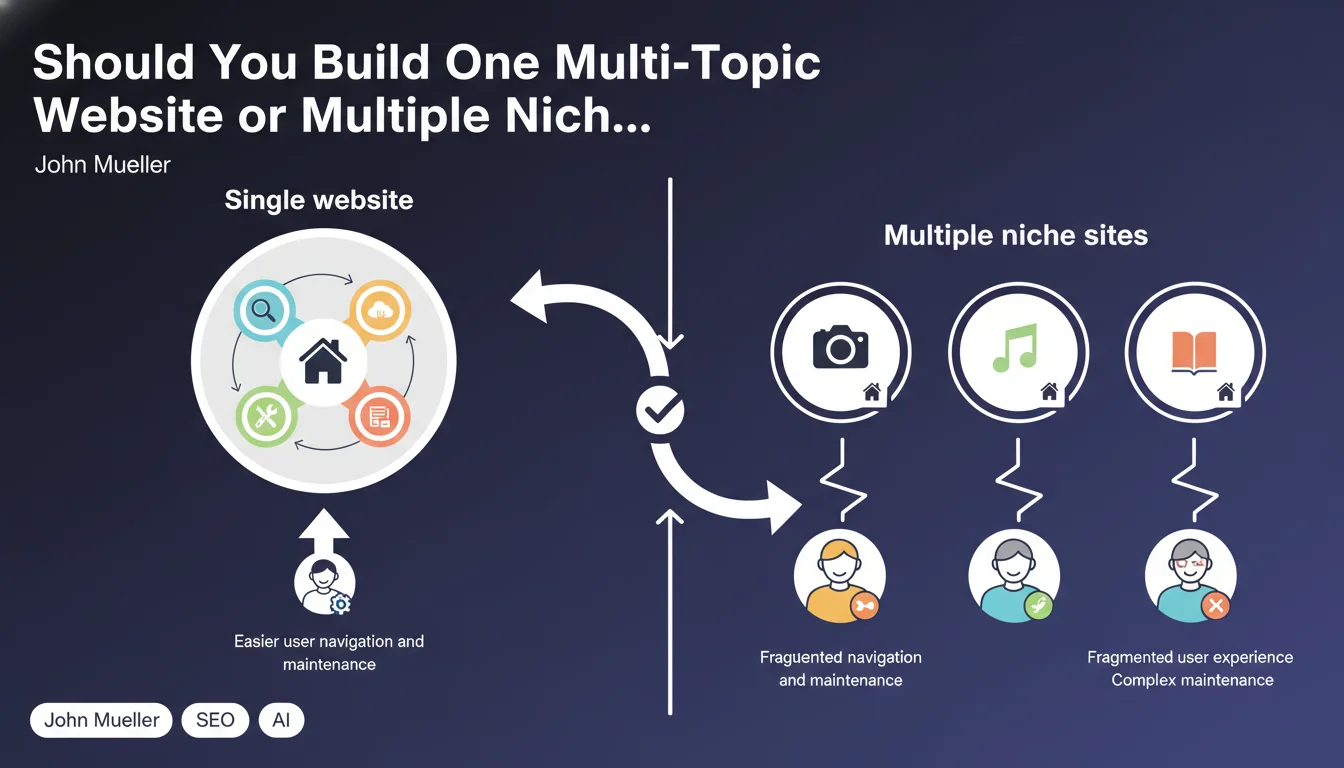
Google recommends prioritizing a single site structured in topical silos rather than multiplying independent niche sites. This approach aims to concentrate authority on a single domain and simplify the user experience.
The main argument put forward is that of maintenance and navigation. Managing several distinct domains represents a considerable investment in time and resources, both for owners and for users who have to juggle between different sites.
What exactly is a topical silo and how does it work?
A topical silo is a site structure where each major topic has its own distinct hierarchy with interconnected content. This organization allows you to create powerful semantic cocoons while remaining on a single domain.
Each silo benefits from the overall popularity of the domain while maintaining internal topical coherence. Users can easily navigate between different topics without changing sites.
What are the technical advantages of a single site according to Google?
From Google's perspective, a single site facilitates crawling and indexing. The robots only have one domain to explore, which optimizes the crawl budget and allows faster content updates.
The consolidation of trust signals is also a key factor: backlinks, domain age, user engagement... All these elements add up on a single domain instead of being diluted across multiple properties.
- Concentration of authority on a single domain name
- Simplified maintenance: one CMS, one hosting, one strategy
- Consistent user experience across different topics
- Optimized crawl budget for Google
- Pooling of SEO efforts (internal linking, content, technical)
SEO Expert opinion
Does this recommendation always align with SEO market reality?
Google's position is partially aligned with ground realities, but it considerably simplifies a complex problem. In practice, many high-performing players successfully use multi-site strategies.
The official discourse deliberately omits the strategic advantages of niche sites: ultra-precise targeting, specialized branding, differentiated monetization, SEO risk isolation, and especially the ability to dominate specific queries with pure topical authority.
In which cases does a multi-site strategy remain relevant?
Independent niche sites maintain their relevance in several strategic scenarios. When topics are very distant (example: DIY and personal finance), grouping them would dilute overall semantic coherence.
For affiliate or targeted monetization projects, having separate sites allows you to optimize conversion rates with ultra-specialized messages. Moreover, in case of a Google penalty, isolation limits the damage to a single domain rather than your entire ecosystem.
What are the real decision criteria between single site and multi-sites?
The decision should be based on business and organizational criteria rather than an absolute SEO rule. Evaluate your ability to regularly produce quality content: one well-maintained site is better than three abandoned sites.
Also analyze the actual topical coherence between your niches. If you find natural angles to connect them (example: sports nutrition and fitness equipment), the single site makes sense. If the topics have no organic link, forcing them together can harm the topical authority of each section.
Finally, consider your brand strategy: certain positioning requires a distinct identity per niche to maximize credibility and engagement from specific communities.
Practical impact and recommendations
What should you actually do if you already have multiple niche sites?
Before making any decision, conduct a comparative performance audit of your different domains. Identify those that generate qualified traffic and conversions, and those that stagnate despite your efforts.
For high-performing sites with an established brand identity, migration to a single site can be counterproductive. On the other hand, underperforming sites can benefit from consolidation via 301 redirects to dedicated silos on your main domain.
Plan migrations carefully: preserve SEO juice with precise page-by-page redirects, not generic redirects to the homepage. Monitor metrics for at least 6 months post-migration to detect any traffic loss.
How do you effectively structure a single multi-topic site?
Create a watertight silo architecture where each topic has its own hierarchy in the URL (/topic-a/category/article). This structure should be visible from the navigation menu to clarify the organization for users and search engines.
Optimize strategic internal linking: strong links within each silo, moderate links between silos only when semantic relevance justifies it. Avoid anarchic linking that would dilute the thematic strength of each section.
Develop distinct pillar pages for each topic, which will serve as authority hubs. These pages should be comprehensive and serve as the main entry point for each silo in your content strategy.
What critical mistakes should you avoid with this strategy?
Never mix incompatible topics under the guise of simplification. A site dealing simultaneously with vegan recipes and sport hunting would lose all credibility with both Google and users.
Avoid cannibalization between silos by ensuring that each topic targets distinct keywords without overlap. Use tracking tools to detect positioning conflicts between pages from different silos.
Don't neglect the visual identity of each silo. Even on a single site, each topic can have its own partial graphic charter (colors, visuals) to reinforce user identification while maintaining overall coherence.
- Audit current performance of each domain before any decision
- Evaluate actual semantic coherence between your topics
- Plan 301 redirects page by page, never in bulk to the homepage
- Create a silo architecture with dedicated URLs per topic
- Develop comprehensive pillar pages as entry points for each silo
- Implement strategic internal linking (strong intra-silo, moderate inter-silo)
- Monitor keyword cannibalization between different silos
- Adapt visual identity to differentiate silos without losing overall coherence
- Monitor metrics for 6+ months after any migration
The single site vs. multi-sites question has no universal answer. Google recommends the single site for maintenance reasons, but this approach is mainly suitable for naturally complementary topics with sufficient resources to develop them.
Independent niche sites remain relevant for very distant topics, specialized affiliate models, or when risk isolation is strategic. The essential thing is to prioritize quality and coherence on each property.
Implementing an optimal strategy requires an in-depth analysis of your digital ecosystem: technical audit, semantic analysis, performance evaluation, planning of potential migrations. These structural optimizations can prove complex to orchestrate alone, particularly to preserve existing SEO capital. Support from a specialized SEO agency can facilitate these strategic transitions by providing technical expertise and global vision, thus ensuring that your architecture choices truly serve your business objectives.
💬 Comments (0)
Be the first to comment.