
Official statement
What you need to understand
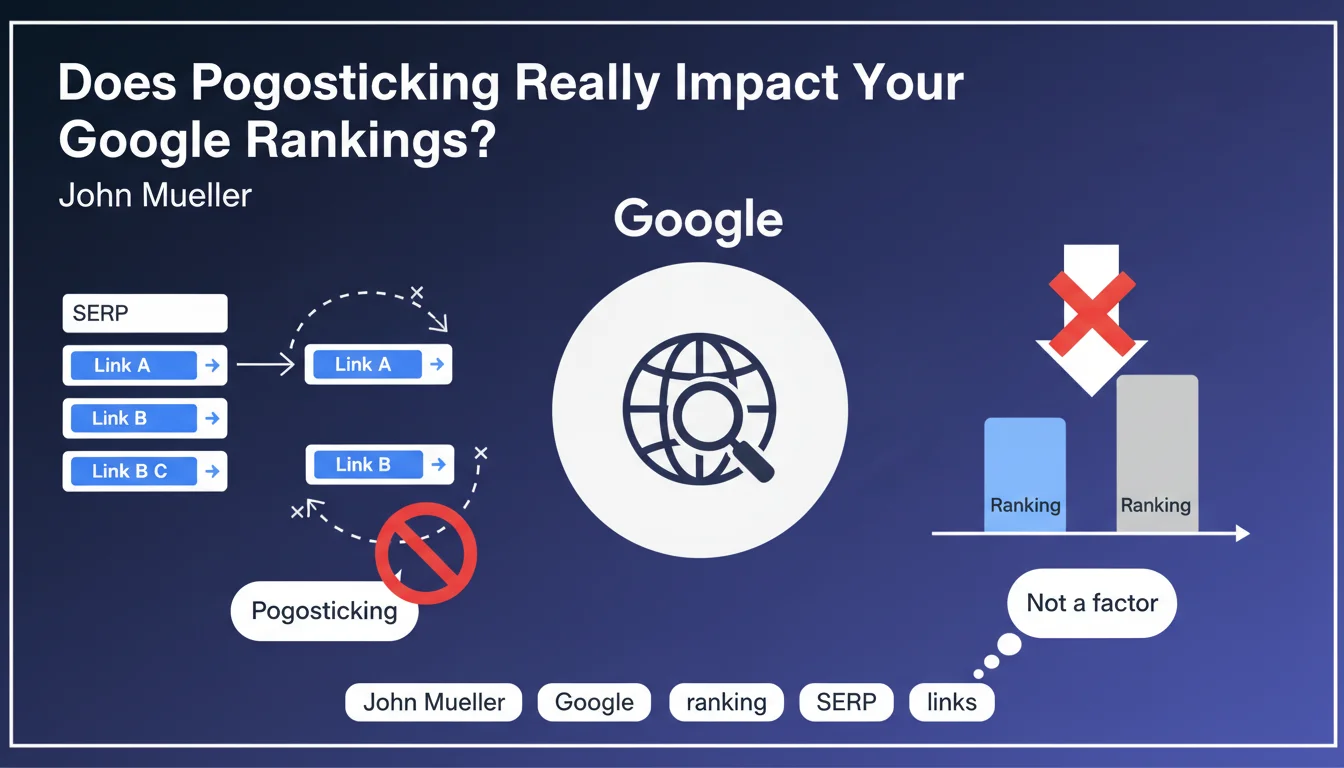
Pogosticking refers to the behavior of a user who performs a search, clicks on a result, quickly returns to the search results page (SERP), then clicks on another link. This repeated back-and-forth between the SERP and visited pages has long been considered by some SEO professionals as a potential signal used by Google to evaluate page quality.
According to this official statement, Google does not use pogosticking as a ranking criterion for individual pages. In other words, if a user quickly returns to the SERP after visiting your page, this does not directly impact your position in search results.
The explanation provided is that Google would rather use these behavioral signals in an aggregated and global manner to evaluate the relevance of its algorithms and the overall results offered for a given query, rather than to penalize or favor specific pages.
- Pogosticking is not a direct ranking factor for pages
- This data helps Google improve the overall quality of its search engine
- The analysis is done at the algorithmic level rather than at the granular page level
- User behaviors remain observed but with a different objective
SEO Expert opinion
This statement is consistent with Google's technical approach and with what is observable in the field. Indeed, using pogosticking as a direct ranking signal would present several major problems: ease of manipulation, variations depending on query types (navigational vs informational), and difficulty distinguishing a legitimate quick return from a dissatisfaction signal.
However, an important nuance must be added: even if pogosticking as such is not a direct factor, the reasons that cause this behavior certainly are. If users massively leave your page, it's often because the content doesn't match the search intent, the page is slow, or the user experience is poor. Yet, these elements (content relevance, Core Web Vitals, UX) are indeed proven ranking factors.
Practical impact and recommendations
This clarification should lead you to refocus on the real ranking factors rather than trying to optimize unconfirmed behavioral metrics.
- Don't artificially manipulate user behaviors (incentives to stay on the page, fake content, etc.) hoping to improve your ranking
- Focus on truly satisfying search intent: does your content precisely answer what the user is looking for?
- Optimize the overall user experience: loading speed, presentation clarity, information accessibility
- Analyze your engagement metrics (time spent, bounce rate, pages viewed) not as direct SEO factors, but as indicators of the quality perceived by your visitors
- Work on your content structure so that key information is immediately visible and meets the expectations created by your title and description
- Test the consistency between your meta tags (title, description) and the actual page content to avoid disappointments
- Monitor Core Web Vitals and other user experience signals which are confirmed as ranking factors
💬 Comments (0)
Be the first to comment.