
Official statement
What you need to understand
What's the Difference Between Personalization and Contextualization in Google?
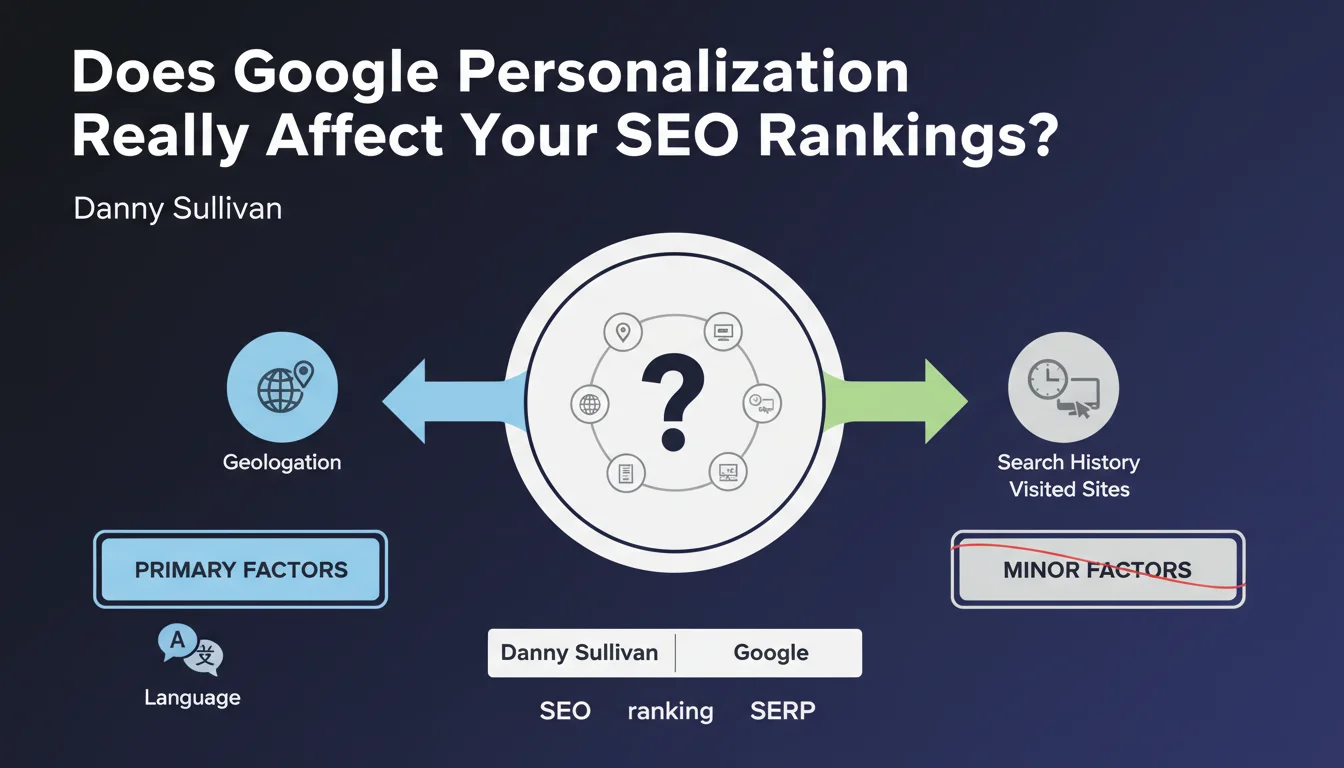
Result personalization relies on the user's browsing history, previous searches, and behavioral profile. Google states that this criterion now has an extremely low weight in its ranking algorithm.
Contextualization, on the other hand, encompasses factors like geolocation, language, or the device used. These elements have a major impact on the results displayed, particularly for local or geolocated queries.
Why Has Google Reduced the Importance of Personalization?
This evolution is primarily explained by personal data protection regulations (GDPR, CCPA). Google has progressively limited the use of behavioral data to avoid privacy issues.
Most of the time, the search engine now no longer considers personal history when ranking a page in organic results.
What Does This Actually Mean for SEO?
- Don't invest resources in optimization for user personalization
- Focus efforts on geographic and local contextualization
- Understand that all users see broadly the same organic results for a given query
- Prioritize universal ranking factors rather than personalized ones
SEO Expert opinion
Is This Statement Consistent with Field Observations?
Absolutely. SEO tests conducted in private browsing versus personalized browsing show marginal differences in organic results. The variations observed are generally less than 5% of positions.
On the other hand, geolocation can radically modify ranking, sometimes up to 80% of results for certain local queries. This is tangible proof of the distinction between personalization and contextualization.
What Important Nuances Should Be Added to This Statement?
While personalization has little impact on organic ranking, it can influence other SERP elements. Search suggestions and certain rich snippets may vary depending on the user.
Additionally, for users logged into their Google account with a very marked history on a specific domain, slight variations may appear. But this remains the exception rather than the rule.
In What Cases Can Personalization Still Play a Role?
For very ambiguous or polysemous queries, Google may use history to disambiguate intent. For example, "apple" might display more technology results for someone who regularly visits tech sites.
However, even in these cases, the impact remains minimal and unpredictable. It doesn't justify any specific SEO strategy.
Practical impact and recommendations
What Should You Actually Do in Your SEO Strategy?
Abandon any optimization attempt based on user personalization. Focus your resources on universal ranking factors: content quality, authority, user experience, and technical performance.
Invest heavily in local SEO if your business has a geographic dimension. Geolocation remains the most powerful and exploitable contextual criterion.
What Strategic Mistakes Should You Absolutely Avoid?
Don't waste time creating different content based on imaginary user profiles. Google doesn't personalize results enough for this to be profitable in SEO.
Also avoid testing your rankings while logged into your Google account after visiting your site. Consistently use private browsing or third-party SEO tools to obtain reliable ranking data.
How Can You Adapt Your Optimization Strategy Accordingly?
- Prioritize optimization for geolocation (Google Business Profile, local citations, geolocated keywords)
- Track your rankings with professional tools in non-personalized mode
- Create universal quality content rather than personalized variants
- Optimize for search intent rather than user profiles
- Focus budgets on technical, content, and authority factors
- Monitor geographic ranking variations rather than personal ones
💬 Comments (0)
Be the first to comment.