
Official statement
What you need to understand
What is the Mobile First index and why is this question crucial?
Since the rollout of the Mobile First index, Google primarily uses the mobile version of your pages for indexing and ranking. This transition has disrupted traditional SEO practices where the desktop version was the priority.
The question of equivalence between mobile and desktop content has become critical because it directly determines your presence in Google's index. A poor understanding of this principle can delay or block your migration to the Mobile First index.
What does "fulfill the same purpose" actually mean in practice?
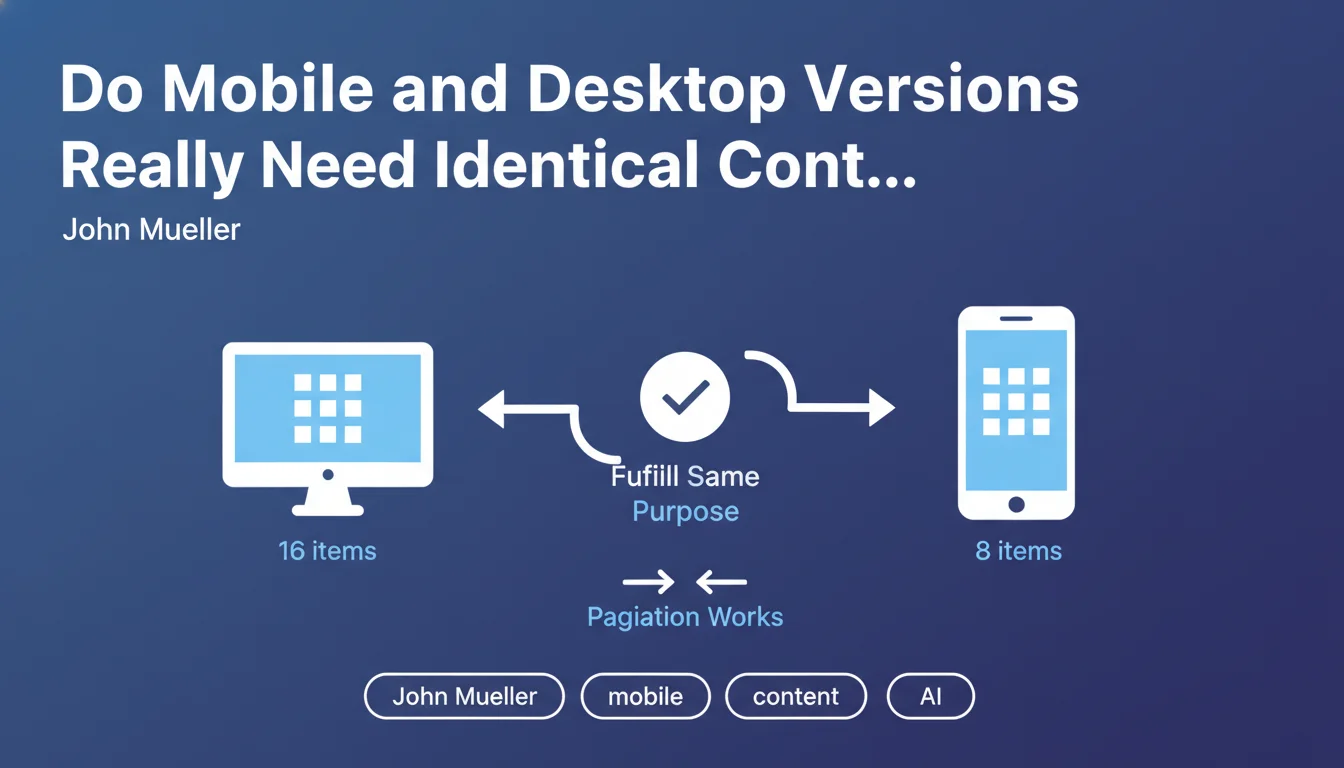
Google doesn't demand strict identity between the two versions, but rather functional equivalence. The user objective must be achieved in both cases, even if the presentation differs.
The pagination example perfectly illustrates this principle: displaying 8 items instead of 16 on mobile is acceptable if the user can access all items through functional navigation. The end result remains identical.
What are the essential points to take away from this statement?
- No strict identity required: mobile and desktop versions can differ in their presentation
- Purpose equivalence mandatory: users must be able to accomplish the same action and access the same information
- Pagination is flexible: the number of items per page can vary between mobile and desktop
- Editorial content remains sensitive: for text, caution recommends maximum equivalence
- Some sites still haven't migrated to the Mobile First index due to excessive divergences
SEO Expert opinion
Does this statement align with practices observed in the field?
My experience across hundreds of audits confirms that Google is indeed pragmatic about presentation differences. Sites with pagination or list display variations generally don't encounter indexing problems.
However, I regularly observe indirect penalties for sites that hide substantial editorial content on mobile. Google may consider that the purpose is no longer fulfilled if entire paragraphs, key information, or calls-to-action disappear on mobile.
What critical nuances should be added to this recommendation?
Google's tolerance mainly applies to structural elements (navigation, pagination, product grids). For main editorial content, the margin for maneuver is much narrower.
I've found that sites reducing their textual content on mobile by more than 20-30% often encounter difficulties. Featured snippets, position zero, and even rankings can be affected if mobile content is too streamlined.
In what cases can this flexibility backfire on you?
E-commerce sites are particularly exposed. Reducing product descriptions on mobile may seem logical for UX, but Google may interpret this as a less complete and less relevant page.
News sites and blogs that truncate their articles on mobile also take a risk. If your competitor displays the full content on mobile, they benefit from a structural SEO advantage even if Google theoretically tolerates your approach.
Practical impact and recommendations
What should you actually do to secure your Mobile First indexing?
Start with a rigorous comparative audit between your mobile and desktop versions. Use Search Console to identify whether your site is already in the Mobile First index and check for any warnings.
For main editorial content, systematically prioritize total parity. Reserve variations for peripheral elements like sidebars, product grids, or secondary navigation elements.
Test your pages with Google's URL Inspection tool in mobile mode. Verify that all your important content is crawlable and indexable, even if it's in accordions or tabs.
What critical mistakes should you absolutely avoid?
Never remove entire content sections on mobile thinking you're improving user experience. Google might consider that the two pages no longer fulfill the same purpose.
Avoid poorly implemented lazy loading techniques that prevent Googlebot from discovering your mobile content. Ensure that your JavaScript properly renders all essential content accessible to the initial crawl.
Don't rely solely on official statements. SEO A/B testing on your own pages remains the best way to validate what actually works for your specific context.
How can you verify and optimize your site's compliance?
- Systematically compare the source HTML of mobile and desktop versions for main content
- Check in Search Console that your site has been properly migrated to the Mobile First index without warnings
- Audit all hidden content (accordions, tabs) and ensure they remain crawlable
- Test mobile and desktop pagination to confirm access to all elements in both cases
- Measure Core Web Vitals on mobile as they are now priority for ranking
- Monitor ranking variations after modifications to detect any negative impact
- Implement continuous monitoring of content differences between versions
💬 Comments (0)
Be the first to comment.