
Official statement
Other statements from this video 9 ▾
- 0:40 Les balises d'ancre influencent-elles vraiment vos positions dans Google ?
- 3:39 La qualité du contenu peut-elle compenser un maillage interne faible ?
- 5:53 Combien de temps faut-il vraiment pour que Google prenne en compte vos modifications de contenu ?
- 10:58 La pertinence du contenu suffit-elle vraiment à garantir un bon classement SEO ?
- 11:36 Le contenu dupliqué conduit-il vraiment à une pénalité Google ?
- 16:32 Le hreflang transfère-t-il vraiment du jus SEO entre vos pages internationales ?
- 19:52 La vitesse de chargement affecte-t-elle vraiment le classement Google ?
- 38:34 Les URLs multiples avec canonical correcte pénalisent-elles vraiment le ranking ?
- 51:40 Faut-il vraiment garder les dates de dernière modification dans vos sitemaps XML ?
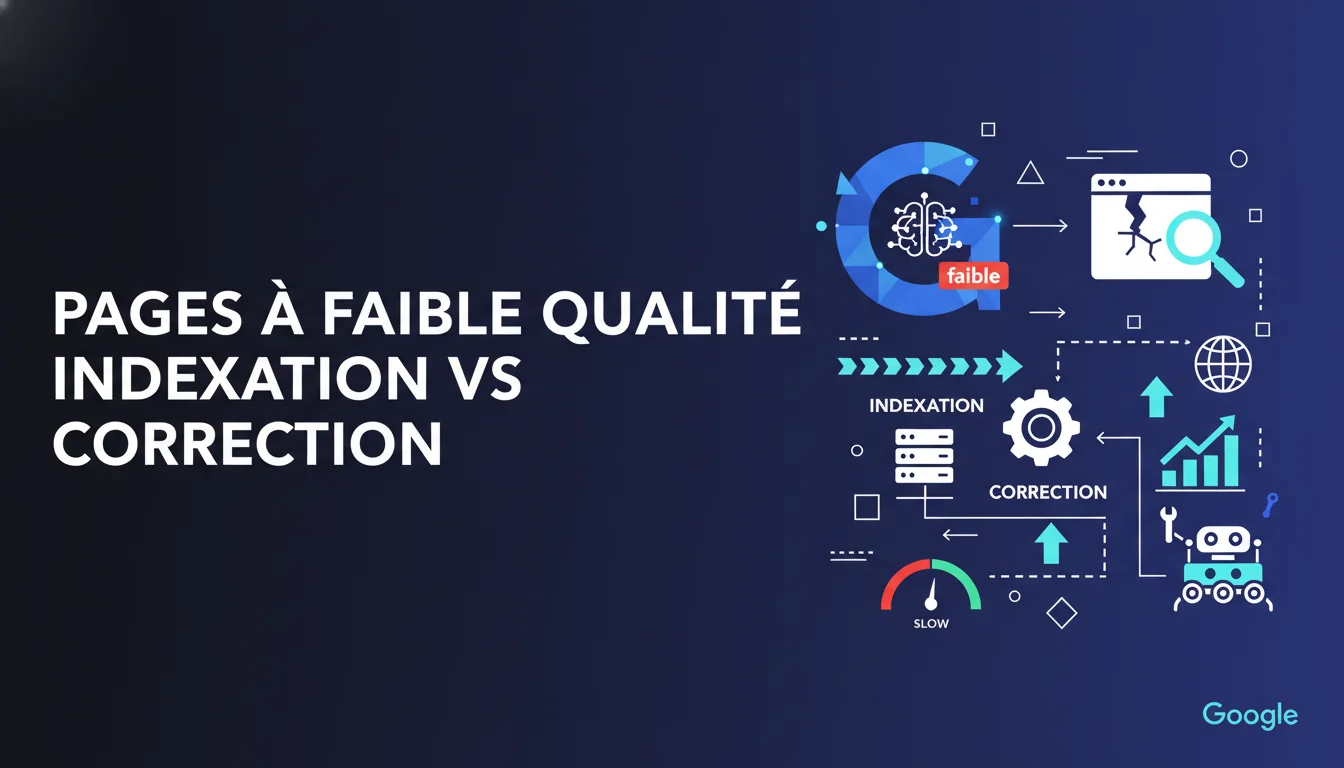
Google recommends correcting low-quality pages rather than excluding them from the index, unless their volume or nature makes correction too burdensome. This official stance suggests that mass deindexing could impact the overall visibility of the site. Essentially, it means prioritizing the improvement of existing content, but using noindex remains a valid option for certain edge cases.
What you need to understand
Why does Google prefer correction over deindexing?
Google favors correcting weak pages because its algorithm evaluates the overall quality of a site. Mass deindexing can be seen as an admission of editorial failure, sending a mixed signal about the site's ability to produce value.
The underlying logic pertains to how the Helpful Content System operates. Google observes the ratio of useful content to weak content across the entire domain. Removing pages does not necessarily improve this ratio if the rest of the site remains mediocre. Correcting content, however, directly enhances perceived quality.
When does deindexing become legitimate?
Google acknowledges two scenarios where noindex or removal is justified. The first scenario: too high a volume. If you have 10,000 product listings generated automatically with three lines of identical text, manually correcting each one is unrealistic. Deindexing allows for a quick cleanup.
The second scenario: hard-to-correct pages. Some content is structurally weak by nature. Empty tag pages, dated archives with no unique content, and facet filters generating endless combinations are all cases where correction makes no economic or technical sense.
What definition does Google provide for 'low quality'?
This is where it gets tricky. Google does not provide any numerical threshold or objective criteria in this statement. It is also known that the Helpful Content System targets content primarily created for engines, thin content, duplicated pages, or pages with low added value.
In practice, a low-quality page often shows: little original text, a high bounce rate, a lack of natural backlinks, a low time on page. However, Google does not publish an official evaluation grid, leaving SEOs unclear about precise diagnostics.
- Prioritize correcting existing content when economically feasible
- Reserve noindex for mass volumes or structurally weak content
- Google provides no objective criteria to define 'low quality'
- Mass deindexing can send a negative signal about the overall quality of the site
- Improving content directly impacts the Helpful Content System
SEO Expert opinion
Is this recommendation consistent with field observations?
Yes and no. On medium-sized sites (a few hundred pages), improving weak content works well. There are regular traffic gains observed after enriching underperforming pages with original content, structured data, and relevant visuals.
On the other hand, on e-commerce or media sites with tens of thousands of pages, the reality is harsher. Manually correcting 15,000 product listings takes months. In these cases, field audits show that selective noindex works very well, contrary to what Google suggests. Several documented cases demonstrate an increase in organic traffic after deindexing 40 to 60% of weak pages. [To be verified] with the specific data of each site.
What nuances should be added to this statement?
Google speaks of a risk of negative visibility impact if too much is deindexed. This is true if one applies noindex blindly without analysis. However, if deindexing targets content that truly has no value (empty pages, technical duplicates, irrelevant filters), the effect is generally positive.
The true limitation of this statement: it says nothing about prioritization. Between a page with 200 visits per month and a potential for quick correction, and a page with 2 visits per year that would require 3 hours of rewriting, the choice is obvious. Google does not provide any method for arbitration. Pragmatically, it’s necessary to analyze the ROI of each action: current traffic, ranking potential, and correction cost.
In what cases does this rule not apply?
On dynamically generated sites with millions of potential pages (facets, filters, parameter combinations), correction makes no sense. The best practice is to mass deindex and keep only those combinations with high traffic potential indexed.
Another case: dated or obsolete content. A page about a past event, a discontinued product, or outdated regulations has no value in being corrected. Deleting or redirecting it remains the best option. Google itself tolerates this type of cleanup quite well, despite its general recommendation.
Practical impact and recommendations
What practical steps should be taken on an existing site?
First step: identify low-quality pages. Cross-reference Google Analytics (low traffic pages, high bounce rates, low time on page) with Google Search Console (pages with impressions but no clicks, average positions beyond the 20th place). Export the complete list of indexed URLs via a site: query or through the Search Console API.
Second step: segment the pages according to three criteria. Current traffic volume (threshold: at least 10 visits/month). Ranking potential (is there identifiable demand for the target query?). Correction cost (estimated time to rewrite, enrich, structure). This matrix allows prioritization: first correct pages with high traffic and low cost, deindex pages with low potential and high cost.
What mistakes should be avoided during the audit?
Classic mistake: mass noindex without analysis. Some SEOs noindex all pages below an arbitrary traffic threshold (for example, less than 5 visits/month). Problem: a page may receive zero visits because it is poorly optimized, not because it lacks potential. Before applying noindex, verify the search volume for the target query.
Second mistake: correcting without methodology. Adding 200 filler words to a product page does not make it qualitative. Effective correction involves: adding unique and useful content, optimizing title/meta tags, inserting original visuals, improving internal linking, and adding structured data. Without these elements, you waste time.
How to check if corrections are yielding results?
Implement a cohort tracking system. Identify 20 to 50 corrected pages and follow their evolution in Search Console over 8 to 12 weeks. Measure: changes in impressions, clicks, average position, click-through rate (CTR). If after 3 months the pages remain stable or decline, it's a signal that the correction was insufficient or that the content genuinely has no potential.
For deindexed pages, verify that the crawl budget is being reallocated to strategic pages. Analyze server logs: Googlebot should crawl important pages more frequently. If the crawl frequency remains unchanged, the deindexing has not had the intended effect on crawl efficiency.
- Identify weak pages using Analytics and Search Console
- Segment according to current traffic, potential, and correction cost
- Prioritize the correction of pages with high ROI (traffic + low cost)
- Reserve noindex for pages without real potential or prohibitive cost
- Implement cohort tracking over 8 to 12 weeks
- Check the reallocation of the crawl budget via server logs
❓ Frequently Asked Questions
Quel est le seuil de trafic en dessous duquel une page est considérée comme faible ?
Peut-on désindexer temporairement des pages pour les corriger ensuite ?
La désindexation de pages faibles améliore-t-elle le crawl budget ?
Faut-il supprimer les pages ou les passer en noindex ?
Combien de temps faut-il pour voir l'impact d'une correction de contenu ?
🎥 From the same video 9
Other SEO insights extracted from this same Google Search Central video · duration 54 min · published on 29/09/2016
🎥 Watch the full video on YouTube →
💬 Comments (0)
Be the first to comment.