
Official statement
What you need to understand
What Does Google Actually Say About Page Speed Impact?
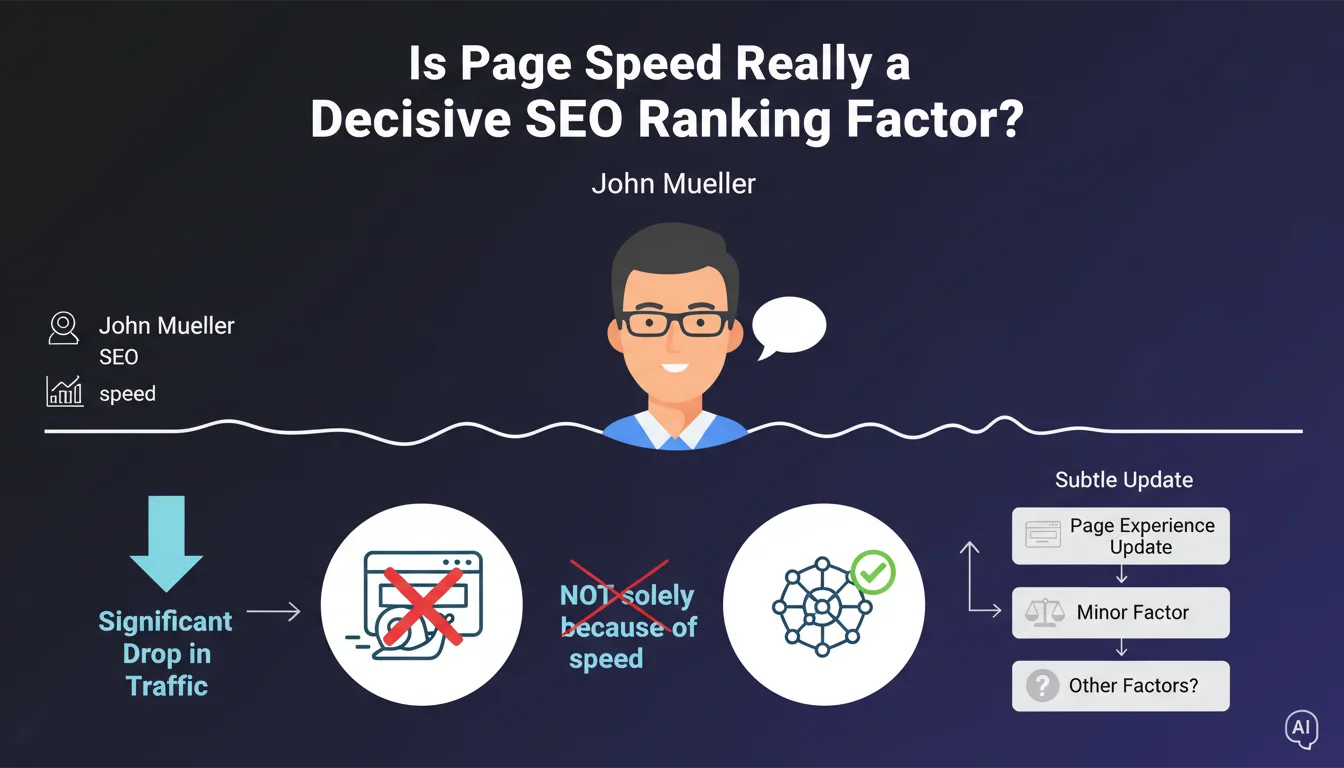
John Mueller from Google clarified the official position during an exchange with webmasters: significant traffic variations cannot be attributed solely to load time issues.
The Page Experience update is described by Google as "fairly subtle." It cannot make or break a website on its own. If you notice a significant traffic drop, look elsewhere than pure performance.
Why Is There So Much Confusion Around This Factor?
The SEO industry has long amplified the importance of web performance, creating a myth around its actual impact. Core Web Vitals have reinforced this perception.
In reality, Google has been repeating for months that speed is a light criterion in its algorithm. It plays a role, but marginal compared to content relevance and link quality.
What's the Real Place of Performance in Rankings?
Technical performance acts as a minor differentiating criterion between two pages of equivalent quality. It is never the primary factor in good or poor positioning.
- Page Experience is a weak signal, not a major criterion
- Significant traffic drops have other causes (content, links, penalties)
- Speed matters primarily for user experience and conversions
- Google always prioritizes relevance over technical performance
SEO Expert opinion
Does This Statement Align With Real-World Observations?
My 15 years of experience completely confirms this position. I've seen countless slow sites dominate their SERPs thanks to exceptional content and strong authority.
Conversely, ultra-fast sites with perfect scores struggle to rank if they lack the necessary editorial substance. Speed has never compensated for a deficit in quality or authority.
What Nuances Should Be Added to This Statement?
There are critical thresholds not to cross. A site with 15+ second load times will indeed experience a negative impact. But between 2 and 5 seconds, the effect on rankings is negligible.
Performance primarily impacts bounce rate and conversions. A user frustrated by slowness will leave, even if you rank first on Google. The SEO impact is therefore indirect, through behavioral signals.
When Does Performance Become More Important?
On mobile, Google's requirements are slightly higher. The Mobile-First Index prioritizes mobile experience, where speed matters more.
For news sites and "fresh" queries, fast indexing requires efficient crawling. Technical performance facilitates this process, indirectly beneficial to SEO.
Practical impact and recommendations
What Should You Prioritize in Your SEO Strategy?
First invest in quality content and semantic optimization. That's where the real organic growth lever lies.
Then develop your link profile and topical authority. These factors weigh infinitely more than a few milliseconds of load time.
Technical performance comes as a third priority. Aim for a properly optimized site (under 3-4 seconds), without falling into the obsession of micro-optimizations.
What Mistakes Should You Avoid With Core Web Vitals?
Never sacrifice content quality or functionality to artificially improve your scores. A fast but empty site is useless.
Avoid overreacting to minor performance variations. Normal fluctuations don't impact your SEO.
- Don't panic if your Core Web Vitals aren't perfect
- Don't attribute a traffic drop to speed without complete analysis
- Don't neglect real SEO factors in favor of technical optimization
- Don't remove content or features to gain speed
How Do You Balance Performance With Other SEO Priorities?
Establish an acceptable performance threshold (Lighthouse score > 50-60) and then focus on content. Technical excellence shouldn't monopolize your resources.
Measure the real impact of your optimizations on traffic and conversions, not just technical metrics. It's the business that matters.
For complex sites, the balance between performance, rich content, and advanced functionality requires specialized expertise. These strategic trade-offs can prove difficult to manage in-house without deep experience.
💬 Comments (0)
Be the first to comment.