
Official statement
What you need to understand
What is Google's official position on site size?
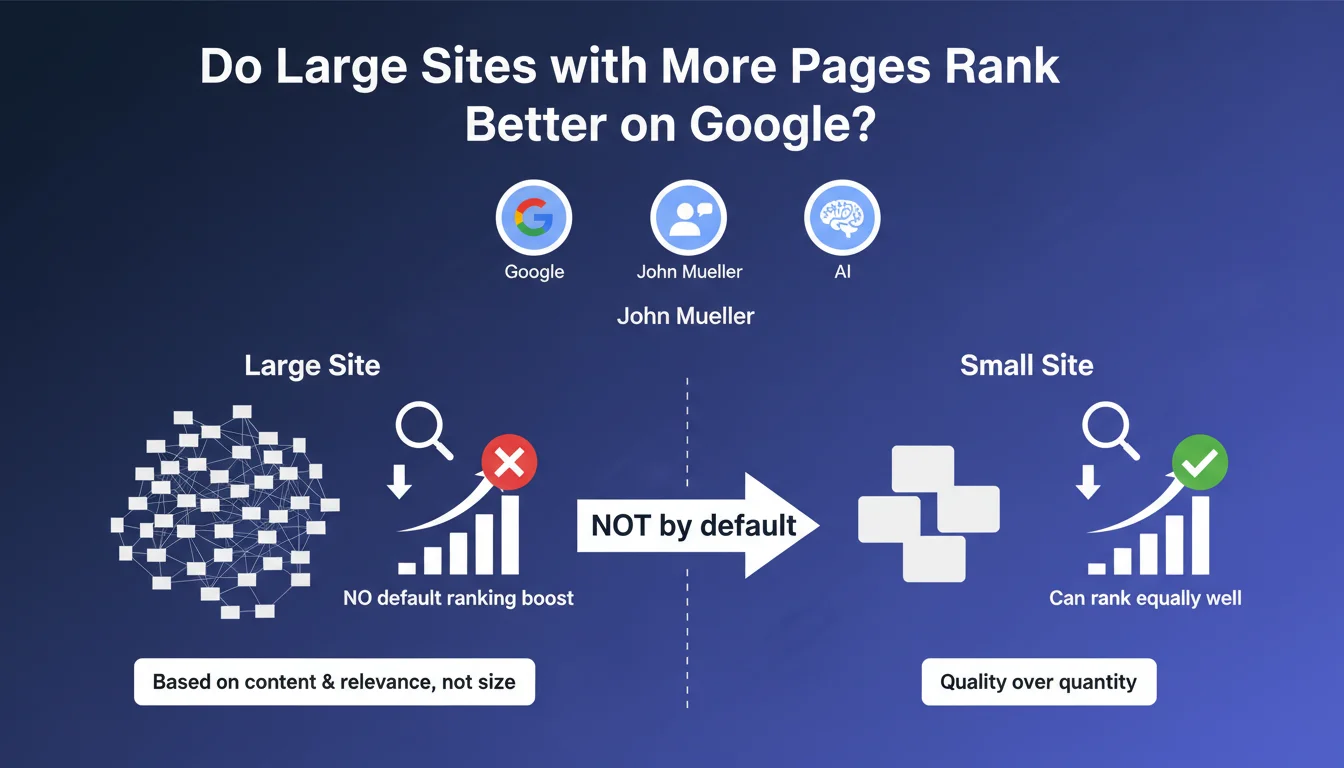
Google clearly states that there is no default advantage granted to sites with a large number of pages. The quantity of content is not a direct ranking factor in itself.
This statement emphasizes that Google primarily evaluates the quality and relevance of the content offered. A site with 50 excellent pages can theoretically outperform a site with 10,000 mediocre pages in search results.
Why does this clarification matter for SEO professionals?
This clarification aims to debunk a persistent myth in the SEO community. Many practitioners still believe that artificially increasing the number of pages mechanically improves rankings.
Google emphasizes that the strategy of multiplying content without added value is ineffective. The algorithm prioritizes depth and expertise rather than raw page volume.
- Volume doesn't mean authority: a large number of pages does not equate to better rankings
- Quality comes first: each page must provide real value to users
- No automatic bonus: Google evaluates each page individually based on its relevance
- Beware of diluted content: too many weak pages can harm the entire site
How does Google actually evaluate sites of different sizes?
Google's algorithm analyzes each page on its own merits: query relevance, content quality, user experience, and authority signals. Site size does not factor into this initial equation.
However, Google also observes domain-level global signals such as expertise, authority, and trustworthiness (E-E-A-T). These signals are built page by page, regardless of total volume.
SEO Expert opinion
Is this statement consistent with real-world observations?
In theory, Google's position is perfectly logical and defensible. In practice, analysis of competitive SERPs reveals a more nuanced reality.
We frequently observe that established authority sites with thousands of pages dominate certain niches, even when their content is not consistently exceptional. This apparent contradiction is explained by indirect factors related to size.
What are the indirect advantages of having more pages?
A site with many quality pages mechanically multiplies its opportunities to rank for long-tail keywords. Each page targeting specific queries becomes a potential entry point.
The more topics a site covers with expertise, the more it develops its topical authority. It also increases its chances of obtaining natural backlinks, as more content is available to be referenced by other sites.
The growth coefficient also plays a role: a site that regularly publishes fresh content sends positive signals of activity and relevance to Google. Stagnation can be interpreted negatively.
When does a volume strategy become counterproductive?
When the race for volume sacrifices quality, sites create thin or duplicate content. Google can then apply algorithmic filters that penalize the entire domain, not just the weak pages.
Sites that generate pages automatically or with little added value risk being considered spam or low-quality content. The net effect becomes negative: it would be better to have fewer pages but all excellent ones.
Crawl budget is also a critical factor for very large sites. If Google must crawl thousands of worthless pages, it risks neglecting truly important content.
Practical impact and recommendations
What strategy should you adopt to optimize your site's size?
Always prioritize a quality over quantity approach. Each new page created must address a real search intent and provide unique value that existing pages do not already cover.
Develop a structured editorial strategy based on keyword research and analysis of your audience's needs. The goal is to progressively build coherent topical authority.
For established sites, regularly conduct content audits to identify underperforming pages. It is sometimes more beneficial to consolidate, improve, or remove weak content than to create new content.
What mistakes should you absolutely avoid?
- Don't create pages solely to increase the total number of indexed pages
- Avoid automatically generated content without strict editorial supervision
- Don't duplicate or paraphrase existing content just to create new URLs
- Don't neglect existing pages in favor of constantly creating new pages
- Avoid creating variations of pages that are too similar targeting nearly identical keywords
- Don't forget to optimize internal linking to distribute authority to strategic content
How can you measure whether your content strategy is effective?
Track the indexation rate of your pages via Google Search Console. If Google only indexes a fraction of your pages, it's a signal that their quality or relevance is insufficient.
Analyze engagement metrics per page: time spent, bounce rate, conversions. Pages that don't engage users probably aren't serving your SEO, regardless of their quantity.
Monitor your long-tail visibility. A site with an effective content strategy should progressively rank for an increasing number of specific queries, not just a few generic keywords.
💬 Comments (0)
Be the first to comment.