
Official statement
What you need to understand
What is Google's official position on the number of links?
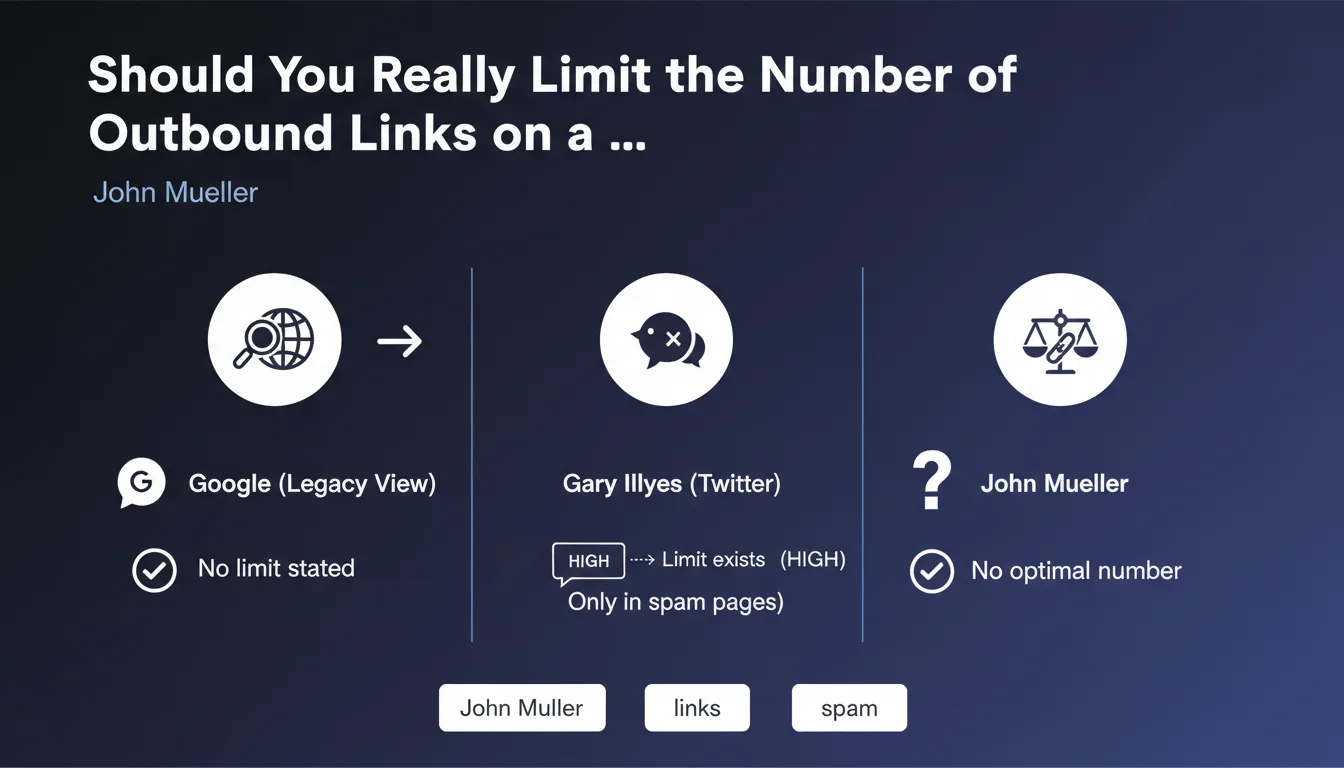
Google has long stated that there is no strict limit to the number of links a page can contain. This historical position was intended to reassure webmasters about their site structure.
However, Gary Illyes revealed the existence of an effective technical limit, albeit extremely high. This nuance creates some confusion in the SEO community.
Why does there appear to be a contradiction between these statements?
The contradiction is only apparent. There is indeed a maximum technical limit beyond which Googlebot stops following links, but it is so high that it only affects spam pages.
John Mueller clarifies that there is no optimal number, which means that Google does not penalize based on a specific threshold. The technical limit exists for crawler performance reasons, not for qualitative reasons.
What are the cases where this limit might be reached?
Only extreme spam pages reach this limit according to Gary Illyes. These are typically automatically generated pages containing thousands of links with no added value.
For a legitimate site, even with a complex structure and numerous internal and external links, this technical limit should never be a problem in practice.
- No strict limit for normal sites
- A technical limit exists but is extremely high
- Only spam pages are affected
- No optimal number to aim for in particular
- Quality takes precedence over the quantity of links
SEO Expert opinion
Is this statement consistent with field observations?
In the field, we indeed observe that Google handles pages containing several hundred links without issue. Archive pages, mega-menus, or link-rich footers are crawled normally.
The real question is not the technical limit but user experience. A page with too many links dilutes its PageRank and creates confusing navigation. That's the real issue.
What important nuances need to be added?
The first nuance concerns crawl budget. Even if Google can technically crawl all links, on a large site, it prioritizes. The more links a page contains, the more fragmented the crawl will be.
The second nuance relates to link juice. Each link dilutes the authority transmitted. A page with 500 links transmits much less value per link than a page with 50 links.
In what contexts do these statements not fully apply?
For massive e-commerce sites with thousands of products, managing pagination and filter links poses specific challenges. The technical limit is not the problem, but the internal linking strategy becomes one.
News sites with large archives must also adopt a strategic approach. Even without a technical limit, an archive page with 1000 links will be less effective than an intelligently paginated architecture.
Practical impact and recommendations
What strategy should you adopt for the number of links per page?
Aim for a user-centered approach rather than a numerical limit. Each link should have a reason to exist and provide value to the visitor.
For strategic pages, limit yourself to 100-150 links maximum to optimize authority transmission. For utility pages (archives, HTML sitemaps), you can go beyond without technical concern.
Prioritize hierarchy: highlight important links at the top of the page, use smart dropdown menus, and structure your internal linking strategically.
What mistakes should you absolutely avoid?
Never add links solely for SEO without considering user experience. Overloaded footers with links or endless sidebars do more harm than good.
Avoid redundant links to the same page. If your main menu, breadcrumb, and sidebar all point to the same URL, you're wasting link juice.
Don't create link catalog pages without editorial value. Google seeks to understand contextual relevance, not to mechanically count links.
How can you audit and optimize your site's link structure?
Use Screaming Frog or a similar tool to identify pages with an abnormally high number of links. Analyze whether all these links are necessary and relevant.
Examine your internal linking to identify optimization opportunities: orphan pages, excessive PageRank dilution, irrelevant links to remove.
- Audit the number of links per page template
- Identify pages with more than 200 outbound links
- Check the contextual relevance of each link group
- Optimize menus and footers to reduce redundant links
- Structure internal linking around strategic pages
- Use pagination rather than massive listings
- Prioritize links according to business importance
- Test the impact of modifications on crawling and ranking
💬 Comments (0)
Be the first to comment.