
Official statement
Other statements from this video 2 ▾
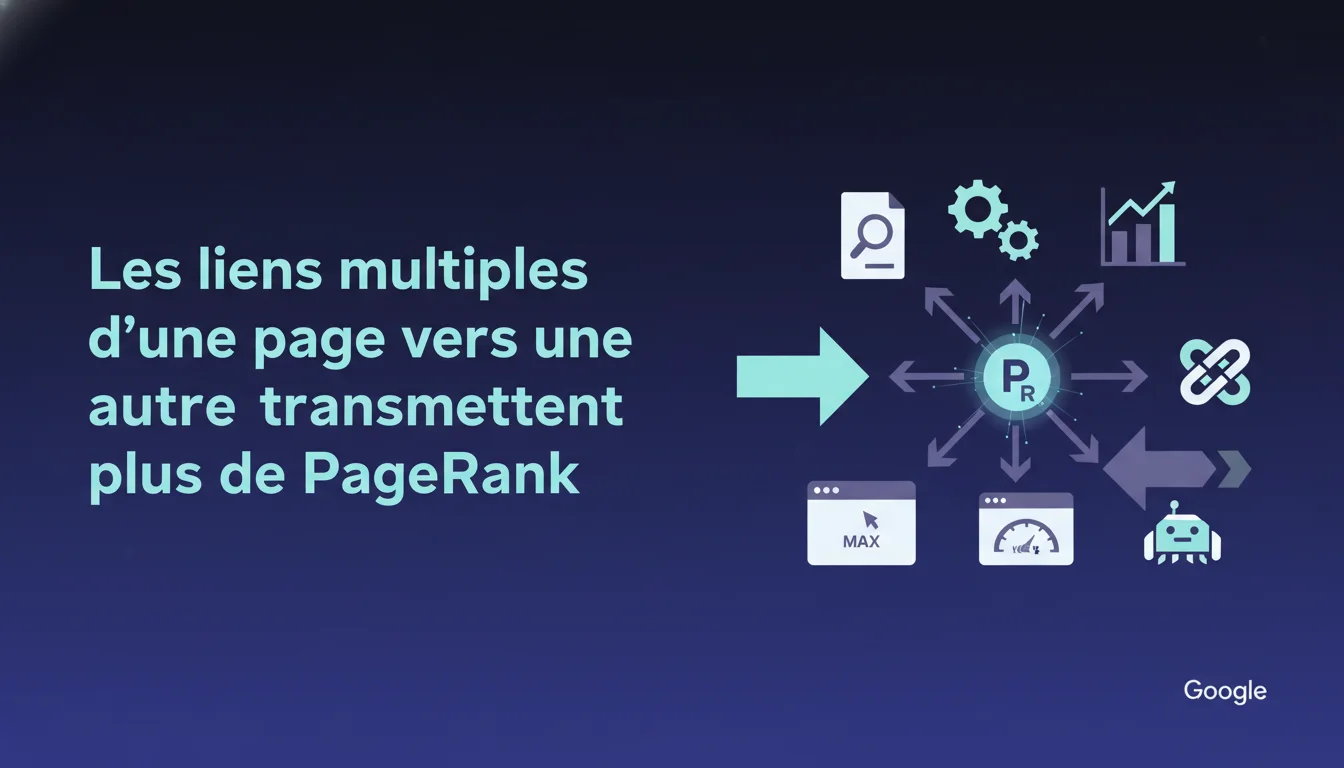
Google confirms that in the original formulation of PageRank, several links from a single page to another proportionally transmit more PageRank. This contradicts the widespread belief that only the first link counts. In practice, this revelation challenges years of SEO best practices that advised having only one link per page to a given destination, but Google reminds us that the obsession with PageRank should take a backseat to creating quality content.
What you need to understand
Did the original formulation of PageRank actually treat multiple links differently?
Yes, and this is a clarification that's making waves. The original formulation of PageRank, as described in the patent by Larry Page and Sergey Brin, considered that each link from a page transmitted a fraction of the total PageRank of that page. If page A, with a PageRank of 10, pointed three times to page B and once to page C, page B would receive proportionally more PageRank than C.
This mechanism was overshadowed for years by an empirical rule popularized in the SEO community: only the first link from a page to a destination counts, and subsequent links are ignored. This belief stemmed from a time when Google only considered the anchor text of the first link for ranking, but not necessarily for the flow of PageRank itself.
Why has this confusion persisted for so long?
Because Google has long been vague about the distinction between PageRank transmission and anchor processing. Matt Cutts stated in 2013 that if a page contains multiple links to the same URL, only the anchor text of the first is considered for ranking. Many SEOs extrapolated this rule, thinking that additional links transmitted no PageRank.
However, Google has just reminded us that in the original mathematical formulation of PageRank, each link counts for PageRank flow, even if the repeated anchor is not reused for textual ranking. This is a critical nuance that changes how we should think about internal and external linking.
Does this revelation actually change the game?
Not radically, but it refines understanding. If you have a strategic page you want to boost internally, multiplying links from the same page can theoretically transmit more link juice. But Google immediately insists on one point: this optimization should never take precedence over creating quality content that naturally generates backlinks.
In short, the obsession with PageRank is a trap. Google knows that SEOs tend to over-optimize technical details at the expense of the essentials: relevance, authority, and the actual usefulness of content. This statement is thus both a reminder and a technical clarification.
- The original formulation of PageRank considers that multiple links from page A to page B transmit proportionally more PageRank than if only a single link existed.
- Only the anchor text of the first link is considered for textual ranking, but additional links still contribute to PageRank flow.
- This distinction is essential: PageRank transmission and anchor exploitation are two different mechanics.
- Google emphasizes quality content as the top priority, not micro-optimizing PageRank.
SEO Expert opinion
Is this statement consistent with field observations?
Honestly, it's difficult to determine with certainty. The exact transmission of PageRank cannot be directly measured by current SEO tools, which rely on proxies (Domain Authority, Trust Flow, etc.). Internal tests some practitioners have conducted show variable results: sometimes, multiplying links from the same page seems to provide a boost, while other times the effect is indistinguishable.
The problem is that PageRank is just one signal among hundreds. Even if technically multiple links transmit more juice, this does not guarantee any visible impact on ranking if other factors (relevance, freshness, engagement) are weak. [To be verified]: Google does not provide any quantitative data on the extent of this proportional effect, leaving a total ambiguity about its real weight.
What nuances should be added to this rule?
The first nuance: we're talking about the original formulation of PageRank. Google now employs dozens of variations and refinements that are no longer public. It is therefore possible that mechanisms for damping or devaluation exist for repeated links, especially to counteract over-optimization abuses.
The second nuance: multiplying links does not mean spamming. If you place three links to the same page in the same text block artificially, you risk an anti-spam filter long before you see any gain in PageRank. The idea is that multiple links should make contextual sense: one link in the introduction, one in the body, one in the conclusion, for example.
The third nuance: the marginal effect decreases. Moving from 1 to 2 links may have an impact, while moving from 10 to 11 is probably negligible. This is typical behavior of weighting systems: the first occurrence counts significantly, while subsequent ones add less and less.
When does this rule not apply or is counterproductive?
If you stuff your page with internal links to the same URL to force PageRank, you ruin user experience and Google will detect it as manipulation. Anti-spam algorithms, including Penguin and its evolutions, are designed to spot abnormal link patterns. A natural and useful linking strategy always outperforms an over-optimized one.
Another case: repeated links in footers or sidebars across all pages of a site. Google detects and heavily downvalues these or even ignores them completely. Multiplying these links will transmit nothing more; in fact, it can be detrimental. The editorial context of the link is critical: a link in the body of the text is worth infinitely more than a template link.
Practical impact and recommendations
What should you practically do with this information?
First, don't change anything if your internal linking is already coherent and user-focused. If your important pages are already receiving contextual internal links from multiple pages, you are likely already in an optimal configuration. Adding artificial links to exploit this rule would only weaken your site.
Next, review your pages with high strategic potential. If a cornerstone page receives only one link from your homepage, while it would be natural to also link it from a category introduction or a related article, this is an opportunity for improvement. But always in an editorial sense: the second link should make sense for the reader.
What mistakes should you absolutely avoid?
Don't fall into the trap of link keyword stuffing. Multiplying exact anchors to the same page in the same content is exactly the kind of signal that Google Penguin tracks. Vary your formulations, use natural and contextual anchors. If you need to create multiple links, ensure they serve different needs in the user journey.
Another common mistake: thinking that more links automatically mean better ranking. PageRank is just one signal among hundreds. If your target page lacks content, is not very relevant, or has slow loading speed, no surplus of PageRank will save it. PageRank is an amplifier, not a ranking engine on its own.
How can you check if your internal linking smartly exploits this rule?
Use a crawling tool like Screaming Frog or Oncrawl to map the flow of internal links. Identify strategic pages and see how many unique links they receive. If an important page is only linked once from the site and there are editorial opportunities to link it elsewhere, it's a quick win.
Then, analyze the click depth of your strategic pages. A page that is 4 clicks away from the homepage receives significantly less PageRank than a page that is 1 click away, even if it has several internal links. Bringing important pages closer to the homepage through multiple paths can have a measurable impact on their visibility.
- Audit your internal linking with a crawler to identify strategically underlinked pages
- Add additional contextual links only if it serves the user, never for pure optimization
- Vary anchor texts for multiple links to avoid over-optimization
- Monitor click depth and bring your important pages closer to the homepage via multiple natural paths
- Never multiply links in footers, sidebars, or templates: Google ignores or downgrades them
- Focus on creating quality content that naturally generates backlinks, making it the top priority over internal PageRank optimization
❓ Frequently Asked Questions
Si je place trois liens vers la même page dans un article, est-ce que je transmets trois fois plus de PageRank ?
Est-ce que seul le premier lien compte encore pour le texte d'ancre ?
Multiplier les liens internes vers mes pages produits peut-il améliorer leur ranking ?
Les liens en footer répétés sur toutes les pages transmettent-ils du PageRank supplémentaire ?
Est-ce que cette règle s'applique aussi aux backlinks externes ?
🎥 From the same video 2
Other SEO insights extracted from this same Google Search Central video · duration 3 min · published on 18/08/2011
🎥 Watch the full video on YouTube →
💬 Comments (0)
Be the first to comment.