
Official statement
Other statements from this video 2 ▾
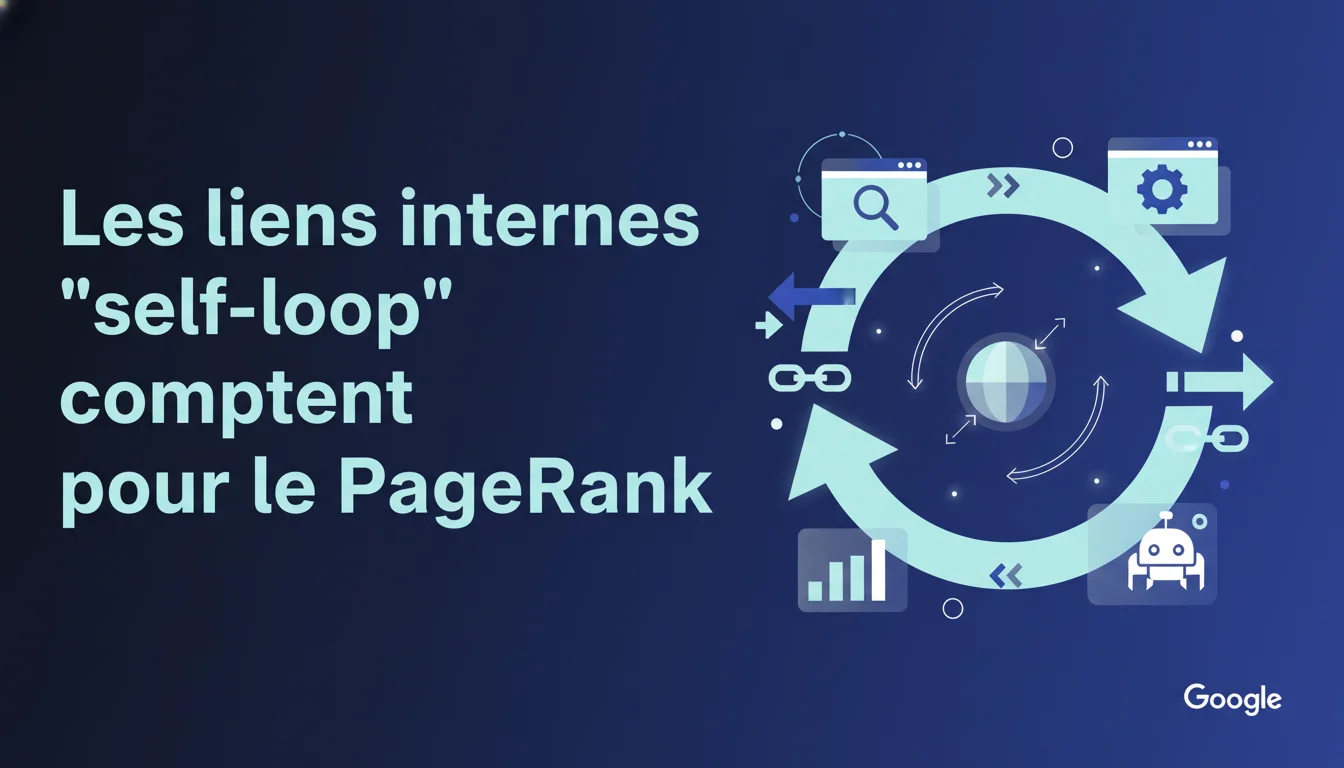
Google confirms that links from a page to itself (self-loops) are taken into account in the PageRank calculation according to the original formulation of the algorithm. This technical clarification challenges certain practices in internal linking optimization. Specifically, each self-referential link potentially dilutes the PageRank passed to other pages on your site.
What you need to understand
What exactly is a self-loop link?
A self-loop link refers to any hyperlink present on a page that points back to that same page. In practice, it usually involves the clickable logo on the homepage, a link in the navigation menu that remains active on the current page, or internal anchors leading back to the top of the page.
These links are ubiquitous in WordPress, Shopify templates, and most CMSs. Many developers leave the logo clickable on all pages, including the homepage. The result: the homepage systematically links to itself.
Why is this Google statement surprising?
For years, the SEO community has debated whether these self-loops actually counted in the PageRank calculation. Some experts claimed that Google simply ignored them, while others believed they were neutralized by filters.
The original formulation of PageRank, as described in Stanford's academic papers, indeed includes these links in the calculation. Google has just confirmed that no specific filter excludes them. Therefore, each self-loop consumes a portion of the PageRank distributed by the page.
How does this affect PageRank distribution?
The PageRank of a page is distributed among all its outgoing links, including those pointing to itself. If your homepage contains 10 links, one of which is a self-loop, the latter theoretically captures 1/10 of the available PageRank for redistribution.
This self-referential redistribution does not increase the PageRank of the page. It simply dilutes the juice passed to other pages. The more self-loops you have, the less PageRank your strategic pages receive through internal linking.
- Self-loops are counted in the original PageRank formula according to Google
- Each self-referential link dilutes the PageRank passed to other internal pages
- Clickable logos, active menus, and internal anchors often create invisible self-loops
- This confirmation changes the way we optimize internal linking to maximize juice distribution
- The actual impact depends on the total number of outgoing links and the site's architecture
SEO Expert opinion
Is this statement consistent with real-world observations?
On paper, yes. The mathematical logic behind the original PageRank makes no distinction between a standard internal link and a self-loop. Both are edges in the web graph.
But let's be honest: the measurable impact on ranking is debatable. A/B tests conducted on average sites rarely show significant variations when self-loops are removed. Either the effect is marginal, or other signals (content, backlinks, user behavior) overshadow this micro-optimization.
What nuances should we add to this assertion?
Google refers to the original formulation of PageRank, not to the PageRank as used today in the ranking algorithm. Modern PageRank incorporates dozens of adjustments: adjusted damping factor, topic-specific PageRank, consideration of semantic context.
There is no proof that the PageRank calculated for the final ranking treats self-loops exactly like other links. Google may apply weighting coefficients that reduce their relative weight. [To verify]: no public data confirms or denies this hypothesis.
In what cases does this rule become truly problematic?
On a site with a shallow architecture and few outgoing links per page, each self-loop weighs heavily. A concrete example: a landing page with 5 links, 2 of which are self-loops, loses 40% of its transmission potential.
Conversely, on an e-commerce site with categories containing 50+ product links, a self-loop on the logo represents 2% of the total. The impact becomes negligible. The problem therefore focuses on strategic pages with a low number of links: homepage, thematic hubs, pillar pages.
Practical impact and recommendations
What should you concretely do to limit dilution?
Start by auditing your existing self-loops. Crawl your site and identify all pages that link to themselves. Prioritize strategic pages: homepage, main categories, pillar content.
For the clickable logo on the homepage, the classic solution is to make it non-clickable only on that page (use <span> instead of <a>). On other pages, it remains a link to the homepage as intended.
What mistakes should you avoid when optimizing?
Do not blindly remove all self-loops without considering the context. An anchor link to a section of the same page (intra-page navigation) can be legitimate for UX, even though it technically creates a self-loop.
Some developers disable navigation menu links on the active page using JavaScript. Google may not execute this JS during crawling, creating a discrepancy between raw HTML rendering and JS rendering. Prefer a server-side or PHP/template solution to ensure consistency.
How can you measure the actual impact of these adjustments?
Set up a controlled test on a section of your site. Remove self-loops from a group of similar pages, keep them on a control group. Measure changes in organic traffic and positions over 60-90 days.
Use tools like Oncrawl or Sitebulb to visualize the internal PageRank flow before/after modification. These crawlers simulate juice distribution and show you which pages gain or lose theoretical PageRank.
- Audit self-loops on the 20-30 most strategic pages of the site
- Make the logo non-clickable only on the homepage via the template
- Ensure that navigation menus properly disable the link from the active page server-side
- Test the impact on a sample of pages before global deployment
- Measure changes in organic traffic over 60-90 days post-change
- Monitor crawl budget and indexation speed for deep pages
❓ Frequently Asked Questions
Un self-loop fait-il monter le PageRank de la page qui le contient ?
Les ancres internes (#section) comptent-elles comme des self-loops ?
Faut-il désactiver le logo cliquable sur toutes les pages ?
Comment désactiver un lien de menu sur la page active sans impacter le crawl ?
L'impact des self-loops est-il mesurable sur un site moyen ?
🎥 From the same video 2
Other SEO insights extracted from this same Google Search Central video · duration 3 min · published on 18/08/2011
🎥 Watch the full video on YouTube →
💬 Comments (0)
Be the first to comment.