
Official statement
What you need to understand
What is Mobile First indexing and what is its impact on dedicated mobile sites?
Mobile First indexing represents a fundamental change in the way Google crawls and indexes web content. From now on, Google's bot prioritizes the mobile version of a site for indexing and ranking, even for desktop results.
This evolution particularly concerns sites with a dedicated mobile architecture (m.site.com), where traditionally mobile pages point to their desktop equivalents via canonical tags.
Why does Google recommend keeping existing canonicals?
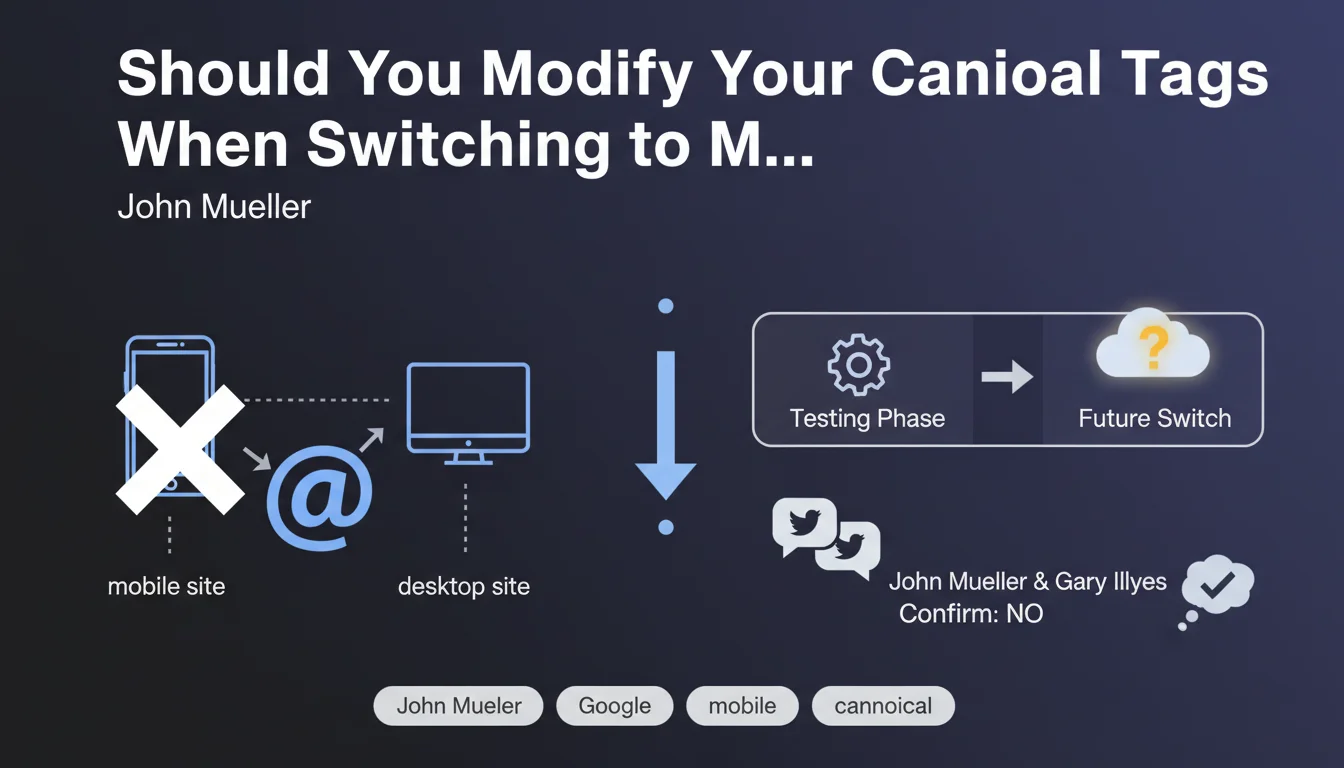
During the transition phase to Mobile First, Google has explicitly confirmed that it is not necessary to modify the structure of canonical tags. Mobile pages can continue to point to desktop versions as the canonical reference.
This approach allows for a gradual transition without disrupting existing indexing. Google automatically handles the identification of the mobile version as the primary indexing source, even if the canonical points to desktop.
- Mobile First indexing requires no changes to canonical tags
- Sites with dedicated mobile versions can maintain their current configuration
- Google ensures a transparent transition between the two indexes
- The mobile → desktop canonical structure remains functional and recommended
- The switch between indexes should occur without visible disruption to performance
How does Google guarantee the transparency of this transition?
Google has committed to making the transition from one index to another as seamless as possible for webmasters. This means that properly configured sites should not observe any sudden variations in their visibility.
The official communication aims to reassure SEO professionals that their existing technical configurations remain valid and do not require urgent overhaul.
SEO Expert opinion
Is this recommendation consistent with real-world observations?
After several years of full Mobile First deployment, this statement has proven perfectly consistent. Sites that have kept their canonical tags pointing from mobile to desktop have not experienced major indexing problems.
However, it should be noted that Google's technical tolerance applies primarily to sites with dedicated mobile versions. For responsive sites, the question obviously doesn't arise since there is only one URL.
What important nuances should be added to this statement?
Although Google accepts this configuration, it is crucial to understand that the mobile version remains the one that will be crawled and indexed as a priority. Mobile content must therefore be as complete and optimized as the desktop version.
The presence of a canonical pointing to desktop does not mean that Google will ignore deficiencies in the mobile version. Sites with truncated content on mobile or limited functionality risk losing rankings.
In what context does this approach remain relevant today?
Today, maintaining dedicated mobile sites is generally considered a legacy architecture. Most new projects favor responsive design which eliminates these duplication and canonical issues.
Nevertheless, for large platforms that have invested heavily in dedicated mobile versions, this statement confirms that an immediate migration was not essential, although it remains desirable in the medium term to simplify technical maintenance.
Practical impact and recommendations
What should you actually do with your canonical tags today?
If you have a dedicated mobile site (m.mysite.com), you can maintain your current configuration with canonicals pointing from mobile to desktop. This structure remains technically valid in Google's eyes.
However, make sure that your mobile version contains all important content, structured data, and metadata. This is the version that Google will primarily use to understand and rank your pages.
For new projects or redesigns, systematically favor a responsive architecture that considerably simplifies technical management and eliminates content duplication issues.
What critical mistakes should you absolutely avoid?
The most common mistake is to consider that the mobile version can be a lightened or simplified version. Even with a canonical pointing to desktop, Google primarily crawls and analyzes mobile.
Never create major discordances between your mobile and desktop versions in terms of text content, title tags, structured data, or internal linking. Google might consider these differences as contradictory signals.
- Verify that mobile content is equivalent to desktop content
- Ensure that all important meta tags are present on mobile
- Check that structured data is implemented on the mobile version
- Validate that internal linking is consistent between both versions
- Regularly test mobile display via Search Console
- Monitor Core Web Vitals specifically on mobile
- Consider migrating to responsive design during the next redesign
How can you verify that your configuration is optimal?
Use the URL inspection tool in Google Search Console to check how Google crawls and indexes your mobile pages. You will be able to see which version is used as the indexing reference.
Also analyze the mobile coverage and mobile usability reports to identify any technical issues that could impact your visibility since the switch to Mobile First.
💬 Comments (0)
Be the first to comment.