
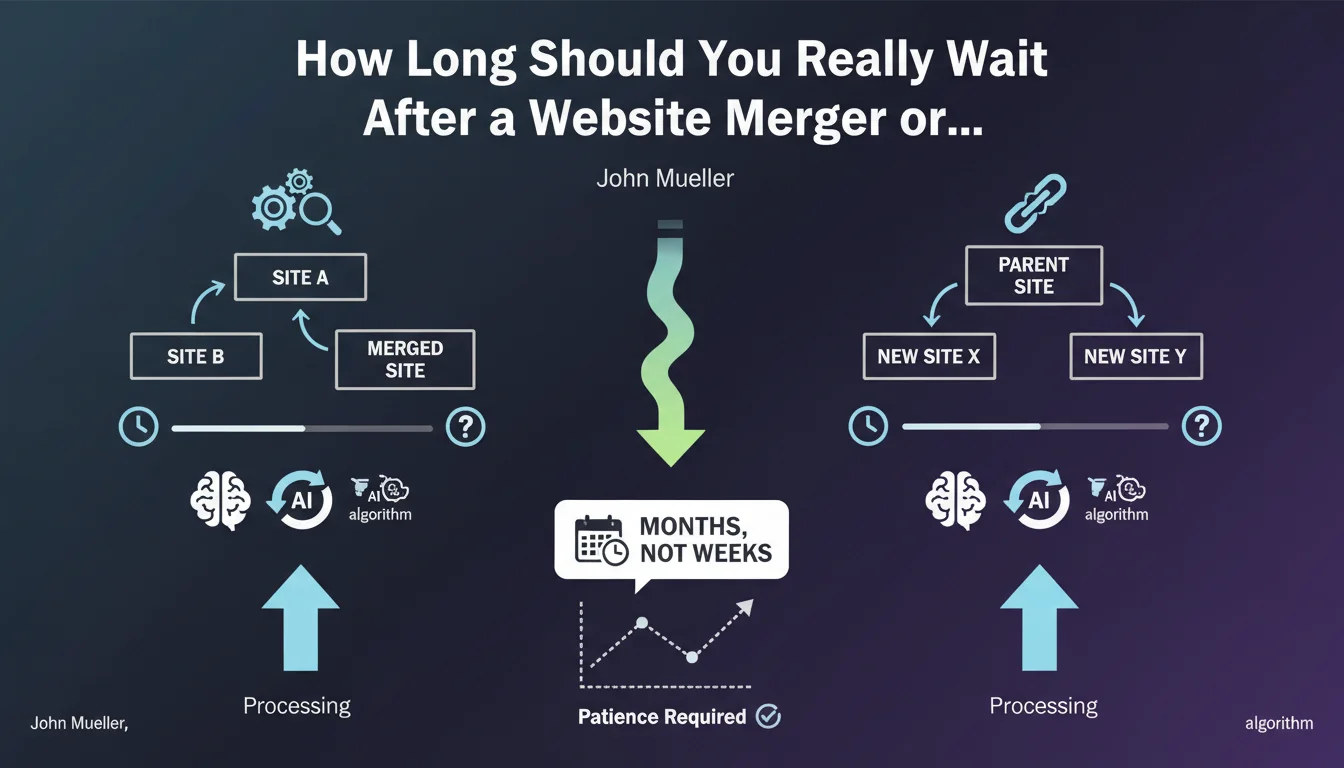
Official statement
What you need to understand
Why Do Site Mergers and Splits Take So Long for Google to Process?
When a site merges with one or more others, or when a single site is divided into several distinct entities, Google must perform a complete re-analysis of the structure. It's not simply about following 301 redirects.
Google's algorithms must recalculate authority, reassess relevance signals, and understand the new informational architecture. This operation is particularly resource-intensive because it affects the macroscopic structure of the site, not just individual URLs.
What's the Actual Processing Time Based on Site Size?
For medium-sized sites, the duration can extend over several months. This is an incompressible timeframe linked to crawl cycles and data reprocessing.
On sites with several million pages, experience shows that the process can take several quarters, or even years. This duration depends on the structural complexity and the volume of content to be reassessed.
What Elements Does Google Need to Recalculate?
- The redistribution of PageRank and authority among the new entities
- The thematic relevance signals for each new site or section
- The complete indexing of the new architecture
- The internal link patterns and their coherence
- The semantic consistency of each new entity
SEO Expert opinion
Is This Statement Consistent with Field Observations?
Absolutely. Feedback on large structural migrations consistently confirms these timeframes. I've personally supported e-commerce site mergers where complete stabilization took 18 months.
What's remarkable is that John Mueller has maintained the same message since 2018, proof that the fundamental technical constraints haven't changed despite algorithmic evolutions. Patience remains the watchword.
What Nuances Should Be Added to This Rule?
The duration heavily depends on the technical execution quality of the migration. A poorly designed redirect plan or massive 404 errors considerably prolong the process.
It's also necessary to distinguish visible signals (indexing, crawling) from ranking signals. You may notice rapid indexing but an impact on rankings that extends over many months.
In What Cases Can the Process Be Accelerated?
A site with strong established authority and a high crawl budget will generally see faster processing. Google invests more resources in sites it considers priority.
Maintaining a sustained publishing rhythm and obtaining external links to the new structures also helps Google accelerate its reassessment. Activity and positive external signals are catalysts.
Practical impact and recommendations
How Can You Effectively Prepare for a Site Merger or Split?
Planning is crucial. Start with an exhaustive mapping of all URLs and their respective SEO value. Identify high-performing content that must absolutely be preserved.
Establish a granular 301 redirect plan that respects thematic consistency. Each old URL should point to the most relevant content possible, not necessarily to the homepage.
Plan for a realistic timeframe: minimum 6 months for medium sites, 12-24 months for high-volume sites. Communicate these timelines internally to manage stakeholder expectations.
What Mistakes Should You Absolutely Avoid During the Transition?
Never remove redirects too early, even if they seem to no longer receive traffic. Maintain them for at least 12-18 months, or indefinitely for high-authority pages.
Avoid redirect chains that dilute authority and slow down crawling. Each old URL should point directly to its final destination.
Don't launch other major structural changes during the transition period. Let Google stabilize its understanding before introducing new variables.
How Do You Track Progress and Measure the Operation's Success?
- Monitor 404 error rates daily in Search Console
- Track the evolution of indexed pages for each new entity
- Analyze organic traffic trends by content segment
- Track average positions on your strategic queries
- Monitor crawl budget and Googlebot visit frequency
- Document all changes to isolate the causes of fluctuations
- Compare Core Web Vitals metrics before/after migration
Site mergers and splits are complex, very long-term operations that require rigorous planning and considerable patience. Timelines of several months to several years are the norm, not the exception.
Success relies on technical execution excellence, meticulous monitoring, and the ability to stay the course despite temporary fluctuations. These projects represent a major technical and strategic investment that durably impacts organic visibility.
Given the complexity and stakes of such operations, many companies choose to surround themselves with specialized SEO expertise to secure each step of the process and optimize the chances of long-term success.
💬 Comments (0)
Be the first to comment.