
Official statement
What you need to understand
What was the August 2018 Medic update all about?
The Medic update was one of Google's most significant algorithmic changes in 2018. It primarily impacted YMYL (Your Money Your Life) sites such as medical, financial and legal websites.
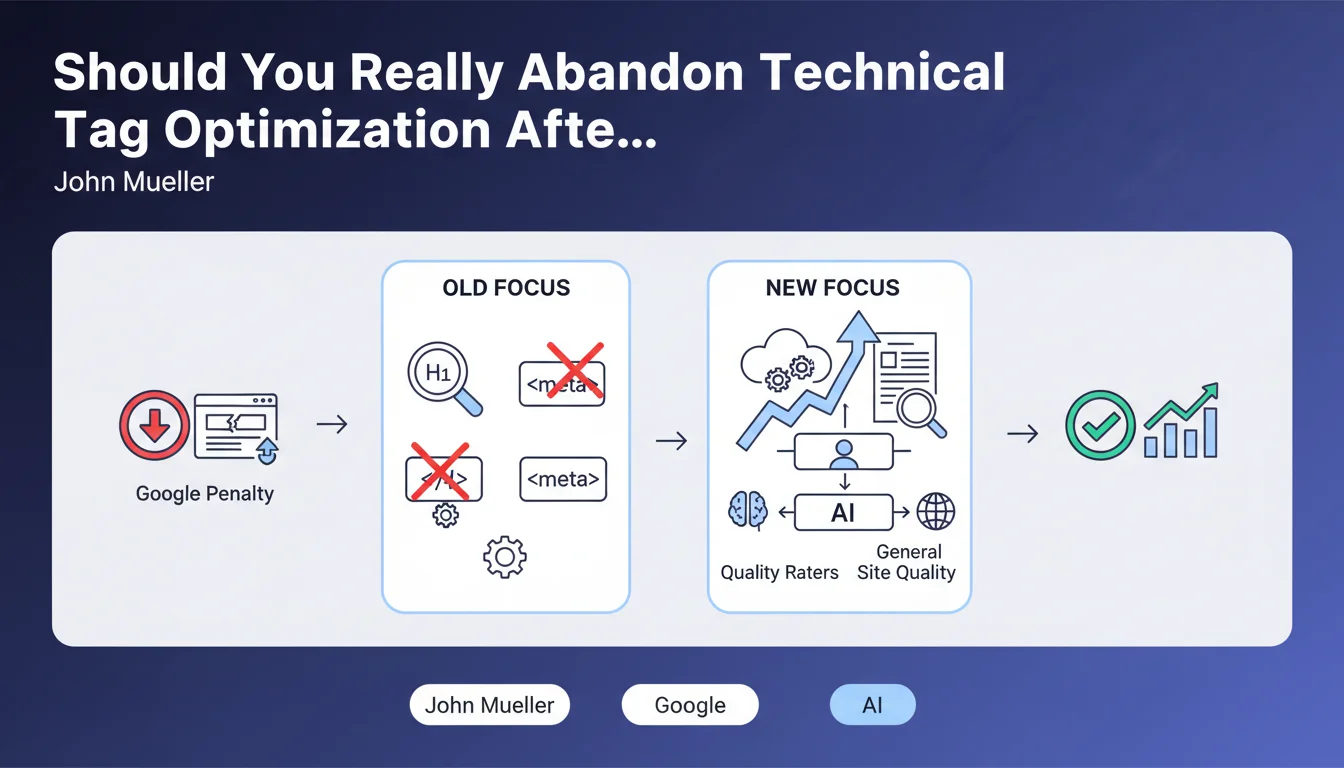
This update marked a turning point in Google's approach. The algorithm strengthened the evaluation of overall site quality rather than focusing solely on isolated technical criteria.
What does working "macroscopically" on quality actually mean?
According to this statement, Google recommends adopting a holistic approach rather than a granular one. It's not about correcting only technical details like an H1 tag or a meta description.
The macroscopic approach involves reviewing the entire site ecosystem: displayed expertise, author credibility, transparency, content depth and overall user experience.
How do Quality Raters Guidelines fit into this approach?
The Quality Raters Guidelines are the reference document used by Google's human evaluators. This manual defines what Google considers quality content and how to evaluate expertise.
In case of impact from an update, these guidelines provide a comprehensive analytical framework to identify structural weaknesses of a site.
- The macroscopic approach takes precedence over isolated technical optimizations
- YMYL sites are particularly concerned by strict quality criteria
- The Quality Raters Guidelines constitute the roadmap for understanding Google's expectations
- A site's overall quality is evaluated on criteria of expertise, authority and trust
- Isolated fixes are not enough to recover from a major algorithmic penalty
SEO Expert opinion
Does this statement align with practices observed in the field?
After 15 years of observation, I can confirm that this approach is totally consistent with reality. Sites that recover after a major update are those that have undertaken deep overhauls, not cosmetic adjustments.
However, there is an important nuance: technical optimizations remain necessary as a foundation. A technically deficient site can never demonstrate its quality, even with excellent content.
The real question is one of prioritization. After a Medic update, investing 80% of your time on redesigning a title tag is counterproductive. You must first tackle the fundamentals of credibility.
What nuances should be added to this recommendation?
While the macroscopic approach is essential, it doesn't mean that technical SEO is obsolete. Both dimensions are complementary, not opposed.
For an impacted YMYL site, the priority is indeed qualitative overhaul. But for an e-commerce site or a new blog, basic technical problems may be the primary cause of underperformance.
In what cases does this approach require adjustments?
For new sites or those with major indexing problems, technical aspects must initially take priority. Without proper indexing, content quality remains invisible to Google.
For established sites impacted by a core or quality update, the macroscopic approach is indeed the solution. These sites generally already have an acceptable technical foundation.
Specialized niche sites must particularly focus on demonstrating their expertise and authority, which confirms the importance of the overall qualitative approach.
Practical impact and recommendations
What should you actually do after being impacted by a quality update?
The first step is to audit your site according to E-E-A-T criteria (Experience, Expertise, Authoritativeness, Trustworthiness) defined in the Quality Raters Guidelines. Identify strategic pages that lack credibility signals.
Then, develop a strategy for demonstrating expertise: detailed author biographies, academic or professional references, cited sources, transparency about research methodology.
Strengthen trust signals: complete legal notices, clear privacy policy, visible contact information, social proof (testimonials, certifications), company history.
What mistakes should you avoid when correcting a quality penalty?
The major error is focusing on technical micro-optimizations hoping for a magic effect. Improving all your H1 tags won't resolve an overall credibility problem.
Don't fall into the trap of artificial content. Massively adding generic or automatically generated content to "create volume" will worsen the situation rather than improve it.
Also avoid neglecting the user dimension. A technically perfect site with confusing navigation or frustrating experience won't satisfy Google's quality criteria.
How can you verify that your site meets Google's quality standards?
Use the Quality Raters Guidelines as an evaluation grid. Go through your main pages and ask yourself the questions a Google evaluator would ask: is this content credible? Is the author identifiable and qualified?
Conduct real user testing to evaluate the trust inspired by your site. Ask external people if they would trust the information presented, particularly on sensitive topics.
Compare yourself to your better-ranked competitors: what makes their content more credible? What reassurance elements do they have that you don't?
- Download and study Google's Quality Raters Guidelines in depth
- Create or enrich author pages with expertise, qualifications and verifiable experience
- Add sources, references and citations for each important claim
- Implement reassurance elements (certifications, testimonials, detailed legal notices)
- Review the depth and comprehensiveness of content on strategic pages
- Improve transparency about who manages the site and for what purpose
- Seek external expert opinions on the site's perceived credibility
- Document content creation methodologies and processes
- Regularly update content to maintain relevance and freshness
- Establish a link building strategy focused on authority rather than volume
💬 Comments (0)
Be the first to comment.